Let's begin our adventure with the very first number: One! It's the number of the sun in the sky, the nose on your face, and the first step of every great journey. Let's explore what makes the number one so special!
Getting to Know the Number 1:
1, spelled one, represents a group of one objects. 1 has 0 tens and 1 one. 0 × 10 + 1 = 1.
- The Whizki Learning Team
Seeing the Number 1 in Our World
The number one is everywhere, representing everything that is singular and unique. Showing this concept in different ways helps your child connect the numeral to the idea of 'a single unit'. Here are a few ways we can show what 'one' really means.
The Numeral
This is how we write the number one. A single, straight, and tall line. It is simple and strong.
The Word
one [wʌn]
This is how we read the number. The word 'one' helps us talk about a single person, place, or thing.
On a Ten-Frame
One dot on a ten-frame shows the very beginning of counting. It's the first space we fill on our journey to ten.
With Your Fingers
You can show 'one' with your hand by holding up just your pointer finger. It's a clear and simple sign recognized everywhere.
Practice the Number 1 at Home (No Screens Needed!)
The best learning happens through play. Here are a few simple, screen-free ideas to continue your number 1 adventure together and make this foundational concept a part of your daily life.
The 'First Step' Game
~1 This is a great gross motor activity that connects the number 'one' to the concept of beginnings. Announce, 'Every great journey starts with just one step!'. Then, challenge your child to take 'one giant step', 'one tiny step', 'one slow-motion step', and 'one spinning step'. This playful game builds body awareness and coordination, and it reinforces the idea that every big action is made up of single, important steps. It's a wonderful metaphor for learning and life.
One-of-a-Kind Self-Portrait
~2 This art activity celebrates the most important 'one' of all: your child! It fosters creativity and self-awareness. You'll need a piece of paper, a mirror, and some crayons or markers. Have your child look closely in the mirror and notice all the things they have one of: one nose, one mouth, one unique smile. Then, encourage them to draw a portrait of their wonderful, one-of-a-kind face. This activity is a powerful confidence booster and a great way to talk about how there is only one of them in the entire world, making them incredibly special.
'I Spy One Thing' Game
~3 This is a simple twist on the classic game that builds observation skills and focus. Instead of spying something of a certain color, the goal is to spy a single object. For example, you might say, 'I spy with my little eye... one big clock on the wall' or 'one red pillow on the sofa'. This helps your child practice isolating and identifying single objects within a busy environment, which is a key skill for visual discrimination. It also turns any moment, whether in the car or at home, into a fun learning opportunity.
Practice Number 1
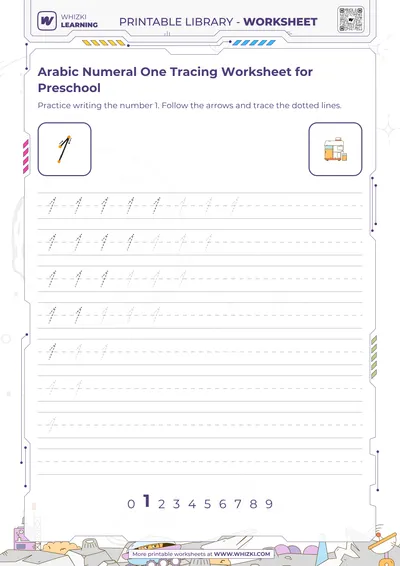
Download free printable worksheets to master this number!
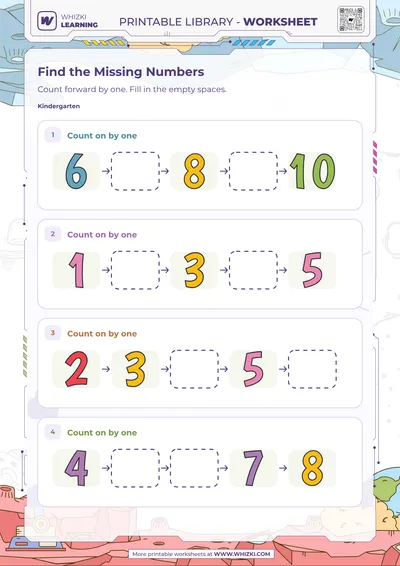
Kids often pause when a counting pattern has holes, even when they can count out loud. This Whizki Learning printable gives your kindergartener four short trails and simple equations to complete together.
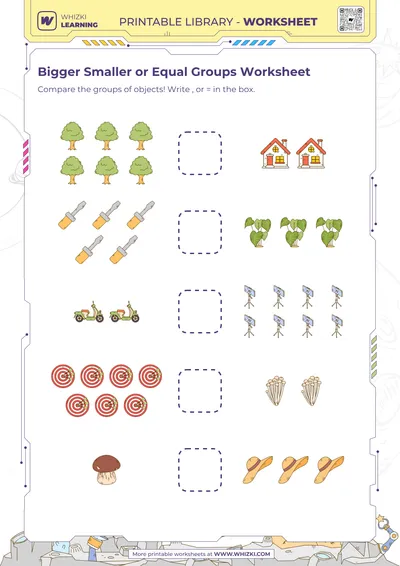
Kids often know “more” in real life but stall when two printed groups look close. Use this page to count each group together, then choose bigger, smaller, or equal.
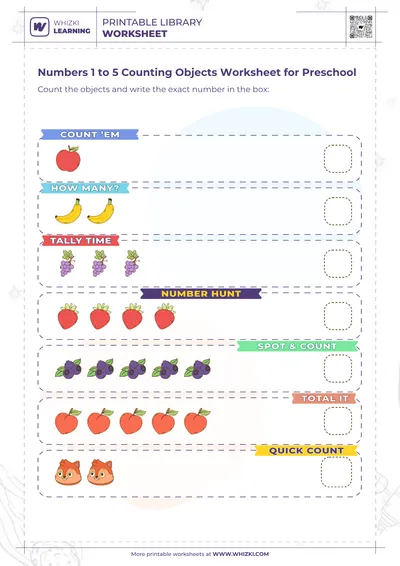
Count illustrated groups, including 1 apple picture, and write each total. Practice touching every picture once and checking the whole quantity with adult support.
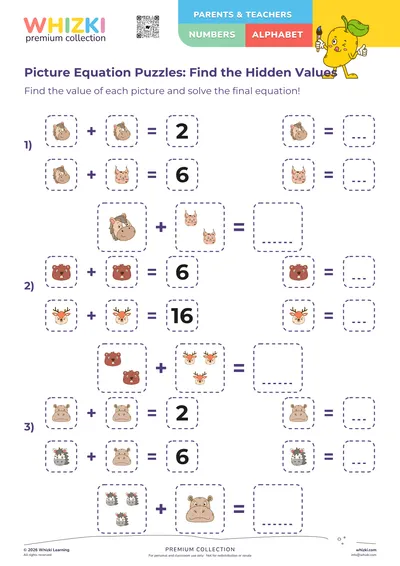
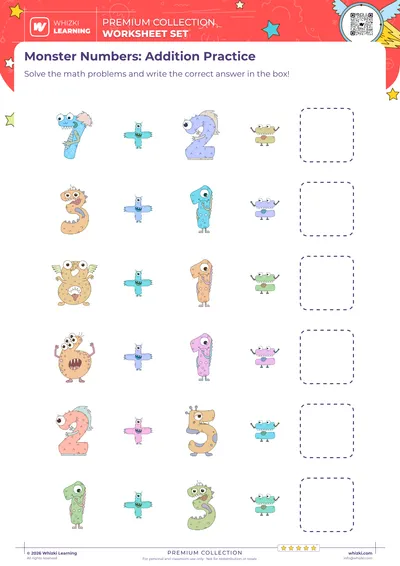
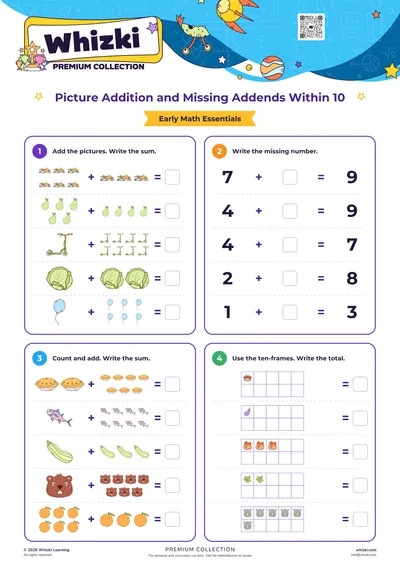
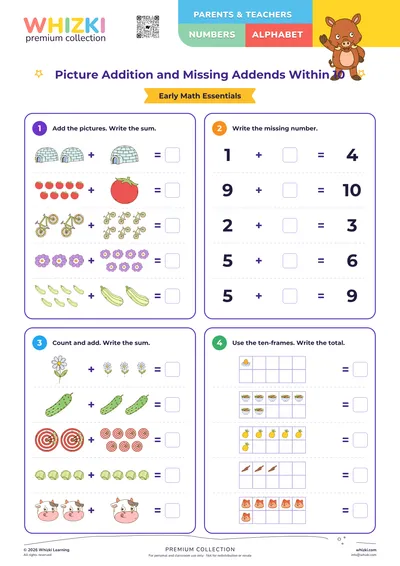
Addition and subtraction become easier to discuss when children can connect symbols with quantities. This pack combines picture arithmetic, number equations, short story problems, and making-ten activities. It also includes counting and comparison pages that can support a child who needs more practice before working with equations. The previews show several distinct formats. Some pages ask for a sum or difference, some compare two quantities, and picture-value puzzles ask children to infer a hidden value from clues. Choose a page that practices the operation you are working on, and introduce the picture-value puzzles after familiar equations feel manageable. Choose a task based on its number range and reasoning demand. Let a child model an equation with counters, explain what a story says happened, or check a comparison by counting. Picture-value puzzles can involve larger totals and several reasoning steps, so they may be a later choice even when their illustrations look playful. Return to Early Math Essentials when quantities and numerals need more work. For arithmetic involving measurement units, explore the Measurement Workshop set . Work through one example together, then ask your child to explain a method on the next instead of relying only on a written answer.
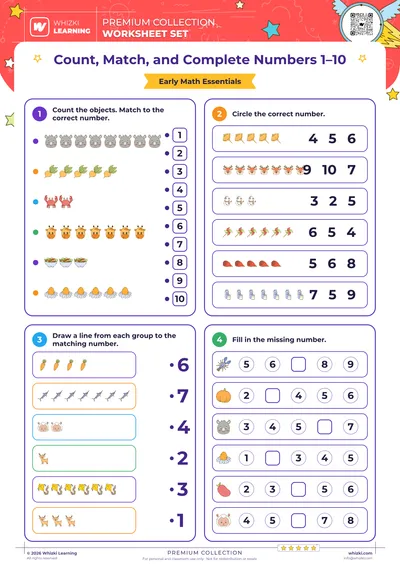
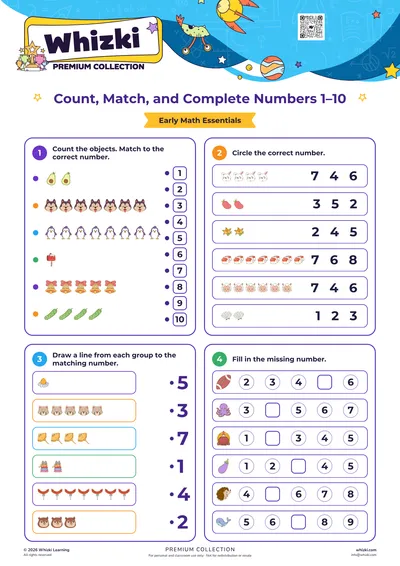
A child can count familiar objects before written numbers begin to make sense. This collection gives adults several ways to connect quantities with numerals: counting picture groups, choosing or writing a number, tracing numerals, and completing number sequences. Start with a page that matches what your child can already count comfortably. The published collection also includes comparing groups, addition within ten, number names, missing numbers, and introductory place value. These formats ask for different skills. The pages are choices for practice rather than a lesson sequence in which every worksheet is easier than the next. Model counting by touching each object once and saying that the last number tells how many there are. When a page introduces addition, use counters to show two groups joining. For comparison, check each quantity before choosing a symbol. Save tens-and-ones work for a child ready to connect grouped objects with a two-digit numeral. The number reference library can help explain a particular numeral. When your child is ready for more arithmetic, explore the Addition and Subtraction Pack . A few careful examples are enough for one sitting; use the rest when another short practice opportunity comes along.
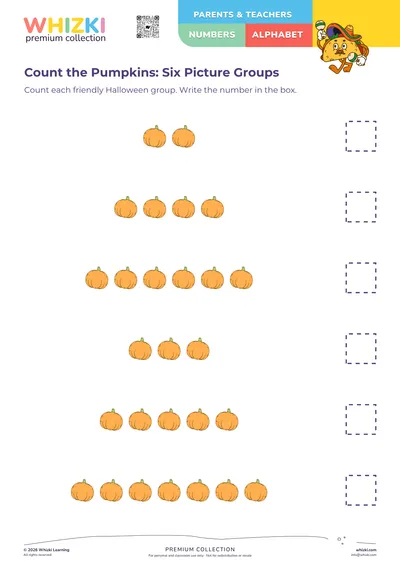
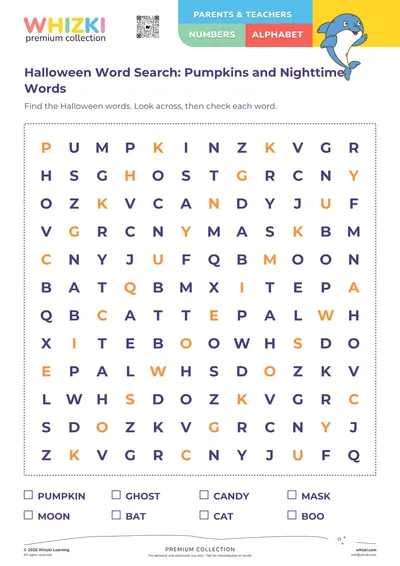
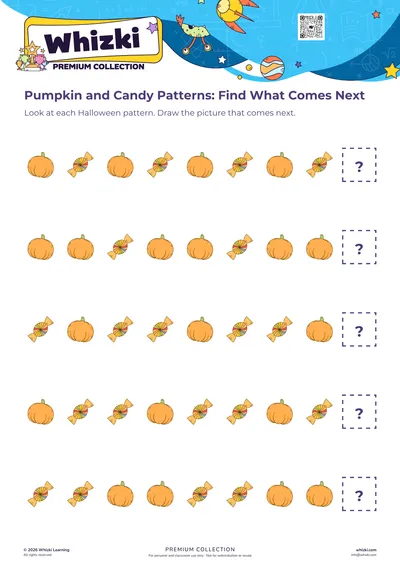
Halloween themes can give a familiar practice task a reason to come back to the table. This collection uses pumpkins, candy, and friendly seasonal pictures in counting, word-search, pattern, and handwriting activities. Choose the format your child is ready to use rather than expecting the theme to make every task equally easy. The counting pages ask children to attend to objects and quantities. Word searches use a printed bank of Halloween vocabulary, pattern pages ask what repeats or comes next, and handwriting pages provide words to trace and write. Check the actual preview for the words, number range, or pattern rule on that page. An adult can read the directions and name unfamiliar seasonal words. For a word search, model matching the first letter and checking the remaining letters in order. For a pattern, say the repeating unit aloud. A child who is ready to count objects may still need substantial help reading a longer word such as costume. Use Early Math Essentials for more counting practice beyond the theme. The Spelling and Word Building Pack provides other word activities. Print a single page for a short seasonal session, or choose several suitable activities from the published collection.
Save the worksheet on its page, or add an activity to your learning planner for another day. Compare Free, Plus, and Pro if you need more saved materials or planning tools.
A Parent's Guide to Arabic Numerals (0-20)
You're doing a great job exploring the world of numbers! Each number has its own unique story. Use this guide as your adventure map to jump to another number you're curious about, or to see how they all fit together in one big, amazing family.