Let's explore the fantastic and fun number Five! It's the number of fingers on one hand, points on a star, and our amazing senses. Let's learn about this exciting and important number together!
Getting to Know the Number 5:
5, spelled five, represents a group of five objects. 5 has 0 tens and 5 ones. 0 × 10 + 5 = 5.
The number five is a common group in nature and our bodies. Representing it in different ways helps your child connect the numeral to the idea of 'a handful' or 'half of ten'. Here are a few ways we can show what 'five' really means.
The Numeral
This is how we write the number five. It has a little hat, a straight neck, and a big, round tummy.
The Word
five [faɪv]
This is how we read the number. The word 'five' helps us talk about groups of this size, like five little ducks.
On a Ten-Frame
Five dots on a ten-frame perfectly fill the entire top row, creating a very clear and satisfying picture of 'halfway to ten'.
With Your Fingers
You can show 'five' with your hand by holding up all the fingers on one hand—a high-five!
Practice the Number 5 at Home (No Screens Needed!)
The best learning happens through play. Here are a few simple, screen-free ideas to continue your number 5 adventure together and celebrate this fantastic number.
Five Senses Scavenger Hunt
~1 This is a wonderful mindfulness activity that connects the number five to our five senses: sight, sound, smell, taste, and touch. It's a fantastic way to practice being present and observant. Go for a walk in your backyard or a park and go on a hunt! The mission is to find: five interesting things to see, five different sounds to hear, five natural things to smell, and five different textures to touch (like a rough rock or a soft leaf). This activity builds scientific observation skills and a deeper connection to the natural world.
High-Five Counting
~2 This is a simple, high-energy game that reinforces the number five in a very physical and positive way. It’s perfect for active learners! Call out different numbers from 1 to 5. Your child's job is to give you a high-five, but they have to use the correct number of fingers. If you say 'three', they give you a high-three. If you say 'five', they give you a full high-five! This game is great for number recognition and kinesthetic learning, anchoring the numbers in a joyful, physical action.
Star-Making Station
~3 This is a fun and creative art activity that connects the number five to the five points of a star. You'll need craft supplies like paper, scissors, and crayons or markers. You can also use craft sticks or playdough. The challenge is to create stars! You can draw them, or try to build them by arranging five craft sticks so their points touch. This is a great problem-solving and fine motor skill challenge. It's a playful introduction to geometry and a wonderful way to practice counting to five while creating a beautiful, celestial masterpiece.
Practice Number 5
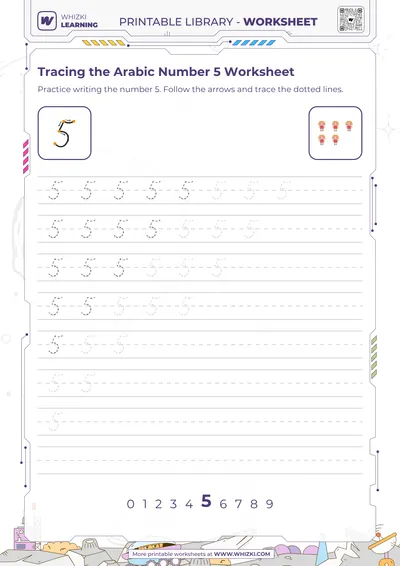
Download free printable worksheets to master this number!
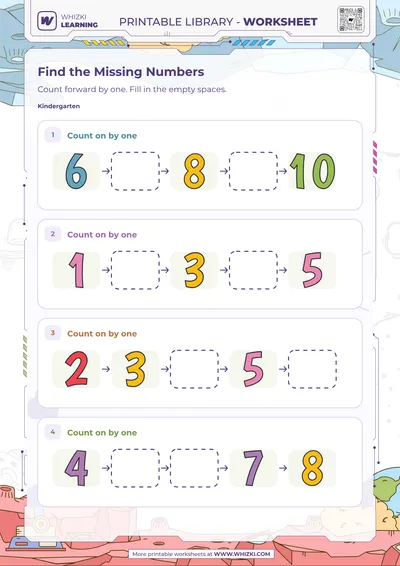
Kids often pause when a counting pattern has holes, even when they can count out loud. This Whizki Learning printable gives your kindergartener four short trails and simple equations to complete together.
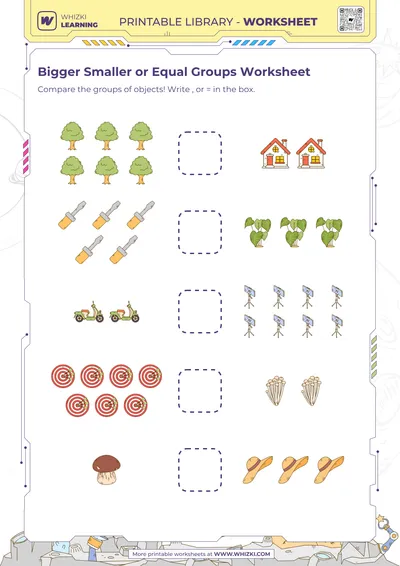
Kids often know “more” in real life but stall when two printed groups look close. Use this page to count each group together, then choose bigger, smaller, or equal.
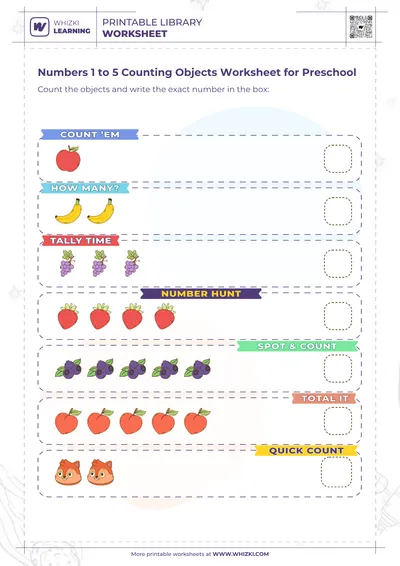
Count illustrated groups, including 1 apple picture, and write each total. Practice touching every picture once and checking the whole quantity with adult support.
Save the worksheet on its page, or add an activity to your learning planner for another day. Compare Free, Plus, and Pro if you need more saved materials or planning tools.
A Parent's Guide to Arabic Numerals (0-20)
You're doing a great job exploring the world of numbers! Each number has its own unique story. Use this guide as your adventure map to jump to another number you're curious about, or to see how they all fit together in one big, amazing family.