Let's explore the lucky and legendary number Seven! It's the number of colors in a rainbow, days in a week, and continents on Earth. Let's learn about this truly magical and important number!
Getting to Know the Number 7:
7, spelled seven, represents a group of seven objects. 7 has 0 tens and 7 ones. 0 × 10 + 7 = 7.
The number seven appears in so many important parts of our world. Representing it in different ways helps your child connect the numeral to these significant real-world concepts. Here are a few ways we can show what 'seven' really means.
The Numeral
This is how we write the number seven. A straight line across the top and a long, angled line down.
The Word
seven [ˈsɛvən]
This is how we read the number. The word 'seven' helps us talk about important groups, like the seven days of the week.
On a Ten-Frame
Seven dots on a ten-frame show a full row of five, plus two more. This is a powerful visual for understanding '5 + 2'.
With Your Fingers
You can show 'seven' with your hands by holding up all five fingers on one hand, and two fingers on the other.
Practice the Number 7 at Home (No Screens Needed!)
The best learning happens through play. Here are a few simple, screen-free ideas to continue your number 7 adventure together and find this lucky number in your daily life.
Rainbow Creations
~1 This is a beautiful art activity that connects the number seven to the seven colors of the rainbow (Red, Orange, Yellow, Green, Blue, Indigo, Violet). You'll need paper and art supplies in all the rainbow colors. The mission is to create a vibrant rainbow! You can draw or paint the arcs, or make a collage by tearing and gluing strips of colored paper. This activity is fantastic for color recognition and fine motor skills. As you create, you can count the seven colors and talk about where we see rainbows in the real world. It anchors the number seven in one of nature's most magical and beautiful displays.
Days of the Week Chart
~2 This is a practical and empowering activity that helps your child understand the concept of a week and connects it to the number seven. You'll need a large piece of paper or a poster board. Together, create a simple chart with seven columns, one for each day of the week. Let your child decorate it. Then, each day, you can add a sticker or a small drawing to the chart to mark the passing of time. This activity introduces the abstract concept of time in a concrete, visual way. It helps children understand their weekly routine ('On Monday we go to school, on Saturday we go to the park') and gives them a sense of predictability and control.
Seven Dwarfs Storytelling
~3 This imaginative play activity connects the number seven to the classic fairy tale of Snow White. It's a wonderful way to practice storytelling and social-emotional skills. First, read the story together. Then, using small toys, blocks, or even just drawings, act out the story. Focus on the seven dwarfs. Can you give each one a name and a personality, just like in the story (e.g., Happy, Grumpy, Sleepy)? This activity is fantastic for memory, sequencing, and exploring different emotions in a safe and playful context. It shows how numbers are a key part of our most beloved stories.
Practice Number 7
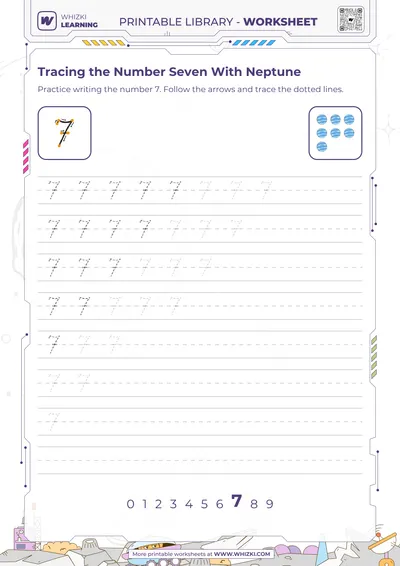
Download free printable worksheets to master this number!
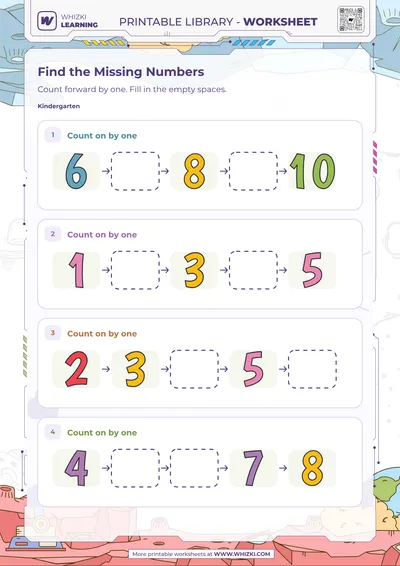
Kids often pause when a counting pattern has holes, even when they can count out loud. This Whizki Learning printable gives your kindergartener four short trails and simple equations to complete together.
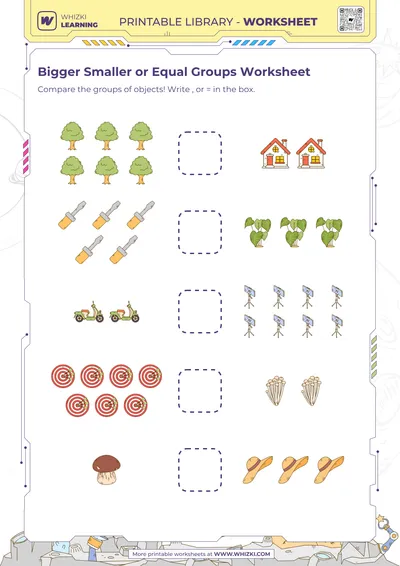
Kids often know “more” in real life but stall when two printed groups look close. Use this page to count each group together, then choose bigger, smaller, or equal.
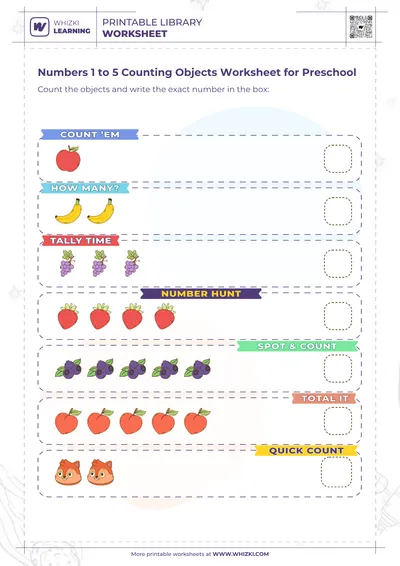
Count illustrated groups, including 1 apple picture, and write each total. Practice touching every picture once and checking the whole quantity with adult support.
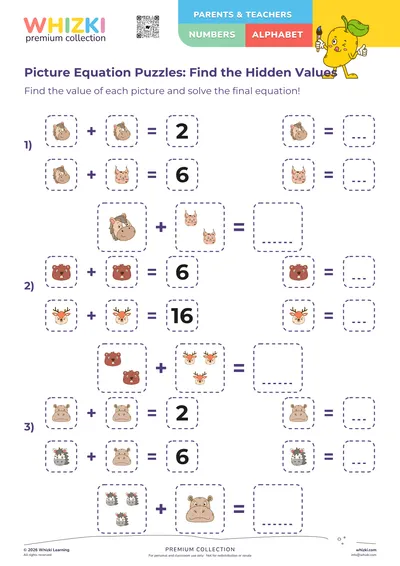
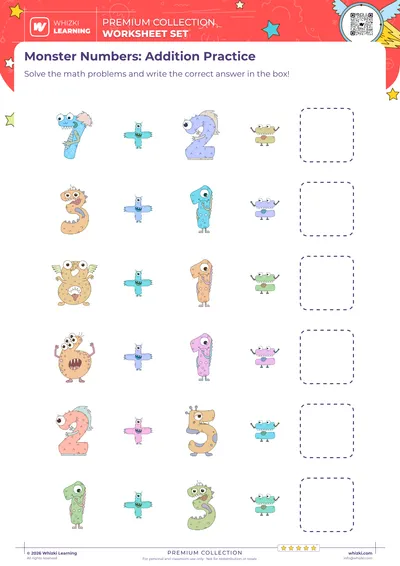
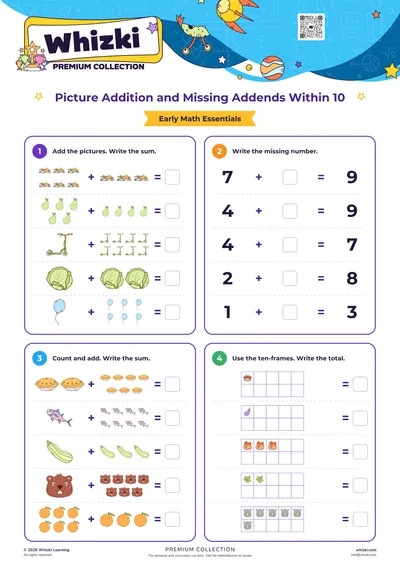
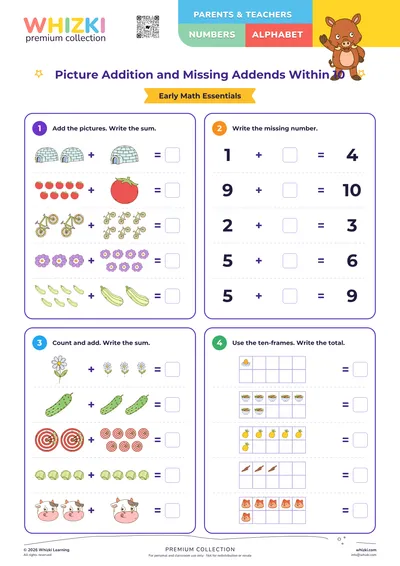
Addition and subtraction become easier to discuss when children can connect symbols with quantities. This pack combines picture arithmetic, number equations, short story problems, and making-ten activities. It also includes counting and comparison pages that can support a child who needs more practice before working with equations. The previews show several distinct formats. Some pages ask for a sum or difference, some compare two quantities, and picture-value puzzles ask children to infer a hidden value from clues. Choose a page that practices the operation you are working on, and introduce the picture-value puzzles after familiar equations feel manageable. Choose a task based on its number range and reasoning demand. Let a child model an equation with counters, explain what a story says happened, or check a comparison by counting. Picture-value puzzles can involve larger totals and several reasoning steps, so they may be a later choice even when their illustrations look playful. Return to Early Math Essentials when quantities and numerals need more work. For arithmetic involving measurement units, explore the Measurement Workshop set . Work through one example together, then ask your child to explain a method on the next instead of relying only on a written answer.
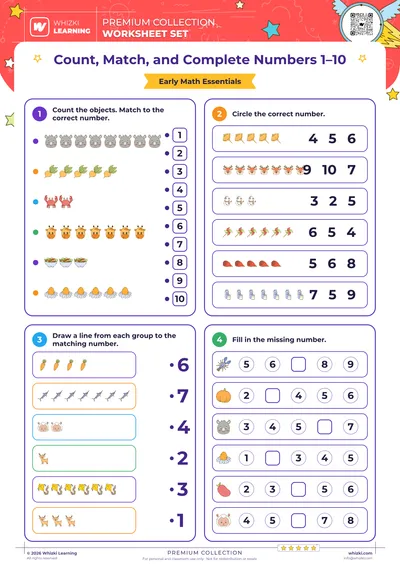
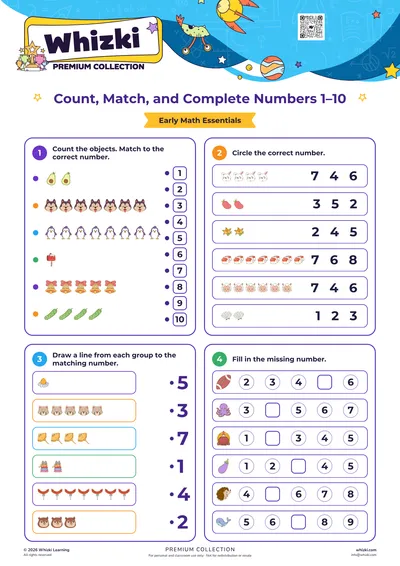
A child can count familiar objects before written numbers begin to make sense. This collection gives adults several ways to connect quantities with numerals: counting picture groups, choosing or writing a number, tracing numerals, and completing number sequences. Start with a page that matches what your child can already count comfortably. The published collection also includes comparing groups, addition within ten, number names, missing numbers, and introductory place value. These formats ask for different skills. The pages are choices for practice rather than a lesson sequence in which every worksheet is easier than the next. Model counting by touching each object once and saying that the last number tells how many there are. When a page introduces addition, use counters to show two groups joining. For comparison, check each quantity before choosing a symbol. Save tens-and-ones work for a child ready to connect grouped objects with a two-digit numeral. The number reference library can help explain a particular numeral. When your child is ready for more arithmetic, explore the Addition and Subtraction Pack . A few careful examples are enough for one sitting; use the rest when another short practice opportunity comes along.
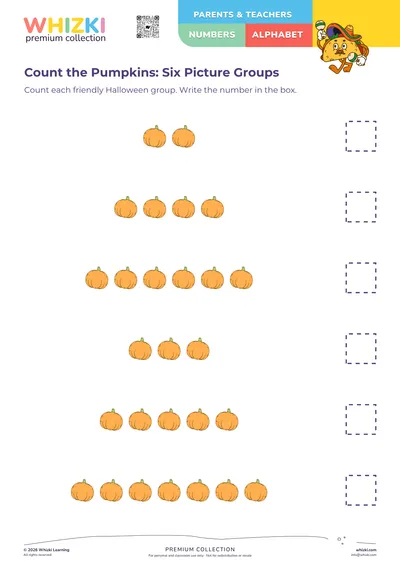
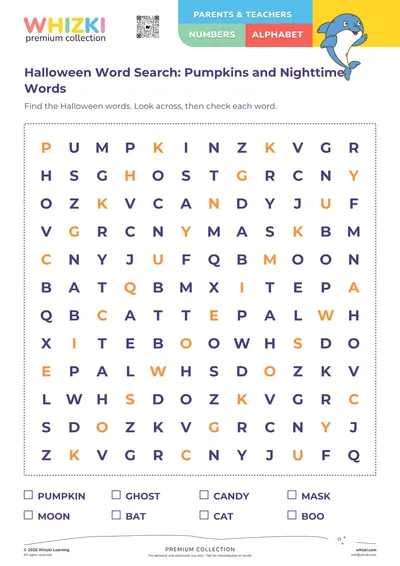
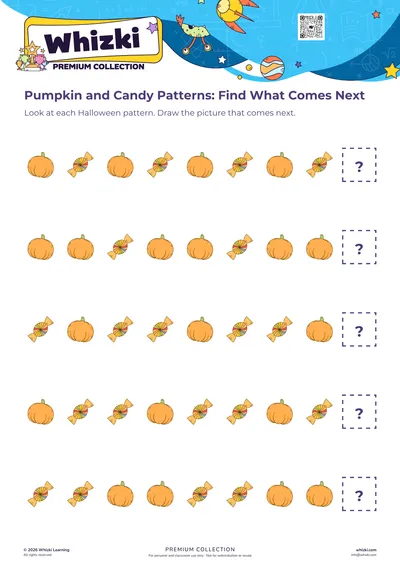
Halloween themes can give a familiar practice task a reason to come back to the table. This collection uses pumpkins, candy, and friendly seasonal pictures in counting, word-search, pattern, and handwriting activities. Choose the format your child is ready to use rather than expecting the theme to make every task equally easy. The counting pages ask children to attend to objects and quantities. Word searches use a printed bank of Halloween vocabulary, pattern pages ask what repeats or comes next, and handwriting pages provide words to trace and write. Check the actual preview for the words, number range, or pattern rule on that page. An adult can read the directions and name unfamiliar seasonal words. For a word search, model matching the first letter and checking the remaining letters in order. For a pattern, say the repeating unit aloud. A child who is ready to count objects may still need substantial help reading a longer word such as costume. Use Early Math Essentials for more counting practice beyond the theme. The Spelling and Word Building Pack provides other word activities. Print a single page for a short seasonal session, or choose several suitable activities from the published collection.
Save the worksheet on its page, or add an activity to your learning planner for another day. Compare Free, Plus, and Pro if you need more saved materials or planning tools.
A Parent's Guide to Arabic Numerals (0-20)
You're doing a great job exploring the world of numbers! Each number has its own unique story. Use this guide as your adventure map to jump to another number you're curious about, or to see how they all fit together in one big, amazing family.