Adventures with the Numeral XI

Let's explore the exciting Roman numeral for eleven: XI! This symbol shows us how the Romans built numbers greater than ten by adding on to the powerful 'X'.

Getting to Know the Roman Numeral XI:

XI represents 11, or eleven, in Roman numerals. Read XI as eleven. Roman numerals use letters to represent numbers; they do not use decimal place value like tens and ones.

- The Whizki Learning Team
Seeing the Roman Numeral XI in Our World

The Roman numeral 'XI' is a symbol for 'eleven' or 'eleventh'. Representing it in different ways helps your child practice the 'ten plus one' rule. Here are a few ways we can show what 'XI' really means.

The Roman Numeral

A stylized illustration of the number eleven, formed by connected dots and lines like a constellation.
This is the symbol 'XI'. An 'X' followed by an 'I' means 'ten plus one'.

The Arabic Numeral

11eleven [ɪˈlɛvən]

The Roman numeral 'XI' is equal to the number '11' that we use every day.

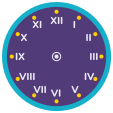
On a Clock

A stylized clock illustration of the roman number eleven
On many clock faces with Roman numerals, 'XI' marks the eleven o'clock position, close to midnight or noon.

In a Book

The eleventh chapter of a book is often labeled 'Chapter XI', where the story often gets very exciting!

Practice the Roman Numeral XI at Home (No Screens Needed!)

The best learning happens through play. Here are a few simple, screen-free ideas to continue your Roman numeral adventure together and master the number eleven.

The 'Ten Plus One' Game

~1
This is a fantastic hands-on activity for understanding how 'XI' is constructed. You'll need ten of one object (like ten buttons) and one of another (like one pebble). First, count out the ten buttons and say 'This is ten, which is X'. Then, add the one pebble and say, 'Now we have ten and one more. This is eleven, or XI.' This simple, physical action provides a very concrete and memorable demonstration of why XI means eleven. It’s a hands-on math lesson that makes an abstract rule easy to grasp.

Team of Eleven

~2
This activity is great for learning about sports and counting. Many sports, like soccer, have a team of eleven players on the field at one time. You can set up eleven of your toys (like action figures or dolls) as a soccer team on the 'field' (a green blanket or rug). You can give them positions and even create a little soccer ball for them to play with. This activity connects the number eleven to a real-world concept and encourages imaginative play and storytelling.

Eleven-Second Challenge

~3
This is a fun, high-energy gross motor game for practicing counting and estimating time. The game is simple: you challenge your child to do an activity for exactly eleven seconds. For example: 'How many times can you hop on one foot in eleven seconds?' or 'Can you stand perfectly still like a statue for eleven seconds?'. You can count aloud together. This game helps children develop a sense of time and rhythm, and it makes counting to eleven a joyful and physical experience. It's a great way to get the wiggles out and practice at the same time.

Plan a little more practice

Pick a page from the math worksheets. Free PDFs need a free account to download. You can also explore number explanations.

For a ready-made set of related activities:

Addition and Subtraction Pack

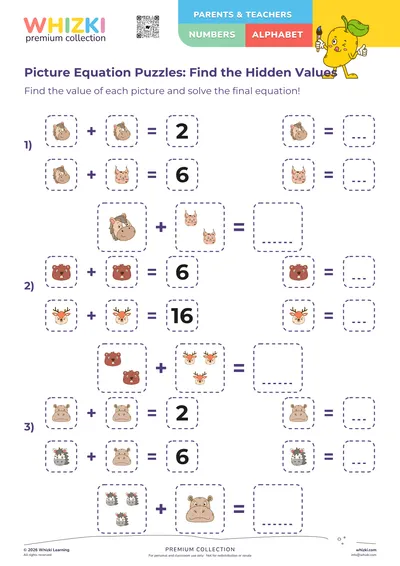
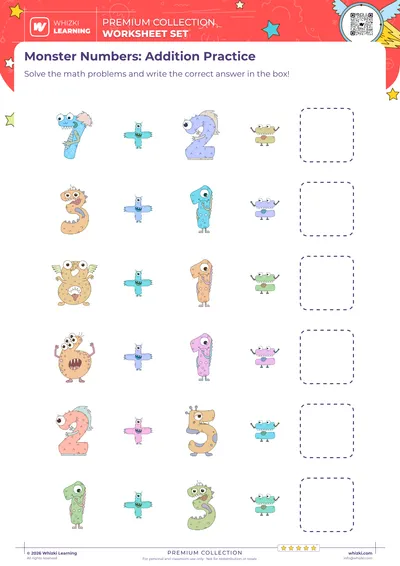
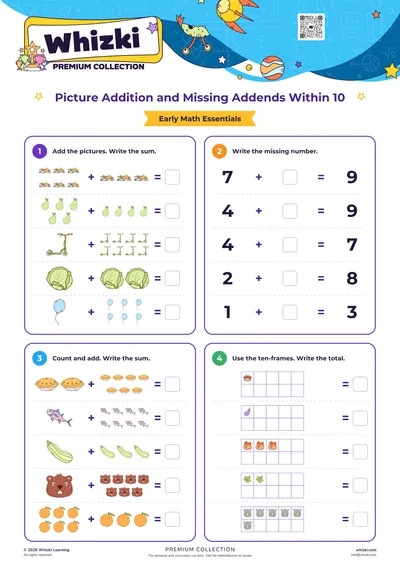
Addition and subtraction become easier to discuss when children can connect symbols with quantities. This pack combines picture arithmetic, number equations, short story problems, and making-ten activities. It also includes counting and comparison pages that can support a child who needs more practice before working with equations. The previews show several distinct formats. Some pages ask for a sum or difference, some compare two quantities, and picture-value puzzles ask children to infer a hidden value from clues. Choose a page that practices the operation you are working on, and introduce the picture-value puzzles after familiar equations feel manageable. Choose a task based on its number range and reasoning demand. Let a child model an equation with counters, explain what a story says happened, or check a comparison by counting. Picture-value puzzles can involve larger totals and several reasoning steps, so they may be a later choice even when their illustrations look playful. Return to Early Math Essentials when quantities and numerals need more work. For arithmetic involving measurement units, explore the Measurement Workshop set . Work through one example together, then ask your child to explain a method on the next instead of relying only on a written answer.

Picture Equation Puzzles: Find the Hidden ValuesMonster Numbers: Addition PracticeCount, Match, and Complete Numbers 1–10
Early Math Essentials

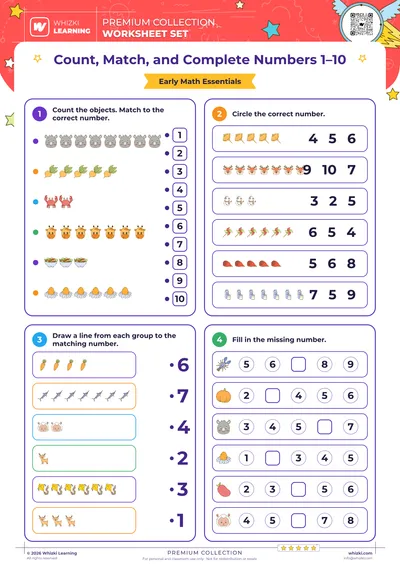
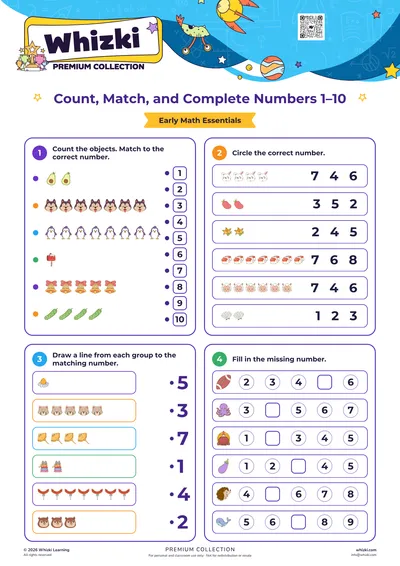
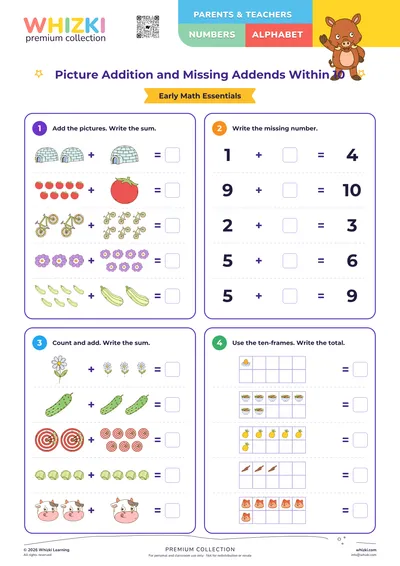
A child can count familiar objects before written numbers begin to make sense. This collection gives adults several ways to connect quantities with numerals: counting picture groups, choosing or writing a number, tracing numerals, and completing number sequences. Start with a page that matches what your child can already count comfortably. The published collection also includes comparing groups, addition within ten, number names, missing numbers, and introductory place value. These formats ask for different skills. The pages are choices for practice rather than a lesson sequence in which every worksheet is easier than the next. Model counting by touching each object once and saying that the last number tells how many there are. When a page introduces addition, use counters to show two groups joining. For comparison, check each quantity before choosing a symbol. Save tens-and-ones work for a child ready to connect grouped objects with a two-digit numeral. The number reference library can help explain a particular numeral. When your child is ready for more arithmetic, explore the Addition and Subtraction Pack . A few careful examples are enough for one sitting; use the rest when another short practice opportunity comes along.

Count, Match, and Complete Numbers 1–10Picture Addition and Missing Addends Within 10Picture Addition and Missing Addends Within 10
Halloween Learning Activities Pack

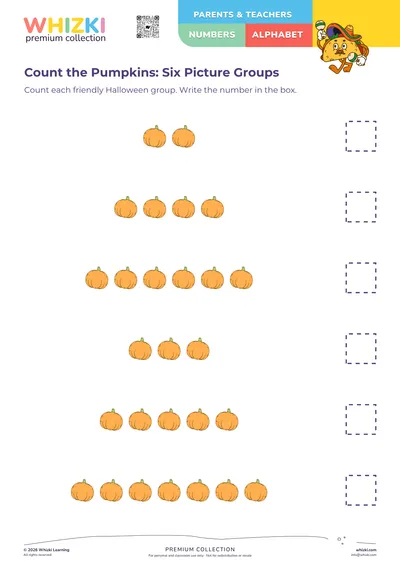
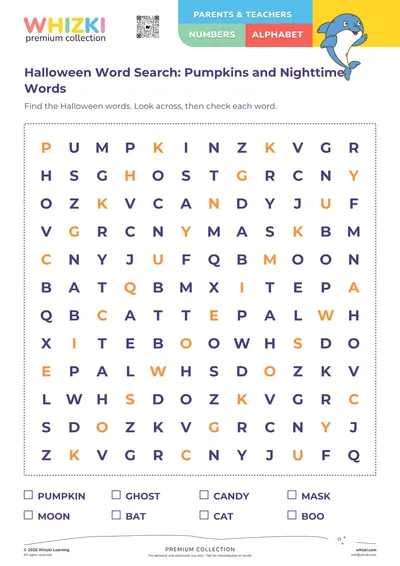
Halloween themes can give a familiar practice task a reason to come back to the table. This collection uses pumpkins, candy, and friendly seasonal pictures in counting, word-search, pattern, and handwriting activities. Choose the format your child is ready to use rather than expecting the theme to make every task equally easy. The counting pages ask children to attend to objects and quantities. Word searches use a printed bank of Halloween vocabulary, pattern pages ask what repeats or comes next, and handwriting pages provide words to trace and write. Check the actual preview for the words, number range, or pattern rule on that page. An adult can read the directions and name unfamiliar seasonal words. For a word search, model matching the first letter and checking the remaining letters in order. For a pattern, say the repeating unit aloud. A child who is ready to count objects may still need substantial help reading a longer word such as costume. Use Early Math Essentials for more counting practice beyond the theme. The Spelling and Word Building Pack provides other word activities. Print a single page for a short seasonal session, or choose several suitable activities from the published collection.

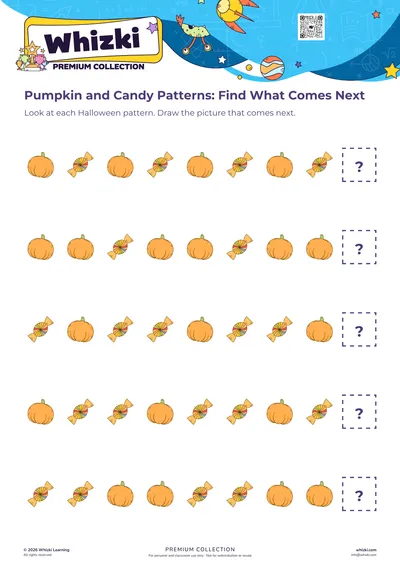
Count the Pumpkins: Six Picture GroupsHalloween Word Search: Pumpkins and Nighttime WordsPumpkin and Candy Patterns: Find What Comes Next

Save the worksheet on its page, or add an activity to your learning planner for another day. Compare Free, Plus, and Pro if you need more saved materials or planning tools.

Your Guide to the Roman Numeral Code

You're currently exploring the numeral XI! Use this guide as your map to discover the other ancient symbols.
See how they are built by adding and subtracting, and jump to any other numeral you're curious about to continue your adventure.

IItwo

[tuː]
The Number two

IIIthree

[θriː]
The Number three

IVfour

[fɔːr]
The Number four

Vfive

[faɪv]
The Number five

VIsix

[sɪks]
The Number six

VIIseven

[ˈsɛvən]
The Number seven

VIIIeight

[eɪt]
The Number eight

IXnine

[naɪn]
The Number nine

XIeleven

[ɪˈlɛvən]
The Number eleven

XIItwelve

[twɛlv]
The Number twelve

For counting and quantities, compare this Roman numeral with the number 11. The math activities below use Arabic numerals.

Frequently asked questions

FAQ

Everything you need to know.

ROMAN NUMERALS

What does XI mean in Roman numerals?

XI represents 11, or eleven, in Roman numerals.

How do you read XI?

Read XI as eleven. Roman numerals use letters to represent numbers; they do not use decimal place value like tens and ones.

PRACTICE IDEAS

How can children practice XI?

Write XI beside 11, then look for Roman numerals in chapter headings or on a clock. Compare the two ways of writing the same number.

Join the Screen-Free Movement.

Get exclusive activities, expert tips, and inspiration for a more meaningful, offline family life.

Copyright © 2025 - 2026 Whizki Learning. All rights reserved.
Printable packs for ages 3-7

Looking for the next printable activity?

Browse ready-to-print packs for early math, shapes, handwriting, and more. Pick one that fits what your child wants to practice next.