
Routines and feelings
Make the week feel predictable
Practice the morning, lunch containers, goodbye, and pickup language before the first day arrives.
Parent guide · preschool to 1st grade
School prep is more than pencils and pages. Use the 7-day family plan, first-day checklist, readiness guidance, parent articles, and a small set of free printables without turning the week into a test.
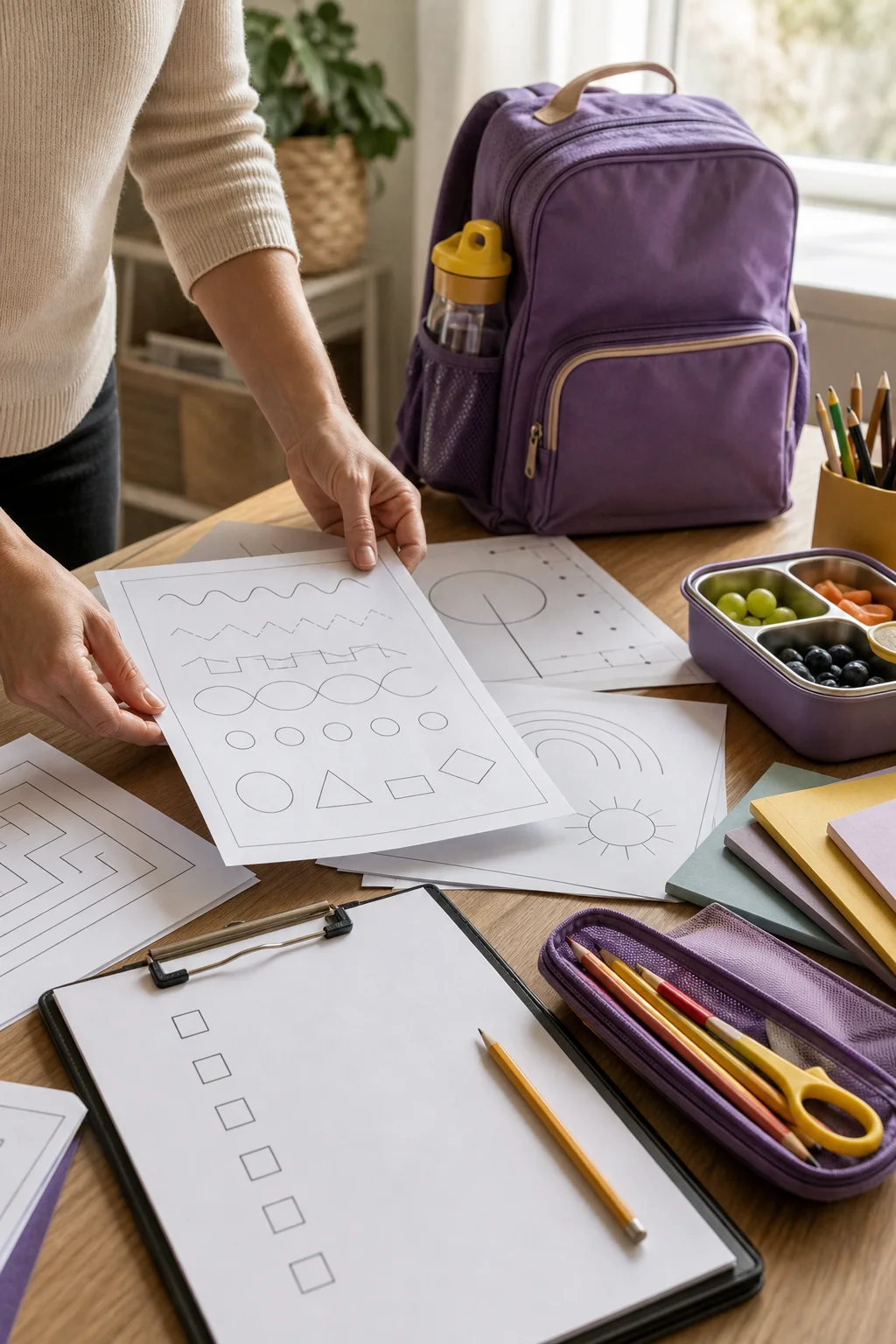
Start here
Choose the pressure point in front of you: an unpredictable routine, questions about readiness, or a child who wants a little practice. You do not need to cover everything. One clear next step is enough.
Routines and feelings
Practice the morning, lunch containers, goodbye, and pickup language before the first day arrives.
Readiness and development
Review practical self-help, communication, early learning, and social-emotional skills in age-appropriate context.
Hands-on practice
Browse short literacy, math, fine-motor, and attention activities only when a little review would feel helpful.
Start one week before school. The plan mixes practical routines, conversation, and short skill refreshers. If a day goes sideways, skip it. There is no need to double up.
Day 7
Open and close the backpack. Pack a folder and water bottle, then unpack them.
Day 6
Find the letters in your child’s name. Trace one line or write the first letter.
Day 5
Choose five familiar letters. Name each letter and say one word that begins with its sound.
Day 4
Count ten crayons, blocks, or snacks. Sort them by color, shape, or size.
Day 3
Open every lunch container and close it again. Practice asking for help when one feels hard.
Day 2
Read a school story, then practice the exact goodbye you will use at drop-off.
Day 1
Get dressed, eat breakfast, pack the bag, and walk through the morning in order. Skip academic practice today.
Keep the plan flexible
Parent checklist
School details vary, but these are the small jobs that most often create a rushed first morning when they are left until the last minute.
Guides and readiness
Use these focused resources for readiness questions, first-day feelings, after-school decompression, or a broader view of what children practice at this age.
Review practical literacy, math, self-help, fine-motor, and social-emotional skills without turning readiness into a test.
Explore resourceUse age-banded context when a preschool, kindergarten, or 1st grade expectation does not feel like the right fit.
Explore resourcePrepare for separation, uncertainty, and the goodbye at the classroom door with a short, predictable plan.
Explore resourcePlan food, movement, quiet time, and better questions for the feelings that can arrive after pickup.
Explore resourceBrowse the full collection of alphabet, phonics, tracing, handwriting, vocabulary, and early reading pages.
Explore resourceBrowse counting, number sense, addition, subtraction, shapes, patterns, and early problem-solving practice.
Explore resourceOptional skill practice
These six pages are for children who want a short skill refresher. Use one for a quick review, kindergarten morning work, a homeschool restart, or a quiet classroom transition.
A low-pressure tracing page for hands that are getting used to crayons and pencils again.
Open free worksheetPractice one clear letter shape while connecting H with a familiar picture and sound.
Open free worksheetComplete a simple A-to-Z sequence while practicing letter recognition and pencil control.
Open free worksheetA short picture-matching page for children who are ready to listen for the first sound.
Open free worksheetCount picture groups, connect quantities to numerals, and practice writing the answer.
Open free worksheetBring familiar facts back with one focused page and a short counter-based routine.
Open free worksheetStraight answers about routines, readiness, timing, printables, classroom use, and first-day feelings.
What is included in this back-to-school guide?
The guide brings together a 7-day family plan, a first-day checklist, readiness and developmental references, parent articles about school-day feelings, and optional free printables for children ages 3 to 7.
Are these back-to-school worksheets free?
The individual worksheet pages linked from this guide are part of Whizki’s free printable library. Curated worksheet sets require a Whizki Plus or Pro plan, and printed workbooks are sold separately.
What ages are these back-to-school printables for?
They are selected for children ages 3 to 7, from preschool and pre-K through kindergarten and 1st grade. Start with the grade cards, then choose a page that matches the child’s current skills rather than the label alone.
What should a kindergartener review before school starts?
Useful review includes name recognition, pencil control, familiar letters and sounds, counting small groups, numbers 1 to 10, shapes, listening, and simple self-help routines. Reading fluently is not required before kindergarten.
How much worksheet practice should a child do each day?
One or two short pages, or about 10 to 15 minutes, is plenty for most children ages 3 to 7. Stop sooner if the child is tired, upset, or rushing through every answer.
How can I keep back-to-school practice from feeling stressful?
Let your child choose between two pages, sit nearby, and begin with something familiar. End while the work still feels manageable. A small success today is more useful than finishing a packet through tears.
When should we start preparing for school?
One or two weeks before the first day is enough for most families. Begin with sleep, morning routines, and self-help. Add a short literacy or math review only when your child has the energy for it.
What can help with first-day separation anxiety?
Visit the school if possible, describe the pickup routine in concrete terms, and use the same short goodbye each day. Avoid sneaking away. If distress stays intense or keeps disrupting daily life, talk with the teacher and your child’s pediatrician.
Can teachers and homeschool families use these worksheets?
Yes. Teachers and homeschool families can print the pages for their own students or children, subject to the Whizki terms. The PDF files themselves should not be re-uploaded or redistributed.
How this guide was prepared
Prepared by the Whizki Learning editorial team for families, teachers, and homeschoolers of children ages 3 to 7. Last updated July 15, 2026 for the 2026–27 school year. These activities support practice and conversation. They are not a developmental assessment or medical advice.
Get exclusive activities, expert tips, and inspiration for a more meaningful, offline family life.
 Whizki Learningwhizki.com
Whizki helps parents and teachers turn letters, numbers, and everyday questions into simple learning activities for ages 3–7. Explore free printable worksheets, ready-to-use worksheet sets, and the Family Learning Planner for learning at home or in the classroom. Printed Whizki workbooks are also available separately on Amazon.