Let's go on a quest for the quiet and quirky letter Q! It's the start of queens, questions, and cozy quilts. We'll learn its unique shape and the sound it makes with its best friend, 'U'.
Getting to Know the Letter Q:
Q is usually followed by u. Together, qu often represents the two sounds k and w, as in queen and quick.
- The Whizki Learning Team
Quirky Words that Start with Q
Questioning is the key to all knowledge! The letter Q might be quiet, but it brings us some very important words. Exploring them is a great way to build your child's vocabulary. Here are a few quality 'Q' words to start with.
The female ruler of an independent state, or the wife of a king. In stories, queens often live in grand castles, wear beautiful crowns, and are known for being wise, kind, and powerful leaders of their people.
If you were the king or queen for a day, what would be your first kind rule for everyone?
Quilt
A warm bed covering made of padding enclosed between layers of fabric, held in place by lines of stitching. Quilts are often very beautiful, with many different colored and patterned squares sewn together to tell a story.
What colors and shapes would be on your perfect, cozy quilt?
Quarter
One of four equal parts into which something is or can be divided. If you cut a pizza into four equal slices, each slice is a quarter. A quarter is also a coin worth 25 cents in the United States.
If we share this cookie, how can we make sure we each get a quarter of it?
Question
A sentence or phrase used to find out information. Asking questions is a superpower for learning! It shows you are curious and want to understand the world more deeply. There is no such thing as a silly question.
What is one question about the world that you've always wanted to ask?
Quail
A small, short-tailed bird that is often hunted for food and sport. Quails are known for being very fast runners and for making a distinctive call. They are shy birds that are good at hiding in the grass.
How do you think a tiny quail would hide from a big animal?
To stop doing something. It's important to know that it is okay to quit a game if it's no longer fun, or to ask to take a break. It can also mean to not give up, as in 'never quit trying your best'.
What is something that is important to never quit trying to do?
Quake
To shake or tremble, often from a strong emotion like fear or excitement, or from the cold. The ground can quake during an earthquake. It describes a very strong and powerful shaking motion.
Can you show me how you would quake and shiver if you were super cold?
Quiver
To tremble or shake with a slight rapid motion. A leaf might quiver in the breeze. It's a much softer and faster shaking than 'quake'. Your lip might quiver just before you cry. It's a gentle, shaky movement.
Can you make your hands quiver like a leaf in the wind?
Question
To ask someone questions, especially in an official context. A detective might question a witness to solve a mystery. It means to ask a series of questions to get to the truth and understand something better.
If you could question your pet, what would you ask it?
Moving fast or doing something in a short time. A rabbit is a quick animal. It's the opposite of slow. Being quick can be very helpful in a race or a game of tag!
Let's have a race! How quick can you get to the door and back?
Quiet
Making very little or no noise. The opposite of loud. A library is a quiet place, and the nighttime is quiet. Sometimes, having a quiet moment to yourself is a wonderful way to relax and think.
What is your favorite quiet activity to do?
Queenly
Like or suitable for a queen; majestic and grand. To have a queenly wave is to wave in a very royal and elegant way. It's a word that describes something as being very special and dignified.
Can you show me your most queenly and royal posture?
At a fast speed; rapidly. When we are late, we have to move quickly. It describes doing an action with speed. It’s important to remember that some things, like art, are better done slowly, not quickly.
What's a game where you have to think very quickly?
Quietly
In a way that makes little or no noise. We should walk quietly in a library to show respect for the readers. It means to do something with a soft and gentle sound so as not to disturb others.
Can you show me how you would tiptoe as quietly as a mouse?
Quite
To the greatest extent; completely or entirely. For example, 'Are you sure?' 'Yes, quite sure.' It can also mean 'to a certain extent' or 'rather'. For example, 'It's quite warm today.' It's a useful word for describing how much.
Is this story quite good, or is it the best story ever?
Practice the Letter Q at Home (No Screens Needed!)
The best learning happens through play. Here are a few simple, screen-free ideas to continue your letter Q adventure together and make learning a part of your daily life.
Cozy Quilt Fort
~1 This is a wonderfully simple and comforting activity that connects the letter 'Q' to the idea of a 'quiet' and 'quality' space. It fosters imaginative play and is perfect for a calm afternoon. You’ll need all the quilts and blankets you can find, plus some chairs or cushions for support. Work together to build the coziest fort imaginable. Once you're inside, it becomes a special, quiet world. You can bring in flashlights and your favorite books for some quality reading time. This activity is a powerful way to create a safe and calming space for connection, showing that learning and fun don't have to be loud and energetic. It's about finding the magic in the quiet moments.
Quick Question Quest
~2 This is a fantastic language game that requires no materials and can be played anywhere! It directly practices the letter 'Q' word 'Question' and builds critical thinking skills. It's a version of '20 Questions'. One person secretly thinks of an object, animal, or person. The other players have to ask 'yes' or 'no' questions to guess what it is. For example: 'Is it an animal?', 'Does it live in our house?', 'Is it blue?'. This game is a brilliant workout for the brain. It teaches children how to ask good, strategic questions, how to use logic to eliminate possibilities, and the importance of listening carefully to the answers. It’s a truly engaging, screen-free game that fosters communication and curiosity.
Queen (or King) for a Day
~3 This is a powerful imaginative play activity that explores leadership, kindness, and responsibility, all inspired by the letter 'Q' for 'Queen'. First, create a simple crown together out of paper or cardboard and decorate it with 'jewels'. The person who wears the crown becomes the Queen or King for a set amount of time (like an hour). The ruler's job is not to be bossy, but to make kind and fun 'decrees' for the family. For example: 'I decree we must have a five-minute dance party!' or 'I decree that everyone gets an extra hug!'. This game is a wonderful way to empower your child, build their confidence, and have a playful conversation about what it means to be a good and fair leader.
Practice Letter Q
Download free printable worksheets to trace, read, and learn!
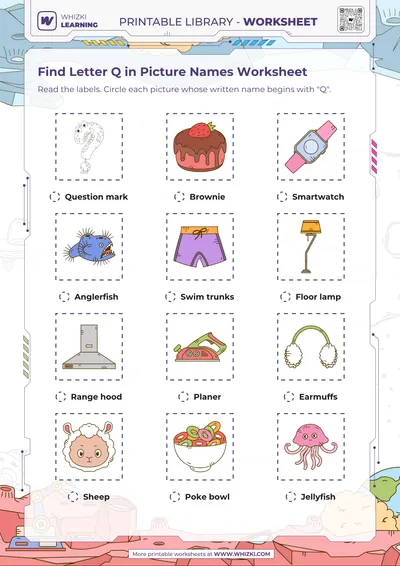
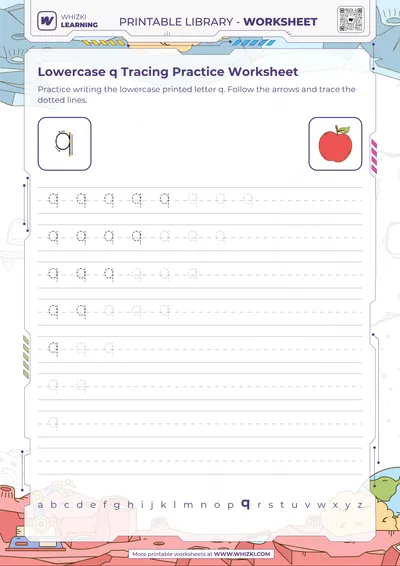
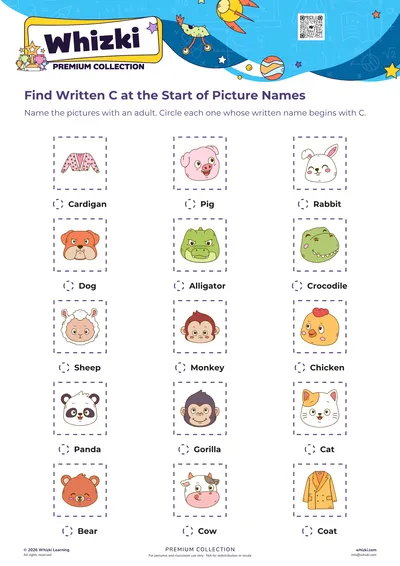
Practice lowercase printed q with a large formation model and dotted tracing rows. Follow the printed direction cues during a short, adult-supported handwriting session.
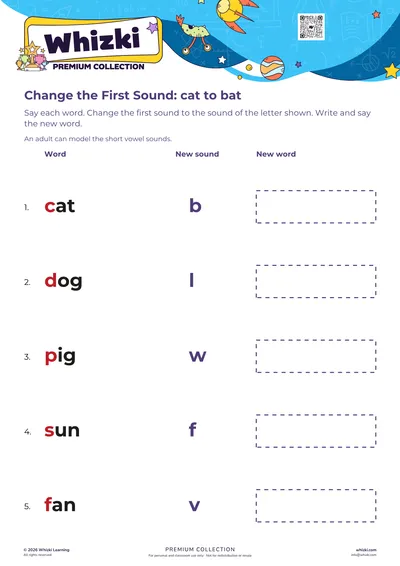
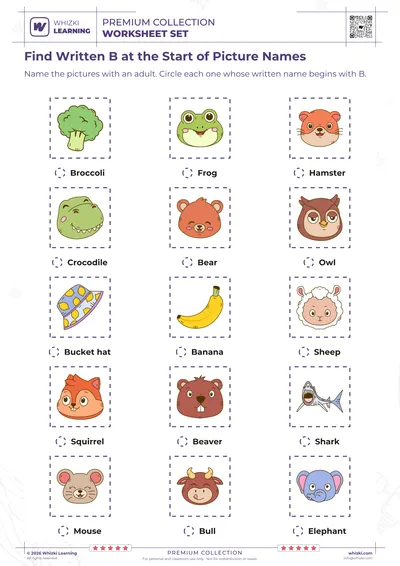
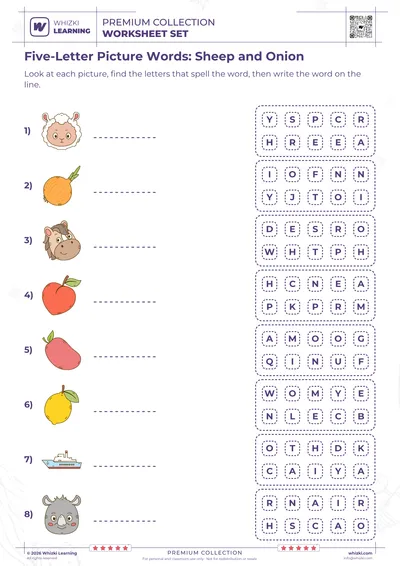
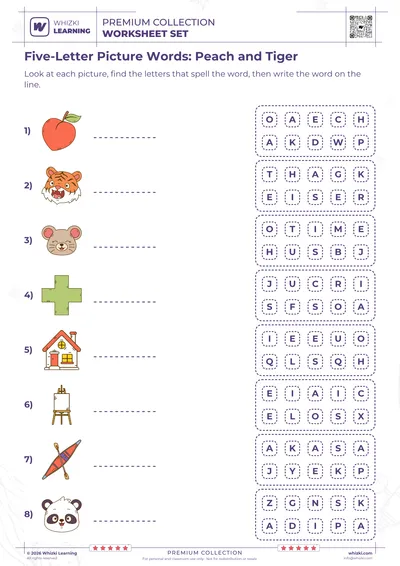
Knowing a letter name, hearing a sound, and reading a written word are related but different steps. This mixed pack gives adults several starting points: picture-word matching, picture spelling, scrambled words, initial-letter picture choices, syllable practice, and changing a sound in a word. Phonics connects written letters and letter groups with speech sounds. Syllable counting works with larger spoken beats, while changing an individual phoneme works with a single sound. Some initial-letter activities use words that share a spelling clue but not one identical beginning sound. Read and say the actual examples together rather than assuming one sound applies to every picture. Choose a page that matches what your child is ready to try. Name unfamiliar pictures, model one item, and show a spelling when oral knowledge is not enough to solve the task. A scrambled longer word can require more support than a short sound-change activity, so the order of pages is not a teaching sequence. Use the alphabet reference pages when a particular letter needs explanation. For further word construction, see the Spelling and Word Building Pack . Keep a short oral sound game separate from handwriting when your aim is to find out what your child can hear.
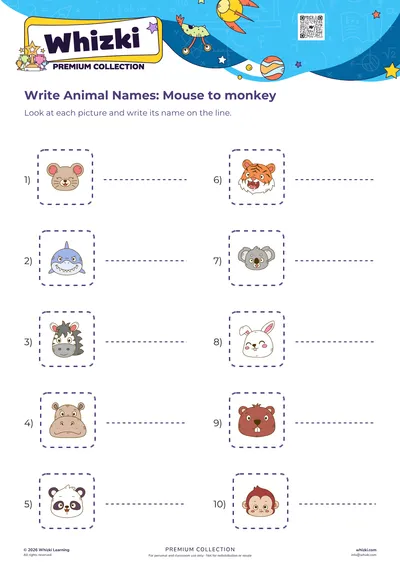
Early readers benefit from connecting a word's spelling with its meaning. This collection offers several ways to practice that connection: picture spelling, rearranging scrambled letters, matching words and pictures, choosing picture words by their initial letter, and building sentences from supplied words. The collection combines vocabulary and spelling activities, with familiar picture nouns and opportunities to use words in sentences. A sight word is a word a reader recognizes automatically; that can include familiar picture nouns as well as frequently used words. Reading an unfamiliar word still calls for attention to its letters and spelling patterns, rather than guessing from the picture alone. Choose a page with words your child can discuss and attempt with support. Name unfamiliar pictures, model how to check the letters, and help with spellings that do not follow a pattern the child knows yet. Some picture names are longer words, so a child just beginning to blend short words may need a different starting page. The Phonics and Sounds Pack offers related practice with written words and spoken sounds. For more word construction, explore the Spelling and Word Building Pack . Use one page or a few items at a time, then read or write a familiar word together in a meaningful sentence.
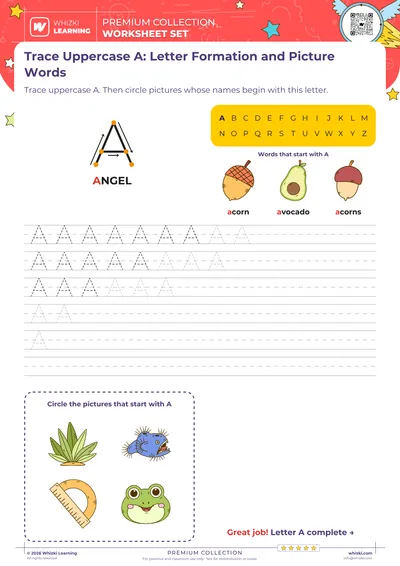
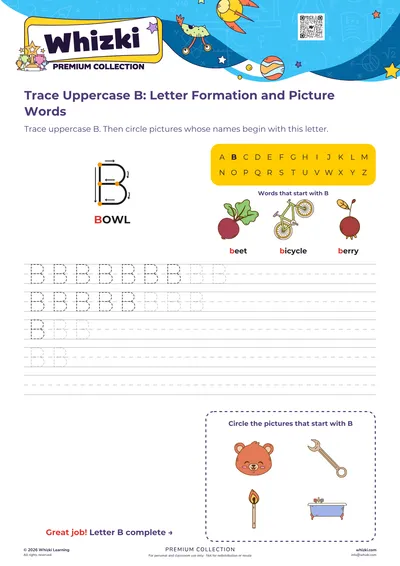
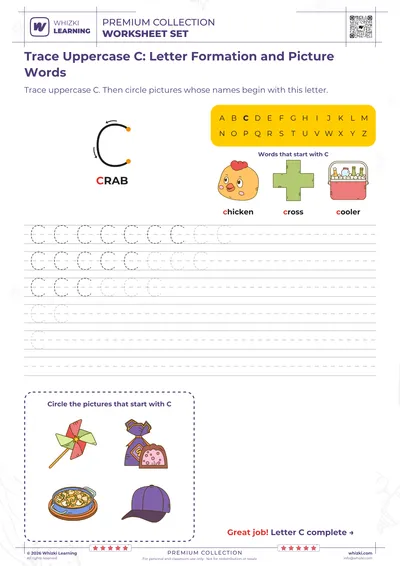
An alphabet song can be familiar long before writing letters feels comfortable. This pack gives adults a page for each uppercase letter, with a large formation model and dotted practice rows. Choose a letter your child recognizes, perhaps one in their name, and work on its shape together. The worksheets combine uppercase tracing with picture-word practice. Depending on the page, children choose pictures whose written names begin with the letter or complete picture words with a missing letter. These are different activities, so read the instruction on the selected page before starting. Lowercase tracing is not included in this pack. Model a few strokes, then let your child try a short section. Name unfamiliar pictures and show how their names are spelled when needed. Sharing an initial letter does not mean words always begin with the same sound; help your child separate the letter's name, its written form, and the sound it represents in a particular word. Use the alphabet reference pages for more about individual letters. A child who needs easier pencil practice may prefer the Pre-Writing Warm-Ups set first. Return to a familiar letter when useful; there is no need to complete the pack in alphabetical order or finish every row at once.
Save the worksheet on its page, or add an activity to your learning planner for another day. Compare Free, Plus, and Pro if you need more saved materials or planning tools.
Your Alphabet Adventure Map
Think of this as your family's personal map to the world of letters. Each letter below is a gateway to its own unique adventure, filled with fun words, hands-on activities, and printable worksheets. Click on any letter to begin exploring its sounds, shapes, and the stories it can tell.
The letter Q is called cue. Its name and the sounds it represents in words are not always the same.
Is Q a vowel or a consonant?
Q is a consonant letter.
What are the uppercase and lowercase forms of Q?
The uppercase form is Q, and the lowercase form is q. They are two forms of the same letter.
LETTER SOUNDS
What sound does the letter Q make?
Q is usually followed by u. Together, qu often represents the two sounds k and w, as in queen and quick.
LEARNING TIPS
How are phonics and phonemic awareness different?
Phonemic awareness means hearing and working with individual sounds in spoken words. Phonics connects written letters with sounds for reading and spelling. Understanding that letters represent sounds is called the alphabetic principle.
PRACTICE IDEAS
How can children practice Q?
Find Q and q in a book, trace or write each form, then listen for a sound the letter represents in a familiar word. Choose one short activity at a time.
Join the Screen-Free Movement.
Get exclusive activities, expert tips, and inspiration for a more meaningful, offline family life.