Some days it feels like your child has a million feelings and not enough words to match them. When you give kindergarten-ready D describing words, you help your child name what they notice and what they feel, without turning every moment into a lesson.
Reviewed by Sarah Mitchell, M.S., CCC-SLP, Speech-Language Pathologist.
For letter practice, use our letter D learning page and pair it with adjective talk during everyday routines.
Feelings and emotions that start with D
In speech-language pathologist practice, naming feelings helps children connect inner states to language, so the classroom and home feel calmer. When you model a feeling word, you are giving your child a “label” they can reach for instead of acting it out.
Use these D feeling words during transitions, after play, and at bedtime, especially when your child is already mid-moment. Keep it short, then wait for your child to choose.
Everyday words
- dazed
- dejected
- delighted
- depressed
- dizzy
- drowsy
- doubtful
- disappointed
Big words for curious kids
- distressed
- displeased
- disgruntled
- disillusioned
- disheartened
- desperate
Kitchen-table sorting tip: set up three piles on the table, down, happy, and mixed. Put picture cards or small objects in each pile, then ask your child to place one D feeling word card with the pile that matches the face you make.
Looks and size adjectives that start with D
Reggio-inspired observation reminds us that children learn from what they can see, touch, and compare. When you describe size and look words out loud, you build the “noticing” skill that supports early writing.
Try describing what your child is holding or wearing, then ask for the describing word. Occupational-therapy basics also point to this, because clear language helps children plan their next step when they are moving or switching tasks.
Everyday words
- dark
- dirty
- drab
- dry
- dusty
- dim
- dingy
- dull
Big words for curious kids
- delectable
- distinct
- delicate
- diagonal
- disproportionate
- dwarfish
Read-aloud tip for looks: pause after you point to the picture, then pick the describing word together. Say, “I see a dark hat. What D word do you see?”
Personality adjectives that start with D
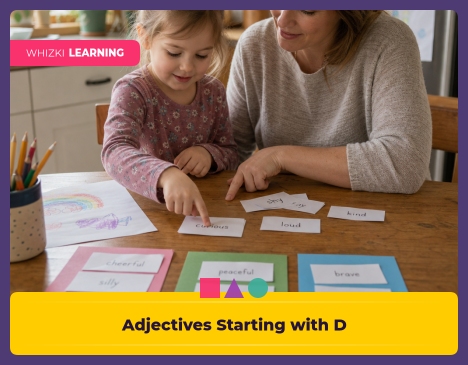
NAEYC guidance highlights how play and warm talk support social-emotional growth. When you use personality words, you help your child describe behavior in a way that feels respectful, not like a label.
Orton-Gillingham style teaching is all about clear, consistent language. You can keep it predictable by using the same sentence frame, “You are being determined,” or “That is a dependable helper,” then letting your child repeat the word.
Everyday words
- dependable
- determined
- daring
- diligent
- devoted
- discreet
- direct
- dutiful
Big words for curious kids
- discerning
- dogged
Quick fix for the “big words” pile: if a word feels too hard, keep the word cards anyway and let your child choose the easier D personality word first. Then, add one “stretch” word only when your child is calm and ready.
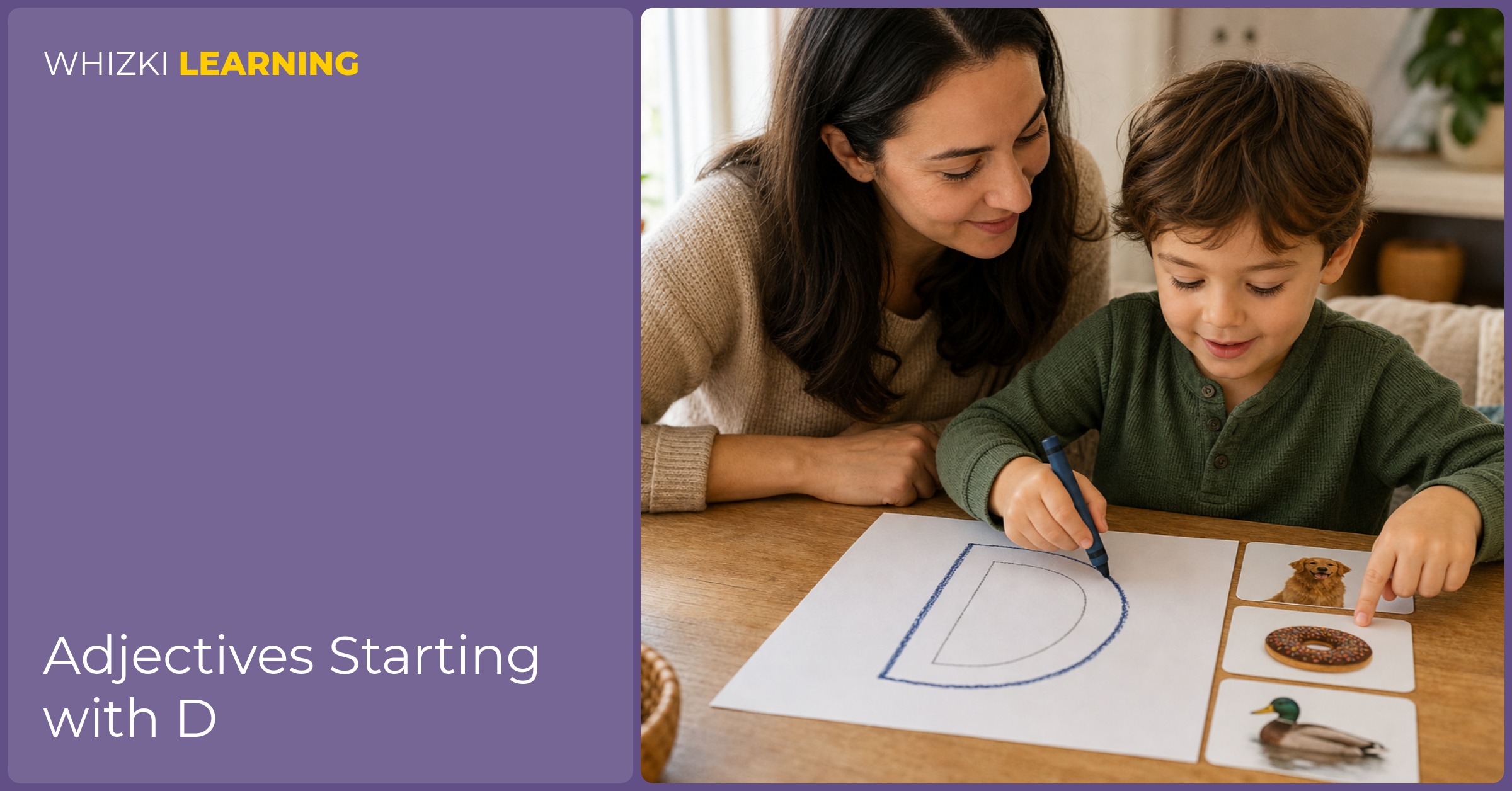
Want more early-reader practice? Add nouns and verbs starting with D to the same routine so your child hears a full set of word types, not just adjectives. For letter practice, trace the big D shape while saying the adjective word, then write it once on paper.
Whizki Learning has D-focused practice that pairs letter work with simple vocabulary, so your child can say the word, see it, and use it in a real moment. If you want a ready-to-go routine, visit the alphabet learning hub and pick the letter D activities for today.
If you want to keep the same practice going on paper, take a look at our alphabet tracing workbook for preschool and kindergarten.
Pair D adjectives with sight words for smoother talk
When children already know a few sight words, they can spend more brain energy on describing words. That is why sight-word practice matters alongside adjective talk, especially for children who get stuck when they are excited.
Use our sight-words printables to support quick reading, then add one adjective during the same activity. Example routine: “I see dark,” then your child points to the sight word card you read.
For a simple script, say, “Show me the dry towel,” then “Now say the D word.” If your child says a different adjective, celebrate the effort and repeat the correct D word once.
Before you end the day, do one last letter moment with the letter D. Trace the big D, then choose one adjective card and say, “I notice a dark thing,” or “I feel dizzy,” whichever fits the moment.