PreschoolKindergartenFirst Grade

Hard vs Soft C: The Easy Rule + Kid-Friendly Examples

Mar 23, 2026
Hard vs Soft C: The Easy Rule + Kid-Friendly Examples

During my years working with early readers, I have observed a predictable moment of frustration that almost every young child experiences. A preschooler masters the hard /k/ sound for the letter 'C' using words like 'cat' and 'cup', only to feel completely betrayed when they encounter words like 'city' or 'cent'. As a parent or educator, explaining why the phonetic rules suddenly shift can feel overwhelming. Early literacy teachers recognize that this specific transition point frequently causes children to lose their reading confidence and resort to simply guessing words based on pictures.

Fortunately, parents do not need to rely on rote memorization to help their children overcome this hurdle. The Orton-Gillingham methodology-a foundational approach used by literacy experts globally-utilizes a highly visual, consistent rule to decode the two sounds of the letter 'C'. This practical guide translates the 'Hard vs Soft C' rule into simple, tactile lessons that make sense to a five-year-old. By focusing on targeted, hands-on learning rather than digital reading apps, parents can equip their children with reliable tools to decode tricky words independently.

Understanding the 'Bossy Vowels' Rule for Letter C

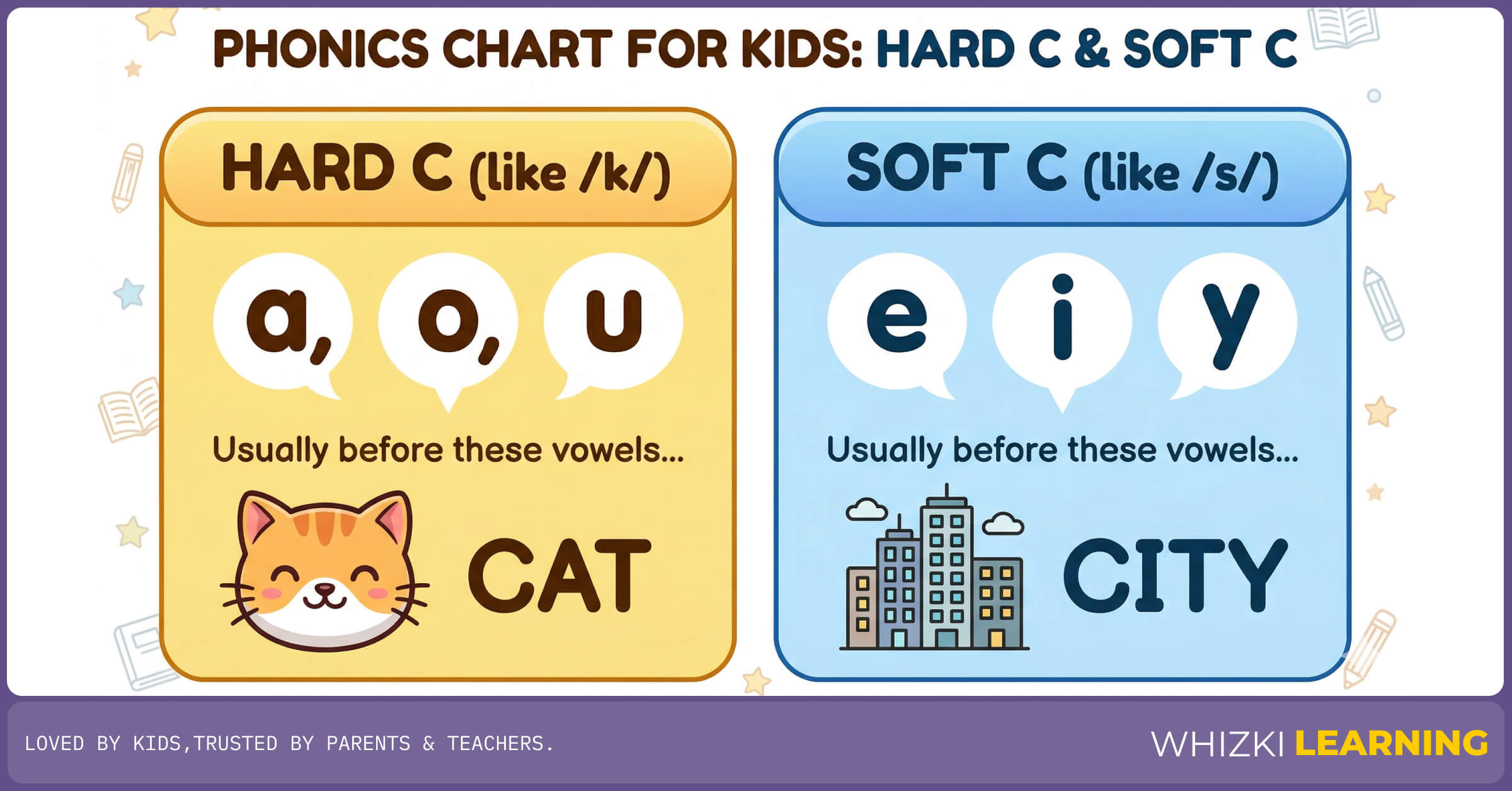
The pronunciation of the letter 'C' depends entirely on the specific vowel that directly follows it in a word. Literacy educators teach early readers to look for the 'bossy letters'-specifically 'E', 'I', and 'Y'. When the letter 'C' is immediately followed by an 'E', an 'I', or a 'Y', the letter 'C' produces a soft /s/ sound (as seen in the kid-friendly examples 'cent', 'city', and 'cycle'). This phonetic pattern remains incredibly consistent across thousands of common English words.

The hard /k/ sound serves as the default pronunciation for the majority of the alphabet. When the letter 'C' precedes the vowels 'A', 'O', or 'U', or when it precedes any consonant, the letter 'C' maintains its hard sound (as in 'cat', 'cot', and 'crab'). Before diving into complex exceptions, parents should ensure their child has mastered this foundational hard sound by utilizing resources like our dedicated Letter C learning hub, which provides comprehensive practice materials for early writers.

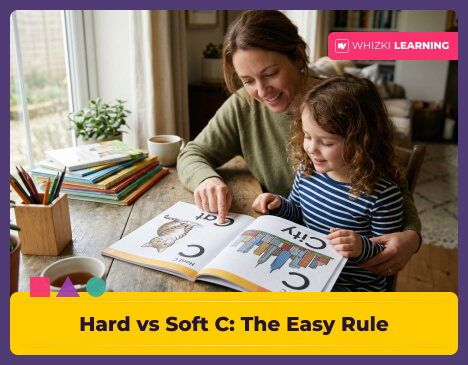
A colorful phonics chart showing the vowels that trigger the hard and soft sounds of the letter C, featuring a cute cat and a cityscape.

How to Teach Hard and Soft C Step-by-Step

A practical, teacher-tested sequence for teaching the Hard and Soft C phonics rule using tactile discrimination and visual highlighting.

1. The 'Cat vs City' Auditory Sort

Early readers must distinguish sounds auditorily before they can understand written spelling rules. Parents should verbally call out a list of simple 'C' words and ask the child to sort them by sound. The child takes a physical step to the left for a 'Cat' sound (hard C) and a physical step to the right for a 'City' sound (soft C). This gross motor activity allows the child to practice auditory discrimination without the pressure of holding a pencil.

2. The Magic Wand Highlighting Trick

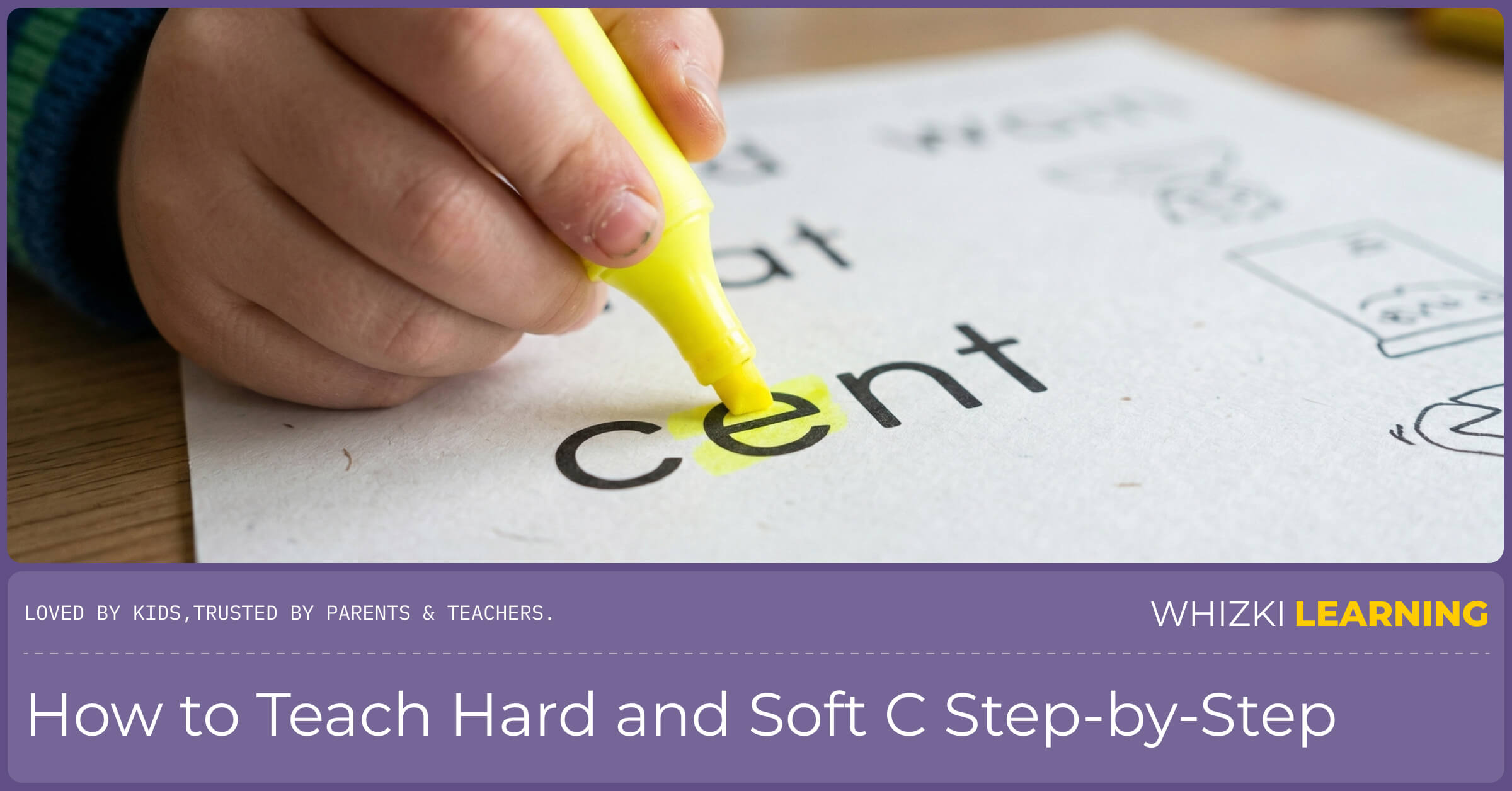
After mastering auditory discrimination, the child must learn to visually identify the 'bossy vowels' that change the sound. The parent writes several 'C' words on a piece of paper and provides the child with a bright yellow highlighter (the 'magic wand'). The child highlights the letter immediately following the 'C'; if the highlighted letter is 'E', 'I', or 'Y', the child draws a small circle around the word to indicate the soft sound. This tactile highlighting activity explicitly trains the child's eyes to scan the entire word rather than just guessing from the first letter.

3. Structured Tactile Practice

Transitioning from playful learning to focused, independent desk work solidifies the phonetic concept in the child's memory. Parents should introduce a high-quality printed workbook featuring specific 'C' sound matching exercises. The physical friction of tracing the letter 'C' while verbalizing the corresponding hard or soft sound builds essential muscle memory. This structured, screen-free practice environment prevents the digital distractions common with tablet-based reading applications.

A close-up of a child's hand using a bright yellow highlighter to mark the letter 'e' in a phonics workbook lesson.

Solidifying Phonics with Whizki Workbooks

Translating the Hard vs Soft C rule from short-term memory to permanent reading fluency requires high-quality tactile materials. Whizki printed workbooks feature engaging phonics activities printed on premium 120gsm paper, which delivers optimal physical friction for early writers. This specific thick paper prevents the child's pencil from slipping, reducing physical fatigue and allowing the child to concentrate entirely on decoding the words. By integrating Whizki workbooks into the learning routine, parents create a calm, analog environment where early readers can practice spelling rules with absolute confidence.

Patience Builds Lifelong Readers

Decoding English spelling rules is a complex cognitive process that requires significant patience from both the child and the parent. By explicitly teaching the 'Bossy E, I, Y' rule through interactive, hands-on activities, parents provide a reliable roadmap through the confusing landscape of early literacy. When children understand the 'why' behind a spelling change, they stop guessing and start reading with genuine, lasting confidence.

Count the Critters! Preschool Number Fun Worksheet Cover BackgroundCount the Critters! Preschool Number FunSpark big number adventures for little learners with the Whizki Learning Preschool Counting Worksheet. Children count cute objects, match numbers, and grow math confidence in minutes. Whizki Learning makes early math feel like play, not pressure.
Count & Play Safari: Numbers to 20 with Whizki Learning Worksheet Cover BackgroundCount & Play Safari: Numbers to 20 with Whizki LearningCounting to 20 turns into an adventure with Whizki Learning. Help a 6-year-old child spot, count, and write numbers using friendly objects and clear visuals. Whizki Learning makes early math feel playful and achievable.
Animal Counting Adventure with Whizki Learning Worksheet Cover BackgroundAnimal Counting Adventure with Whizki LearningSpark big number fun with Whizki Learning. Young mathematicians will count adorable animals, toys, and fruit while building real confidence with early numbers. Whizki Learning makes first math practice feel like playtime.

Frequently asked questions

Are there exceptions to the soft C rule that my child needs to memorize?

The soft C rule is actually one of the most reliable phonetic patterns in the English language, possessing extremely few exceptions compared to other spelling rules. Linguistic analyses indicate that the 'C followed by E, I, Y' rule applies consistently to nearly all common English vocabulary words introduced in elementary school. The only notable exceptions are a handful of foreign loan words, such as the Italian word 'cello', which produces a 'ch' sound rather than a soft 's'. Parents do not need to teach these rare exceptions during early phonics instruction; kindergarten and first-grade students should focus entirely on the primary rule until reading fluency is firmly established.

At what stage of reading should a parent introduce the soft C sound?

Parents should introduce the soft C sound only after the child confidently reads basic consonant-vowel-consonant (CVC) words. Educational literacy frameworks, such as the Orton-Gillingham sequence, structure phonics lessons to solidify the default hard /k/ sound first to prevent early reading confusion. Delaying complex rules allows the young reader to build foundational decoding confidence before tackling spelling exceptions. However, an immediate exception exists if the child's own name or a sibling's name begins with a soft C, such as 'Cecilia' or 'Cindy'. In these specific cases, parents should teach the soft sound immediately because personal relevance drastically accelerates the child's phonetic retention.

Do digital phonics games help children master the hard and soft C rules?

Digital phonics games provide less effective learning outcomes for spelling rules than physical, tactile sorting activities. Pedagogical research demonstrates that manually highlighting words on paper or physically sorting objects engages multiple sensory pathways, which significantly deepens a child's retention of abstract spelling rules. Swiping a smooth tablet screen requires minimal cognitive effort and fails to build the muscle memory associated with writing the letter 'C'. An exception can be made for high-quality audiobooks that model correct pronunciation, provided the child follows along with a physical printed text. Ultimately, analog activities utilizing paper and pencils remain the superior method for teaching reliable phonics skills.

Limited Time Sale
Kids’ Workbooks!

Boost your child’s skills with our discounted workbooks. Engaging activities for preschool, kindergarten, and grade 1 - now at special sale prices!

June Summer Activities Kindergarten to 1st Grade Workbooks... Workbook Cover BackgroundJune Summer Activities Kindergarten to 1st Grade Workbooks, Math, Reading Comprehension, Brain Quests, Writing, Science, Social Studies Summer Activities for Kids Learning ActivitiesPrevent the summer slide with our fun Summer Activities Workbook for kids moving from Kindergarten to 1st Grade! This screen-free book is pa...

-27% $10.99

List Price: $14.99
Buy Now
Summer Brain Activities Workbook for Kindergarten and Pres... Workbook Cover BackgroundSummer Brain Activities Workbook for Kindergarten and Preschoolers: Fun Learning with Coloring, Logic Puzzles, Brain Quests and Social Studies - Activities for Preschoolers and Kindergarten)Keep young minds active with our Summer Brain Activities Workbook for Kindergarten and Preschoolers! This screen-free book is packed with ha...

-45% $10.99

List Price: $19.99
Buy Now
Preschool and Kindergarten Math Workbook Ages 3-7: Fun Edu... Workbook Cover BackgroundPreschool and Kindergarten Math Workbook Ages 3-7: Fun Educational Practice for Pre-K and Kindergarten: Numbers, Counting, Time, and More: Includes Activities to Boost Early Math SkillsMake math fun with our Preschool and Kindergarten Math Workbook for ages 3-7! This screen-free book is packed with hands-on activities to bo...

-40% $8.99

List Price: $14.99
Buy Now
Kindergarten Arbeitsbuch für Vorschulkinder ab 5 Jahre: Za... Workbook Cover BackgroundKindergarten Arbeitsbuch für Vorschulkinder ab 5 Jahre: Zahlen Schreiben Lernen, Konzentration und Feinmotorik fördern, Logik Rätselspaß, Malen und 20 Zahlen und Sonderzeichen (German Edition)Help your child learn German numbers with our Kindergarten Workbook for preschoolers! This screen-free book is packed with hands-on activiti...

-19% $12.44

List Price: $15.44
Buy Now

Join the Screen-Free Movement.

Get exclusive activities, expert tips, and inspiration for a more meaningful, offline family life.

At Whizki Learning, we believe in the magic of unplugged learning. It's a chance for kids to build real-world focus, develop their imagination, and strengthen fine motor skills away from distracting screens. We’re a team of parents and educators pouring our hearts into creating beautiful, screen-free workbooks that spark real curiosity and joy. Each one is proudly printed in the USA, because we know quality you can feel makes all the difference in a child's hands. 
Copyright © 2025 Whizki Learning. All rights reserved.