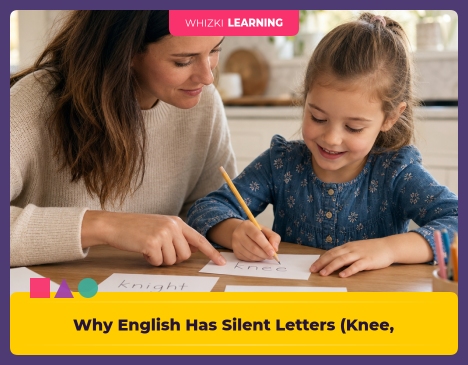
When a 5-year-old stares at the word knee like it’s a trick question, it can feel like you are the one being tested too. Take a breath, because silent letters are a normal part of English spelling, and you can teach them in a calm, kid-friendly way that builds confidence.
Reviewed by Sarah Mitchell, M.S., CCC-SLP, Speech-Language Pathologist.
Why English has silent letters (and why kids get stuck)
In early literacy, the goal is not to “catch” kids making mistakes, it is to help the child notice patterns. The Orton-Gillingham approach uses short, clear practice so spelling surprises feel more predictable over time, and silent letters are one of those surprises.
Silent letters happen when English spelling keeps older word history, even after pronunciation changed. When a child reads knee, the letter k is written, but the sound is not spoken, so the child needs a new rule, not more guessing.
For kindergarten and preschool teachers, NAEYC guidance reminds us to keep learning warm and interactive, not punitive. A simple routine, “Look, say, cover, write,” helps the silent letter feel like part of the word, not a personal failure.
Silent K patterns: know, knee, knife
Speech-language pathology practice often starts with consistent word-level teaching, because silent letters are easiest when a child learns them as part of specific words. A common silent K pattern shows up when k comes before n.
Two kid-friendly examples are knee and knife. In both words, the k is written, but the spoken sound starts with the vowel sound, so the child reads them without saying “kuh.”
One history note for families, English spelling kept the k from older pronunciation, and later the sound dropped while the spelling stayed. If you want more practice with letter patterns, visit our alphabet learning hub for classroom-ready ideas.
Silent B patterns: after M, like doubt and debt
Occupational-therapy basics for learning readiness include reducing frustration, because a child who feels stuck will avoid the task. When you teach silent letters with a quick, repeatable routine, the child can focus on the spelling pattern instead of the feeling of “I’m wrong.”
A common silent B pattern appears when b comes after m. Two examples are doubt and debt, where the b is written but not spoken.
A one-line history note, English kept the b spelling from earlier forms, even though pronunciation changed. Word practice can also connect to reading sight words, and our sight-words printables can help you build confidence alongside spelling work.
Silent C and CH patterns: cheers, chair, chess
In a Reggio-inspired classroom, teachers observe what children notice and then build small next steps. When a child asks “Why do we write it if we do not say it,” that question is a perfect doorway into a simple pattern lesson.
For the letter c, one common “quiet” moment is when c is followed by h, like in cheers, chair, and chess. In these words, the ch spelling works together, and the child does not say a separate “c” sound.
A one-line history note, English spelling for ch comes from older spellings that matched earlier sounds, and the modern pronunciation is now learned as a unit.
Silent P and PS patterns: psychology and receipt
Orton-Gillingham style teaching uses clear, multisensory steps, and silent letters are a great match for “see it, say it, trace it.” When the child can feel the spelling with a finger or pencil, the word becomes more memorable.
Silent P shows up in words that start with ps, like psychology and psyche. The spoken sound does not include a “puh,” so the child reads the word without saying the p.
Another example is receipt, where the p is written but not spoken. A one-line history note, many ps spellings come from older Greek and Latin word forms, and English kept the spelling even after pronunciation shifted.
Silent G patterns: foreign and gnome
Speech-language pathology practice often emphasizes accurate modeling, because children learn best when they hear one clear target pronunciation. When you teach silent g with a few consistent examples, the child stops guessing and starts recognizing.
Two examples are foreign and gnome. In both words, the g is written but not spoken, and the word begins with the vowel sound that follows.
A one-line history note, older pronunciations included a sound that later disappeared, while spelling stayed the same. If your child is building reading stamina, keep the practice short and successful, like a 2-minute word hunt with a clipboard or sticky notes.

What to say when a 5-year-old gets stuck on “knee”
When the child gets stuck on knee, you want a script that is kind and specific, not a lecture. The NAEYC guidance on supportive interactions fits here, because the child needs encouragement plus one clear next step.
Try this short table script, say it slowly and point to the letters: “Look at knee. We see a k, but we do not say it. We read the word starting with the vowel sound, so we say knee like ‘nee.’ Now let’s tap the letters, k-n-e-e, and then say the whole word together.”
Then add one quick check: “Show me with your finger where the sound starts.” If the child points to the k, gently redirect: “Good noticing. The sound starts at the n part for this word.” For extra practice, you can keep a small word list and revisit it daily, 2 minutes at a time.
Quick kid-friendly rules to remember
In a classroom or homeschool setting, the best silent-letter teaching is simple enough to fit into real routines. The Orton-Gillingham approach supports short practice cycles, so the child gets repeated exposure without long, tiring sessions.
Use these “one rule, two words” reminders: silent K before N in knee and knife, silent B after M in doubt and debt, and CH as a unit in cheers and chair.
One history note for the whole group, English spelling often keeps older letter choices even when pronunciation changes. When a child keeps struggling across many words, ask a speech-language pathologist or reading specialist for a quick screen, especially if the child also has trouble with rhyming, sound awareness, or decoding.
Whizki Learning can help you keep silent-letter practice consistent with printable word work. Try a quick daily set from the store so your child gets short, repeatable exposure to tricky spelling patterns.
Silent letters are not a character flaw, they are a spelling feature. When you teach a few patterns at a time, model the pronunciation, and give the child a quick way to check where the sound starts, the stuck feeling usually softens fast.
Keep the practice small, friendly, and repeatable, and let the child collect “word facts” like knee and doubt. If you want a steady routine, pair letter work with sight-word practice and celebrate progress, even when the spelling still looks a little sneaky.