
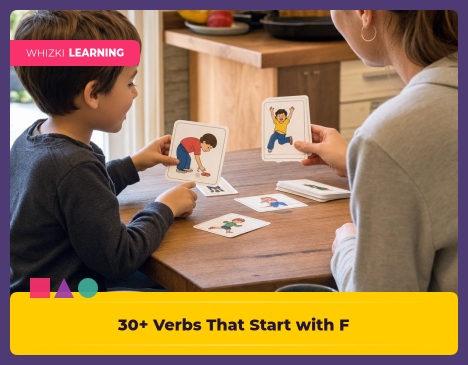
If your child turns letter practice into wiggling, bargaining, or couch climbing, start with five F action words your child can do right now. Action words give a busy 3- to 7-year-old a place to put that energy, and the F sound becomes easier to hear when the mouth, hand, and whole body are working together. Pick one group below, say the word slowly, and let your child act the sentence before any pencil work.
Reviewed by Whizki Editorial Team, Early Childhood Education Editors.
What F verbs are for young readers
F verbs are action words that begin with the /f/ sound. In an Orton-Gillingham lesson, the teacher connects sound, mouth shape, letter, and movement so the child has more than one path into the word. A parent can copy that rhythm at home by saying the sound, tracing F in the air, and acting the verb.
The letter F can feel friendly because the sound is easy to stretch, fffff, and the child can see the top teeth touch the lower lip. If the child is also collecting objects or picture names, keep that lesson separate with first words starting with F. If the child is describing a frog as fast or fuzzy, save that word job for describing words starting with F.
The letter-sound routine works best when the adult keeps practice short and playful, which matches NAEYC guidance about active, meaningful learning in early childhood. For a simple sound-and-letter warmup, pair the verb list with our letter F learning page. The alphabet page can sit beside the action list so the child sees the same letter while moving.
Body actions that start with F
Body verbs are my first choice when a child is wiggly because movement is not the enemy of reading. Occupational-therapy basics remind teachers to alternate big movement with small hand work, especially for children ages 3 to 7. A quick action before tracing can help the child settle into the next tiny task.
The body action list below uses short sentences because beginning readers need success without a long memory load. Say the verb, clap the syllables if the word has more than one beat, and act the sentence. Keep the action safe, soft, and silly enough for a kitchen or classroom rug.
Body action words
- Fall: Fall onto the pillow.
- Fly: Fly across the rug.
- Flap: Flap both silly arms.
- Flip: Flip onto your back.
- Flex: Flex your strong arm.
- Freeze: Freeze like a statue.
- Float: Float your hands slowly.
- Follow: Follow my quiet steps.
- Flee: Flee from the dragon.
- Face: Face the sunny window.
- Fidget: Fidget with your fingers.
- Fit: Fit inside the hoop.
- Fist-bump: Fist-bump your grown-up.
- Fan: Fan your warm face.
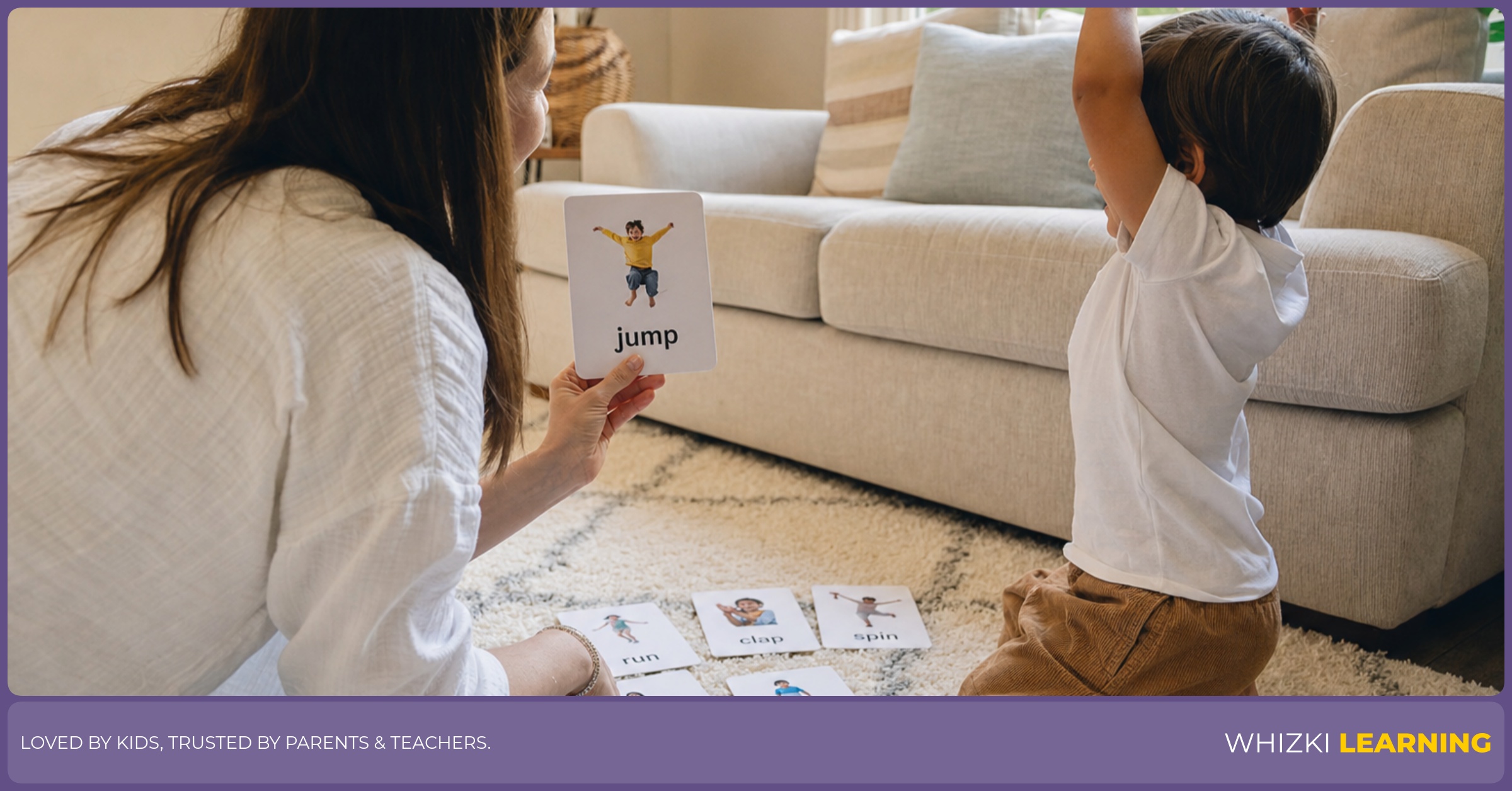
Print a matching page from our sight-words printables, then tape the F action sheet at child height on the wall. During cleanup or snack prep, point to one word, act the sentence together, and let the child trace the first letter with a finger.
Household actions that start with F
Household verbs help children hear that reading words live inside real routines, not only on worksheets. Montessori practical-life work uses child-sized jobs because useful hand work builds attention, order, and control. The same idea works with F verbs when the child handles a safe, real object.
NAEYC guidance also supports using familiar family life as early-literacy material. A child who helps at the sink, couch, or coat hook has a clear reason to listen to the word. Keep every job child-safe, model the action first, and stop while the child still feels successful.
Household action words
- Feed: Feed the hungry fish.
- Fill: Fill the blue cup.
- Find: Find your red sock.
- Fix: Fix the crooked blanket.
- Fold: Fold one small towel.
- Fluff: Fluff the couch pillow.
- Flush: Flush after using potty.
- Flick: Flick off the switch.
- Finish: Finish your snack plate.
- Fetch: Fetch a clean spoon.
- Fasten: Fasten your coat zipper.
- Frost: Frost the little cupcake.
- Freshen: Freshen the pet bowl.
Play actions that start with F
Play verbs work well because pretend play already carries story, movement, and language. In a Reggio-inspired classroom, the teacher watches the child closely and adds words to the play the child has already chosen. A parent can do the same by naming the action while the child handles scarves, blocks, playdough, or stuffed animals.
The play action list should feel light, not like a quiz. Say one word, act one sentence, and let the child change the prop if the play idea grows. The adult keeps the F sound clear while the child keeps ownership of the game.
Play action words
- Fish: Fish with a magnet.
- Flop: Flop on the beanbag.
- Fling: Fling the soft scarf.
- Finger-paint: Finger-paint three red dots.
- Fiddle: Fiddle with the puzzle.
- Form: Form a playdough snake.
- Fumble: Fumble the big ball.
- Flash: Flash a happy grin.
- Feast: Feast at teddy picnic.
- Fake: Fake a dinosaur roar.
- Flutter: Flutter like a butterfly.
- Fry: Fry a pretend egg.
F verb charades and tracing
F-verb charades gives a child a reason to listen closely before reading or writing. Speech-language pathology practice often uses model, wait, and expand, which means the adult shows the word, pauses for the child, then adds a tiny bit of language. A parent can keep the game warm by praising clear effort instead of perfect performance.
The charades routine also fits the Orton-Gillingham idea of multisensory practice. The child hears the sound, sees the letter, moves the body, and then traces the word. Four minutes is enough for many preschool and kindergarten learners.
Act-it-out charades game
- Choose six slips from one group above.
- Place the slips face down in a bowl.
- Let one child pick, listen, and act.
- Have the watcher guess the action word.
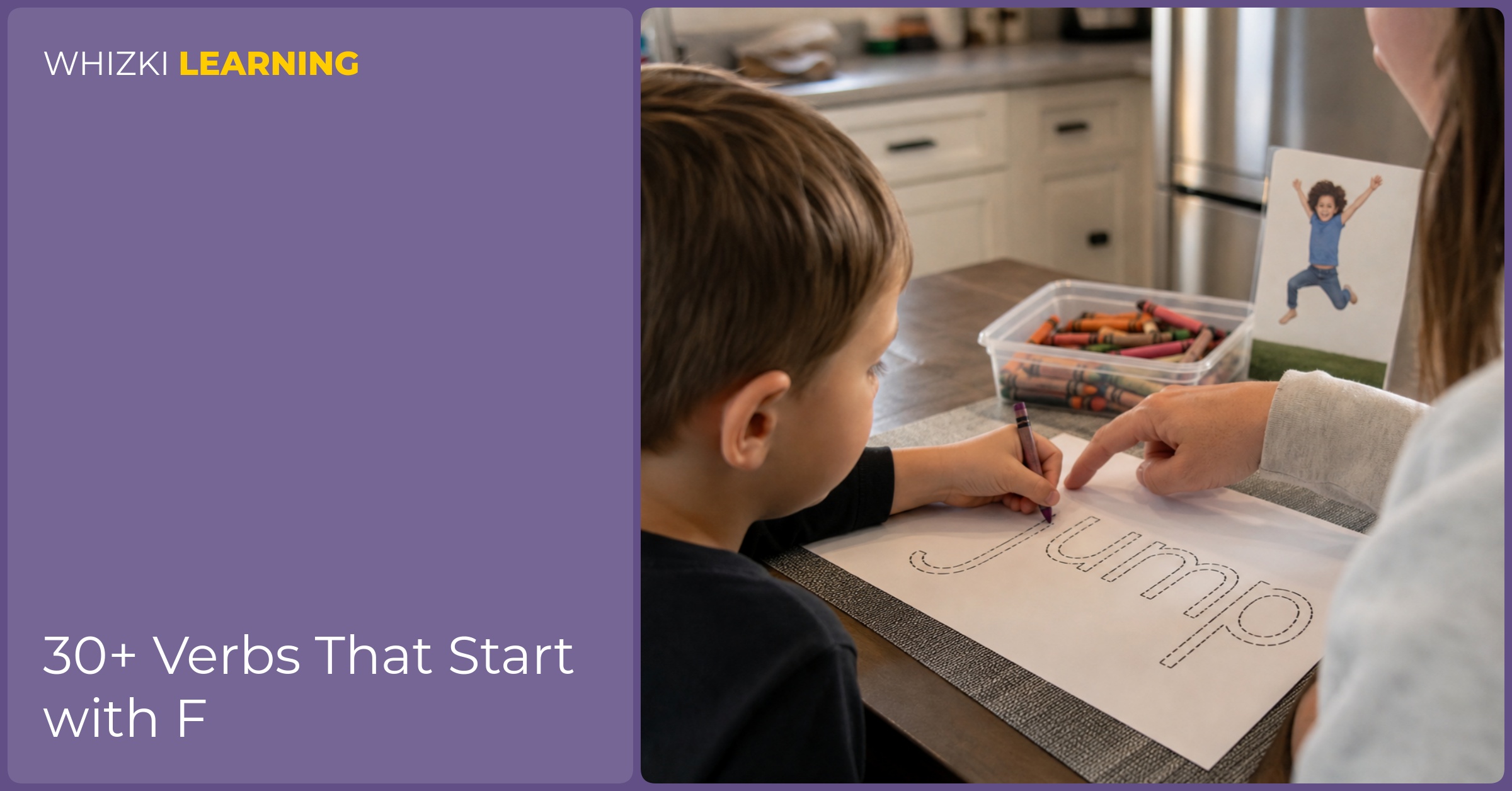
The trace-the-word tip is simple: write one F verb in large letters on paper, and place a crayon dot where the child should start. The child traces the first letter with two fingers before using a pencil or crayon. If pencil grip is tiring, let the child trace in salt, on carpet, or on a steamed mirror first.
What to practice next
The next step is to choose five verbs that match the child's real day, because Reggio-inspired observation starts with what the child is already doing. A child who loves couch cushions may need body actions, while a child who helps in the kitchen may remember household actions first. A teacher can rotate one group per week and revisit older words through quick acting, not long quizzes.
The F verb list does not cover naming words or describing words because young children learn word jobs more clearly when the jobs are not mixed too fast. Montessori-style three-period language can help: the adult names the word, asks the child to show the word, and later asks the child to name the word. A parent can say that a verb tells what someone does, then point to the body doing the action.
Keep F verb practice small: one sound, one word, one action, and one quick trace. The routine can happen while shoes go on, soup cools, or blocks get put away. A child who laughs and moves while hearing the /f/ sound is building the kind of word memory that early reading can use.