
Some days it feels like you are repeating the same words over and over, and your child still looks unimpressed. When you keep it simple and hands-on, letter F vocabulary becomes a calm routine instead of a battle. Today, you will pick a few F words, practice them for a few minutes, and move on.
Reviewed by Sarah Mitchell, M.S., CCC-SLP, Speech-Language Pathologist.
Why letter F first words feel easier with play
In an Orton-Gillingham style approach, the letter sound and a small set of words get repeated in short, predictable turns, so your child is not guessing. Letter F practice works best when you connect the sound to something concrete in the room, like a fan or a fish.
In NAEYC guidance, learning sticks when children have active involvement, not just listening. A quick “touch and say” routine helps your child build confidence, because the word has a real job in daily life.
In occupational-therapy basics, sensory input matters, so hands-on practice supports attention and memory. When your child points, taps, or holds the object while saying the word, the brain gets more hooks to remember it.
In speech-language pathology practice, clear modeling and consistent word use help children map sounds to meaning. Keep the practice to a few words at a time, then give a break so the words do not blur together.
Everyday F words your child can touch
In a Reggio-inspired classroom moment, children learn vocabulary by exploring materials with their senses. Choose 6 to 10 everyday objects and let your child handle them while you say the word slowly.
In NAEYC play-based learning, object talk during real routines is more motivating than worksheet talk. Use the same words during cleanup, bath time, and snack time so letter F stays connected to life.
Everyday words
- fan
- fish
- fork
- faucet
- floor
- foot
- frame
- fence
- fire
- flag
Big words for curious kids
- forest
- furniture
- feather
- fountain
- fort
- fossil
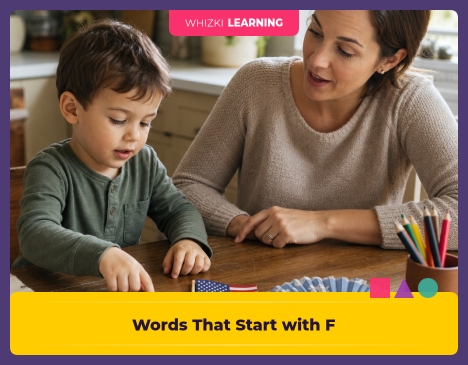
Tip for the kitchen table, hold one object at a time and ask for one response, “Show me fork,” then celebrate the try. If your child misses, model the word again and move the object closer to their hands.
Action F words your child can do
In an Orton-Gillingham approach, action words work well because the child can watch, then do, then say. Pick 4 to 8 verbs and practice them during movement breaks, like blowing bubbles or building blocks.
In NAEYC guidance, children learn best when adults join the play and keep language connected to the moment. When the verb matches what the child is already doing, the word becomes easy to use.
In occupational-therapy heuristics, movement supports regulation, so action-word practice can be a win for attention. If your child is wiggly, choose verbs that match the energy, like bounce or blow.
Everyday words
- fan
- feed
- fill
- fold
- flip
- fix
- fry
Big words for curious kids
- fumble
- fascinate
- foster
- fashion
Script you can use, “First we fill, then we fold.” After your child tries, pause and let the action finish, then repeat the verb one more time.
First names that start with F
In speech-language pathology practice, familiar names reduce guessing because the child already knows who the word points to. Use names during pretend play, like “Bring the book to Frank.”
In NAEYC social learning, names help children practice turn-taking and listening. When the adult uses the name consistently, the child learns that words carry meaning in conversation.
In a Reggio-inspired home setup, children can help create a “name wall” with sticky notes. Add a few F names and let your child point to the name when it is called.
Everyday words
- Frank
- Fiona
- Felix
- Faith
- Finn
- Freya
Big words for curious kids
- Fletcher
- Frances
- Felicity
- Ferdinand
Tip for quick success, choose one name and use it in two short pretend scenes the same day. If your child loves it, keep the name practice going for one more day, then rotate to a new F name.
Whizki Learning has our sight-words printables to pair with letter F word practice, so your child gets repetition without the pressure. Add a few F words from this post, then let the printable do the steady review work while you keep the tone light.

Spot the F word walking game, plus flashlight bedtime
In NAEYC play-based learning, a scavenger-style game turns vocabulary into a shared mission. Walk for five minutes and look for one F object each time you pass something you can name, then celebrate the find.
In occupational-therapy basics, short movement breaks help kids stay regulated, so the game can be a natural attention reset. If your child gets distracted, switch to “point and say” only, no extra questions.
In speech-language pathology practice, consistent modeling helps children hear the word clearly. Say the word once, then ask your child to repeat it, and keep the turn short so the game stays fun.
For bedtime, use a flashlight and do “F in the room,” shine the light on one object that starts with F, then say the word together. If your child is tired, choose only 3 words and end the game before frustration starts.
When your child is ready to add more language, try describing words starting with F so the new vocabulary can grow into sentences. For letter shape practice, use our letter F learning page to connect the sound to the written letter.
Pick one routine, like bath time or cleanup, and practice the same small set of F words for two days. When your child uses a word on their own, treat it like a win and keep the next practice just as simple.