
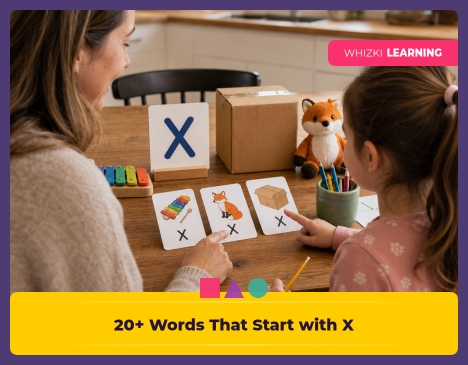
Some days it feels like every letter except X is “easy,” and you are stuck searching for words your child can actually use. Let’s make letter X feel doable with a small set of real, everyday words and a quick game you can run in minutes, following the alphabet learning hub rhythm.
Reviewed by Sarah Mitchell, M.S., CCC-SLP, Speech-Language Pathologist.
Letter X first words, built for real life
When you teach letter sounds and early vocabulary the Orton-Gillingham way, you keep it short, consistent, and connected to what the child can see and touch. Letter X is a tough one for many kids, so the goal is not perfection, it is repeated success with X words across the day.
For preschool and kindergarten routines, NAEYC guidance points to play-based learning and meaningful language, not worksheets-only practice. The word lists below are meant for kitchen-table talk, classroom centers, and quick at-home games, so your child hears the words again and again.
If you want extra support, occupational-therapy basics remind us that “doing” helps learning, so pair each word with a small action, like pointing, tapping, or moving a toy. That is how the words stick without turning the moment into a battle.
For letter-shape practice, use our letter X learning page alongside these first words, so your child gets both the sound and the visual.
Want more practice that stays hands-on? Try our sight-words printables to pair familiar words with simple routines, then add these X words during snack, bath time, and cleanup.
Everyday objects that start with X
In Reggio-inspired teaching, the classroom environment is part of the lesson, so these X words connect to things your child can reach and notice. Keep it concrete, point with a finger, and let your child touch the object or picture.
Everyday words
- xray
- xylophone
- xmas
- xylitol
- xenon
- xylem
- xenial
- xerox
Big words for curious kids
- xeric
- xerophyte
- xanthic
- xiphoid
- xenophile
- xenophobia
- xylotomy
Tip script for parents: “I spy something that starts with X. Touch it, then say the X word with me.” If your child skips a word, you model it once and move on, speech-language pathology practice supports that kind of low-pressure repetition.
Action words that start with X
Action words are perfect for short, embodied practice, and occupational-therapy basics say movement supports attention and language. Pick one action word for the moment, do it together, and then let your child try.
Everyday words
- x-ray
Big words for curious kids
Tip script for parents: “Show me how you would do that X action.” If your child gets stuck, you do the action first, then you ask for the word, that sequencing matches how many speech-language pathologists build confidence.
First names that start with X
Common names help kids practice vocabulary with people they can picture, and NAEYC encourages using familiar social language in play. When you use a name, keep it warm and real, like you are calling someone over for a quick turn.
Everyday words
- Xander
- Xavier
- Ximena
- Xiomara
- Xena
Big words for curious kids
- Xzavier
- Xzena
- Xyrena
- Xanthe
- Xanthea
- Xylia
Tip script for parents: “If your name started with X, what would you want to do first?” Then let your child answer, and you repeat the name back clearly.
Spot the X word walking game
For a quick walking game, use the “spot, say, touch” routine, which fits Reggio and Montessori-style observation. You are not testing, you are noticing, and that matters for kids who get tense when they feel evaluated.
How it works: pick one X word from the lists, then walk room to room and “spot” something that reminds your child of that word. You can also spot the letter X on a sign, book cover, or label, then celebrate the find.
Keep it short, 3 to 5 minutes, and end while your child still wants more. That is how you protect motivation and make the next practice feel easy.
Flashlight bedtime variation for letter X
At bedtime, use a calm, low-effort routine, and keep language playful, not pressured. Speech-language pathology practice often recommends brief, predictable interactions because kids learn language through repeated, comfortable exposure.
Variation: turn off the main lights, use a flashlight, and let your child “hunt” for the letter X on a page, a toy box, or a book cover. Each time your child finds an X, you say one X word, then your child repeats it once.
If your child is tired, you can skip the repeating and just label the X word clearly. The goal is a warm finish and a brain that is ready for tomorrow’s practice.
For tomorrow, choose one list word and use it three times during daily routines, like “xylophone” during music time or “Xander” when you line up. The alphabet learning hub works best when you keep it consistent, so letter X gets the same kind of steady attention as the other letters.
If you also want describing words, add describing words starting with X on a different day, so your child does not have to carry two new vocabulary jobs at once.
And if you are thinking, “My child is not ready,” you are not failing, you are adjusting. Start with one word, one moment, and one kind voice, then let the practice grow when your child shows interest.