PreschoolKindergartenFirst Grade

40+ Words That Start with H: First Words for Kindergarten Readers

May 29, 2026
40+ Words That Start with H: First Words for Kindergarten Readers

Some days it feels like every new word turns into a power struggle at the table, and you just want learning to feel calmer. Introducing a small set of H words with hands-on moments helps kids stay engaged while you keep expectations realistic.

Reviewed by Sarah Mitchell, M.S., CCC-SLP, Speech-Language Pathologist.

For letter-shape practice, use our letter H learning page and then bring the sound to life with a few everyday words.

Start with a pace your child can handle

In the Orton-Gillingham approach, the adult keeps the routine steady and the child gets short, successful turns, so learning feels doable instead of heavy. When you add H words right after G, give a little breathing room so the new sound and new word forms do not blur together.

In NAEYC guidance, play and meaningful interaction come first, so the letter work stays connected to real life. A quick “say it, touch it, do it” cycle works well for ages 3-7, especially when the child is already comfortable with basic letter sounds.

In occupational-therapy basics, attention improves when the body gets a job, like pointing, carrying, or tapping the page. If your child loses focus, switch from sitting to moving and keep the word list small for that day.

In speech-language pathology practice, repetition is helpful when it is varied, not when it is forced. Try one object, one action, and one name across the day, then stop while your child still wants “one more.”

Everyday H words kids can touch

In Reggio-inspired teaching, the classroom and home become the “materials,” so children learn vocabulary through noticing and handling. Pick 6 to 10 H words from the list below and put them in your child’s real routines.

In a Montessori-style observation, the child learns best when the adult offers clear, concrete choices. When the child reaches for the object, the adult labels it once, then waits for the child’s turn to say it.

Everyday words

  • hat
  • house
  • hut
  • horse
  • high
  • hop
  • book
  • ball
  • bath
  • boat

Big words for curious kids

  • hay
  • hen
  • heart
  • hip
  • hit
  • hide

Tip for the kitchen table, hold up the object for one second, say the word, then ask for a “show me” moment, like “Show me the hat.” If the child is not ready to say it yet, the child can point, and the adult still counts that as a win.

Action H words for what kids do

In the Orton-Gillingham approach, action words stick when the adult models them clearly and the child gets a turn right away. Keep the actions short, like one breath, one bounce, one bake step, and then switch to the next.

In NAEYC guidance, movement-based learning supports engagement for young children. When you pair H words with body actions, the child hears the sound and feels the meaning.

Everyday words

  • help
  • have
  • has
  • hurt
  • hunt
  • hide
  • hurry
  • haze

Big words for curious kids

  • happen
  • hasten
  • harvest
  • harness
  • hover
  • hatch

Script you can use while you play, “I will hide the toy, your turn, you hide it.” If your child gets frustrated, slow down and do the action together once, then try again.
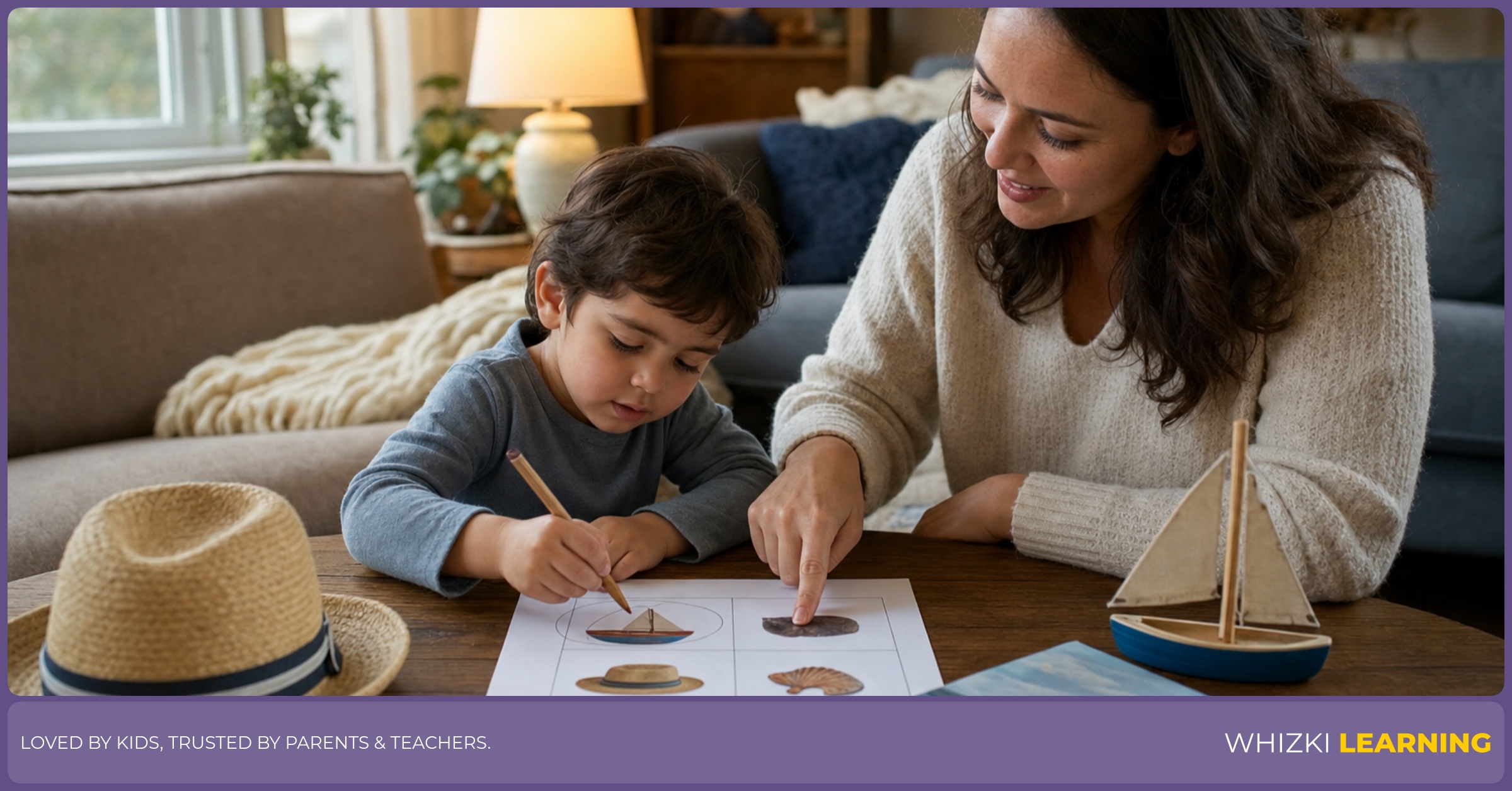
A parent and child sit at a low table, touching a hat and book while practicing H words on paper with a pencil.

First names that start with H, plus a quick printable boost

In speech-language pathology practice, familiar names are powerful because children already care about them. When a name starts with H, the child hears the sound in a meaningful way, not as an isolated letter.

In NAEYC guidance, adults support language growth by building on what children already know. If your child is ready for more practice, add a short sight-word routine using our sight-words printables for quick, low-pressure review.

In the Reggio approach, the adult notices what the child is drawn to and then adds language around it. If your child loves a certain character or friend, use that name as the anchor for the H sound.

Everyday words

  • Hal
  • Hank
  • Hannah
  • Harper
  • Henry
  • Hope

Big words for curious kids

  • Hector
  • Helena
  • Hugo
  • Holly
  • Hunter

Quick tip for the alphabet routine, add one name to the day’s check-in, “Henry, can you help me?” Then point to the letter H on the alphabet learning hub when your child is calm and ready.

Whizki Learning makes it easier to keep practice short with printable activities that match early literacy routines. Pair the H word list with a simple worksheet from the letter H learning page so your child gets consistent, hands-on repetition.
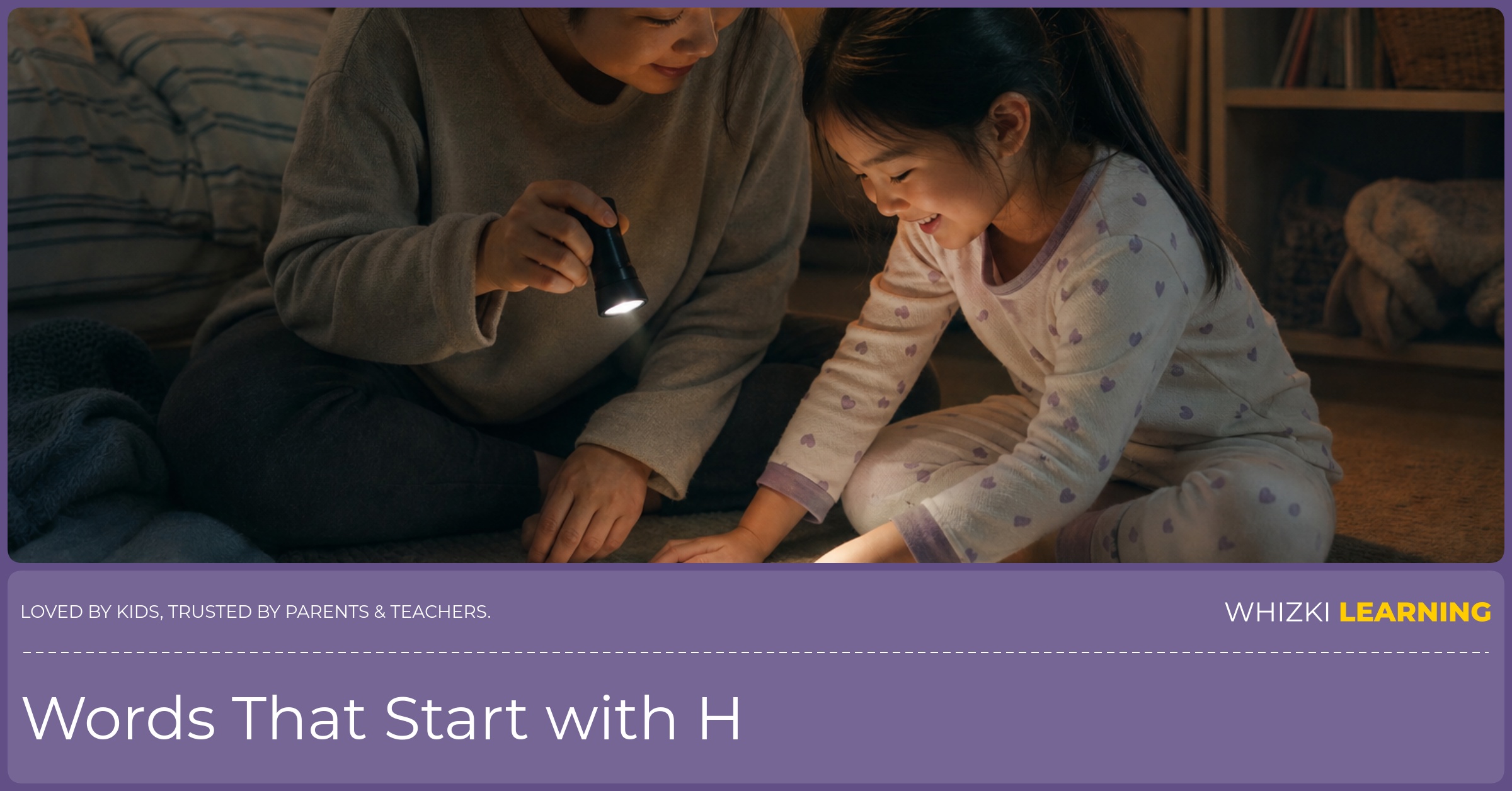
A parent and child play a flashlight game at bedtime, pointing to H words on paper and tracing the letter H.

Try the Spot the H word walking game, pick one H word for the day, like hat, and then walk through the house saying, “Do you see something that starts with H?” When your child spots it, the child gets to touch it and say the word once, then the next spot is the next word.

For bedtime, do the flashlight H variation, place 6 H word cards on the floor, and let the child use a small flashlight to “find” one card at a time. Each find is one word, then one deep breath, then the card goes away, and the routine stays short.

If your child is asking for more “H words,” add describing words starting with H so the child can say what something is like, without turning today’s lesson into a long list.

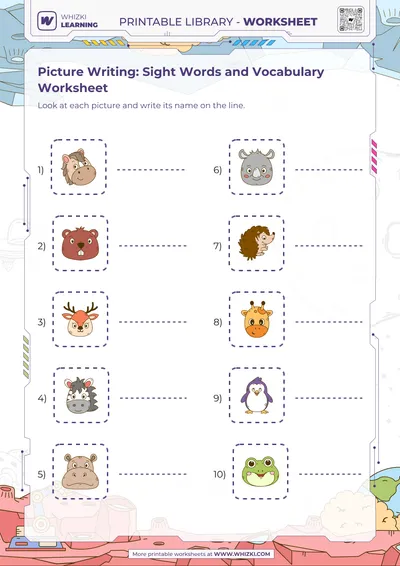
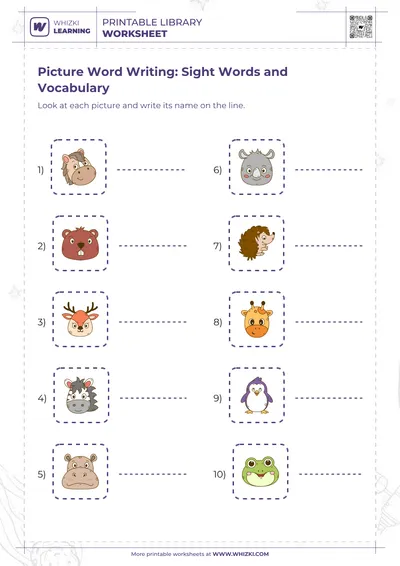
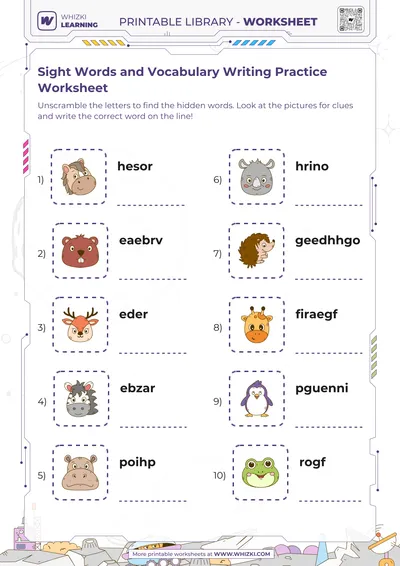
Sight Words and Vocabulary Writing Practice Worksheet Worksheet Cover BackgroundSight Words and Vocabulary Writing Practice WorksheetSome kids stall on letter shapes, and five-year-olds get bored fast before the word feels familiar. Use this Whizki Learning page by saying the word, matching it to the picture and scrambled letters, then letting your child write it once on the line. Stop after one word, even if the page has more.
Sight Words and Vocabulary Word Search Puzzle for Kinderga... Worksheet Cover BackgroundSight Words and Vocabulary Word Search Puzzle for KindergartenKids often stall on letter shapes or get bored fast with flashcards. The Sight Words and Vocabulary Word Search Puzzle from Whizki Learning is a screen-free next step: circle one word, say the word out loud, then hunt for the next word with a calm second round.
Sight Words and Vocabulary Word Writing Practice Worksheet Cover BackgroundSight Words and Vocabulary Word Writing PracticeFive-year-olds can stall when letter shapes feel confusing, or get bored before a word feels familiar. This Whizki Learning page pairs a picture with a scrambled-letter hint, then offers one writing line to finish together.

Frequently asked questions

What if my child mixes up H with other letters?

Mixing up letters is common when new sounds are added too quickly. Short practice sessions with real objects and a pause between letters help the brain sort the differences, and you can ask a speech-language pathologist for guidance if confusion stays strong over time.

How many H words should I teach in one day?

Teach about 6 to 10 H words in a day, then stop while your child is still interested. Repetition with movement and quick turns works better than long lists, and a pediatric speech-language pathologist can help if your child needs a slower plan.

When is a good time to practice H words?

A good time is when the child is fed, rested, and not rushing into a transition. Practice works best right after a routine like snack or bath, and you should ask an occupational therapist for strategies if attention and sensory needs keep getting in the way.

Where can I use H words besides the table?

Use H words during everyday moments like dressing, cleaning, and play. The adult labels once, then the child points or does the action, and you can talk with a speech-language pathologist if the child avoids speaking during these moments.

Can my child learn H words without writing them yet?

Yes, children can learn H words through speaking, pointing, and touching before they write. Letter-sound learning and vocabulary can come first, and you can ask a teacher or speech-language pathologist about readiness if writing is causing stress.

Limited Time Sale
Kids’ Workbooks!

Boost your child’s skills with our discounted workbooks. Engaging activities for preschool, kindergarten, and grade 1 - now at special sale prices!

June Summer Learning Workbook for Kindergarten to 1st Grad... Workbook Cover BackgroundJune Summer Learning Workbook for Kindergarten to 1st Grade: Math, Reading, Writing, Science, Brain QuestsA workbook for the slow weeks of June. Reading, math, writing, science, and brain quests for kids stepping from kindergarten into 1st grade.

-27% $10.99

List Price: $14.99
Buy Now
July Summer Learning Workbook for Kindergarten to 1st Grad... Workbook Cover BackgroundJuly Summer Learning Workbook for Kindergarten to 1st Grade: Alphabet Tracing, Math, Numbers, Preschool ActivitiesA July workbook for the middle of summer. Alphabet tracing, early math, number practice, and pencil work for kids moving from kindergarten i...

-27% $10.99

List Price: $14.99
Buy Now
August Summer Learning Workbook for Kindergarten to 1st Gr... Workbook Cover BackgroundAugust Summer Learning Workbook for Kindergarten to 1st Grade: Numbers Tracing, Alphabet, Writing, Science, Social StudiesAn August workbook for the last stretch of summer. Number tracing, alphabet review, writing, science, and gentle social studies for the week...

-27% $10.99

List Price: $14.99
Buy Now
Animal Coloring Adventures Workbook for Kids Ages 3-7: Fac... Workbook Cover BackgroundAnimal Coloring Adventures Workbook for Kids Ages 3-7: Facts, Mazes, Quizzes, and Coloring ActivitiesAn animal-themed coloring and brain-quest book for ages 3 to 7. Facts, mazes, and quizzes about jungle, ocean, and backyard animals.

-31% $8.99

List Price: $12.99
Buy Now

Join the Screen-Free Movement.

Get exclusive activities, expert tips, and inspiration for a more meaningful, offline family life.

Copyright © 2025 - 2026 Whizki Learning. All rights reserved.