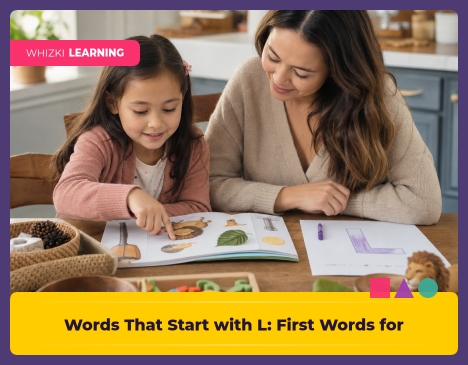
Some mornings you just want your child to talk and read a little, and the alphabet feels like one more thing on your plate. Letter L can be simple when you pick a few everyday words and practice for a few minutes at a time. Our letter L learning page can guide the sound and shape, so the practice feels steady, not random.
Reviewed by Sarah Mitchell, M.S., CCC-SLP, Speech-Language Pathologist.
Start with ready-to-learn L words
Letter L vocabulary works best when preschool and kindergarten kids already recognize letter sounds, which matches the Orton-Gillingham idea of small, clear steps. When the child can say the letter sound and point to the letter, the brain has an easier job attaching meaning to sound. Our letter L learning page at our letter L learning page can help you keep the practice consistent.
Letter L word practice also fits NAEYC guidance for short, playful learning moments, because kids learn more when the activity stays connected to real life. A quick routine, like choosing three L words from the day’s list and using them during play, keeps vocabulary from feeling like homework. If the child gets frustrated, the routine can shrink to one word, one time, and one calm try.
Letter L is a great place to use occupational-therapy basics for attention and sensory comfort, like steady pacing and hands-on input. A child can touch a log picture, hold a book, or point to a lotion bottle in the bathroom, then say the word once. The goal is clear repetition, not long explanations.
Letter L word practice can also be supported by speech-language pathology strategies like modeling and immediate use in a sentence. A caregiver can model, “I see the lion,” then ask for one word back, like “Say lion.” When a child mixes up sounds or avoids speaking, a caregiver can pause and try again later the same day.
Everyday L words kids can touch
Letter L everyday nouns are easiest when a child can see and handle the item, which aligns with Reggio-inspired learning through real materials. Pick a few objects from the list, keep them in the same spot, and let the child reach and point. Sight word and vocabulary practice can pair well with these tangible nouns, especially with repetition across days.
Letter L nouns also connect to early literacy because naming objects builds the vocabulary a child uses to understand simple text. For more practice routines and printables, check our sight-words printables for quick, kid-friendly ideas.
Everyday words
- lamp
- lady
- lion
- log
- lunch
- leaf
- lace
- lock
Big words for curious kids
- lizard
- litter
- lost
- light
- listen
- lips
- lily
Letter L everyday nouns work best with a simple script, “Touch it, say it, and put it back,” which keeps the learning moment predictable. When a child says the word, a caregiver can celebrate the effort, then use the word again during the next minute of play. If the child is not ready, the caregiver can model the word and let the child point instead.
Action L words for what kids do
Letter L action verbs are powerful because kids can act them out, which matches the NAEYC idea of learning through doing. When a caregiver says an action word and the child copies it, the word sticks faster than a worksheet alone. Action practice also supports language planning, a common speech-language pathology focus for young learners.
Letter L verbs are also a good fit for Orton-Gillingham-style repetition, because the same simple structure can repeat across different days. A caregiver can keep the sentence frame the same, “I can listen,” then swap in one action word. This keeps the child from chasing new patterns while learning new vocabulary.
Everyday words
- lick
- like
- look
- lose
- lift
- light
Big words for curious kids
- listen
- link
- laugh
- lead
- leave
- lock
- latch
Letter L action words become a game when a caregiver uses a quick “Do it, say it” routine. Caregiver says the verb, child does the action, caregiver repeats the verb once, then the activity moves on. When the child refuses, the caregiver can lower the demand by having the child choose between two actions.
First names that start with L
Letter L first names are a friendly way to practice vocabulary with real identity, which fits Reggio-inspired respect for the child as a whole person. When a child hears a familiar name, the child pays attention because the word connects to relationships. Occupational-therapy basics also support this approach, because familiar social cues can calm transitions and reduce “shut down” moments.
Letter L names can also support early reading confidence, because names appear in books and classroom signs. A caregiver can use names during morning routines, “Lena, your shoes,” then pause for the child to respond with one word, “Lena.” This kind of back-and-forth mirrors speech-language therapy practice for turn-taking and purposeful language.
Everyday words
- Lady
- Lily
- Lucy
- Leo
- Lou
- Laura
Big words for curious kids
- Lin
- Leah
- Lola
- Logan
- Landon
- Lincoln
Letter L names work great with a calm walking routine, “Find the L name,” where the child points at a family photo, a book character, or a name card. When the child points, the caregiver says the name once and then asks, “Your turn, say it.” If the child is not ready to say the name, pointing is still a win.
Whizki Learning supports quick practice with kid-friendly printable activities, so letter-sound work stays short and doable on busy days. For more vocabulary practice routines, visit the alphabet learning hub and pick a single page to match today’s letter L words.
Try this “spot the L word” walking game tonight, it takes two minutes and feels like play. Caregiver says, “I’m looking for an L word,” then the child spots an object in the room that matches the list, like lamp or log, and the child says the word once. For a bedtime variation, use a flashlight and do “L word hunt,” caregiver shines the light on a book, a picture, or a familiar item, and the child names the matching L word before the lights go out. If you want more word practice, describing words starting with L live on the sibling page at describing words starting with L, and those adjectives can come next after the nouns and verbs feel steady.