Some days it feels like every new word turns into a battle at the kitchen table, and you just want your child to cooperate. When you keep it short, hands-on, and predictable, learning words that start with K can feel calm and doable.
Reviewed by Sarah Mitchell, M.S., CCC-SLP, Speech-Language Pathologist.
Start with the letter K sound and 1 tiny routine
In early literacy, the letter K sound is the anchor, and a simple routine helps children notice the pattern without pressure, which matches an Orton-Gillingham style approach of clear, repeated sound-to-word practice. Before you teach any K words, say the sound once, then point to the letter K on paper or a card.
In NAEYC-aligned practice, children learn best when adults keep activities brief and responsive to attention, so aim for 2 to 3 minutes and stop while your child still wants more. After that, connect the sound to one real object word from the list, like key or kite, and let your child touch it if you can.
In speech-language pathology practice, many kids benefit from hearing and saying the same word in the same way, so use a consistent script: “I see a key. Your turn, key.” Then celebrate the attempt, even if the sound is close.
If you want a quick visual for letter formation, use our letter K learning page for K shape practice alongside these first words.
Everyday K words your child can touch
In Reggio-inspired teaching, children learn vocabulary through real experiences, so everyday objects make K words easier to remember than words pulled from a worksheet alone. Pick 6 to 8 object words and keep them in your home “word rotation” for a few days.
In occupational-therapy basics, hands-on input supports attention, so let your child hold the object, point to it, or help you “find it” around the room. When your child is ready, ask one simple question: “Where is the ball?”
Everyday words
- ball
- bear
- banana
- book
- bath
- boat
- kite
- key
- kit
- knee
Big words for curious kids
- knob
- knock
- knot
- knuckle
- kind
- kid
- kitten
Try this quick script during play, “Touch the ball. Ball starts with K.” Then repeat the same pattern with one new object word the next day.
Action K words for play and routines
In an Orton-Gillingham approach, verbs are powerful because they connect language to movement, so your child can “show” the word with their body. Choose 4 to 6 action words and practice them during a real moment, like baking, cleaning, or outside play.
In NAEYC guidance, children learn best when adults model, then invite participation, so you can do the action first and then hand the turn to your child. Keep the language simple, “I kick the ball. You kick.”
Everyday words
- kick
- keep
- know
- knock
Big words for curious kids
- bake
- bring
- blow
- build
- bounce
- ketchup
- kindle
Use the “do it, say it, do it again” tip, say the K verb once, do the action, then let your child copy the action with the word.
First names that start with K
In classroom practice, common names help children connect vocabulary to people they care about, which supports motivation and engagement, a key NAEYC principle. Use names in everyday directions, like “Kara, can you help?” or “Ben, bring the book.”
In speech-language pathology practice, name practice can also support clear speech because children often repeat names with confidence, especially when adults keep the interaction warm and predictable. Keep it playful, not corrective, and repeat the name naturally.
Everyday words
- Ken
- Kim
- Kate
- Kayla
- Kevin
- Kyle
Big words for curious kids
- Karen
- Kristen
- Katherine
- Kelly
Try a “name and word” moment at clean-up, “Kim, keep the kit in the bin,” then pause for your child to repeat the name.
Spot the K word walking game
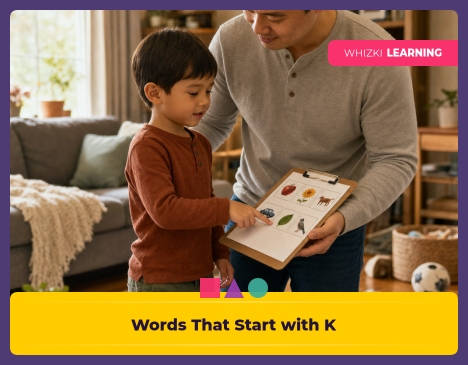
In occupational-therapy-informed routines, movement plus attention cues helps many preschoolers stay with the task, so a short walking game is a great fit after lunch or before bath. Gather 6 picture cards or small paper slips with K object words, then walk and “hunt” for the real thing.
In Reggio-inspired observation, the child’s noticing is the learning, so let the child lead the search and keep your prompts light. If your child misses a word, the adult can model once and then try again without turning it into a quiz.
In NAEYC practice, children do best with clear turns, so use this simple rule: “I pick one K word, you find it, then you pick the next.”
When you finish, celebrate with one sentence you both repeat, “We found a key and a kite,” then end the game.
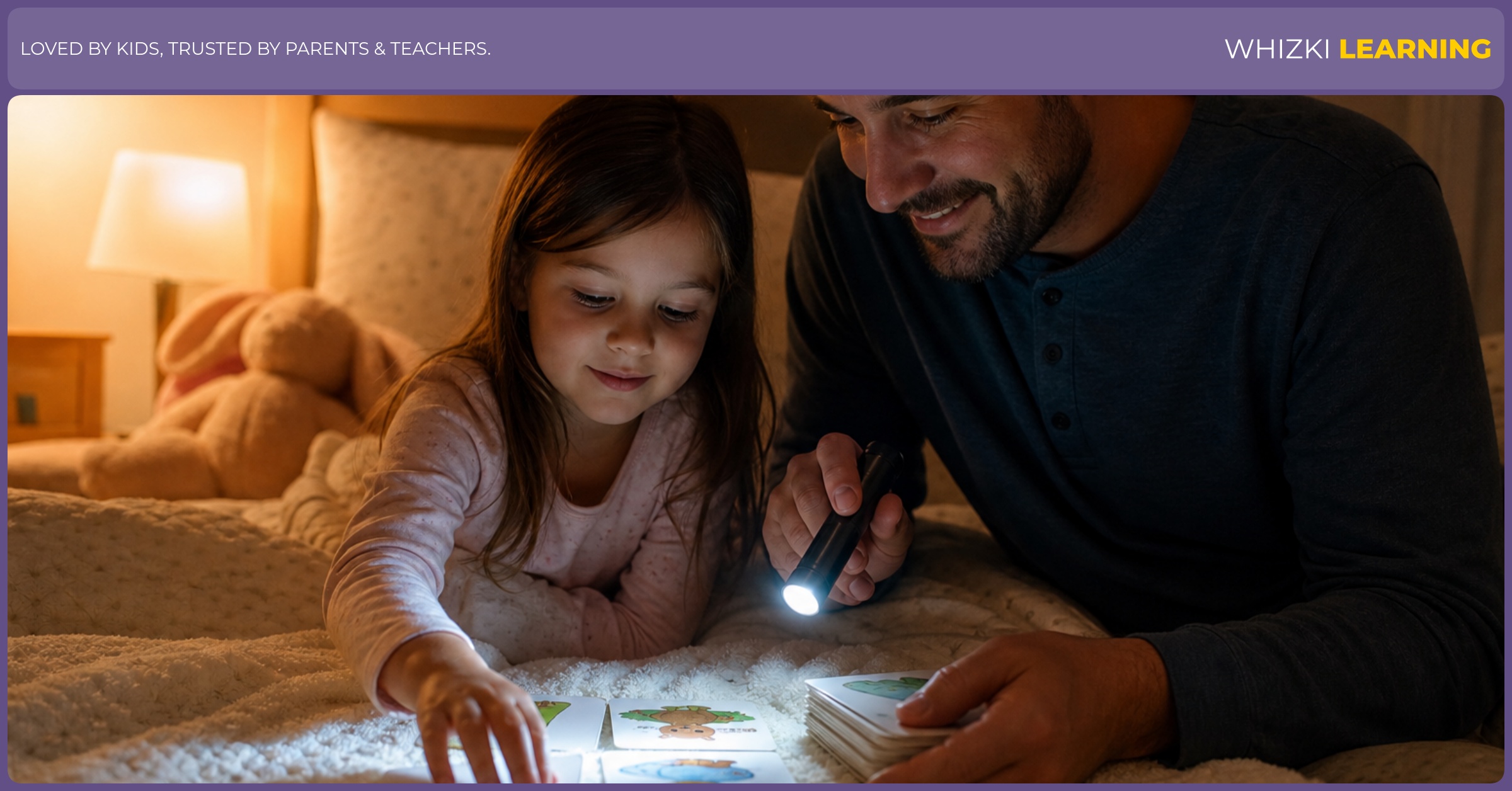
Flashlight bedtime variation for one last K word
In speech-language pathology practice, bedtime is a good time for short, low-demand language because children are calmer and adults can slow down the pace. Put 3 picture cards near the pillow, then use a flashlight to “spot” one card at a time.
In an Orton-Gillingham style routine, the adult models the word, then the child repeats, and the adult immediately provides a second chance with the same word. Use this script, “Flashlight on the book. Book starts with K. Your turn.”
In NAEYC-aligned guidance, keep it brief and stop after success, so the child ends the day feeling capable. If the child is tired, the adult can do all the pointing and the child can just choose which card comes next.
If your child asks “What does it look like?” after learning these K words, you can add describing words next with describing words starting with K.
For the next 3 days, choose one object word, one action word, and one name, then practice for just a few minutes during real life. When the routine stays small, the words stick, and your child gets to feel like a successful reader-in-training.
Whizki Learning has printable practice that helps kids connect letter sounds to simple vocabulary, which is perfect for short, repeatable sessions. If you want more support, check our sight-words printables for extra word practice you can use alongside letter K work.