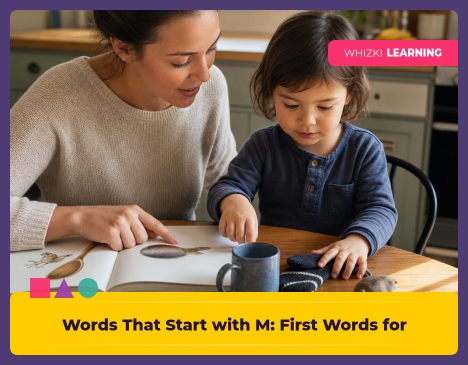
When your kitchen routine turns into “one more word” time, it can feel like you are fighting for focus. This letter-M word practice is short, concrete, and doable, using what kindergarten kids can touch and do, with a calm pace that fits real days.
Reviewed by Sarah Mitchell, M.S., CCC-SLP, Speech-Language Pathologist.
Letter M first words that fit daily life
The Orton-Gillingham approach is built on clear, repeated sound and meaning connections, and letter M is a perfect place to start with words your child already knows how to use. The NAEYC guidance on play-based learning reminds us that kids learn best when vocabulary shows up in familiar moments, not in long lessons. For letter-shape practice, use our letter M learning page alongside word play.
Each time your child picks a word, the child gets a chance to hear it, say it, and connect it to something real. Occupational-therapy style “just right” learning looks like small steps, a steady routine, and quick success, especially for preschool and kindergarten attention spans. If your child gets wiggly, shorten the activity and end on a win.
For quick extra practice with what kids can read right away, check our sight-words printables when you are ready to add a few review minutes.
Everyday objects that start with M
The Reggio-inspired mindset is “watch the child, then follow,” so these letter-M object words are chosen from the things children naturally reach for. Speech-language pathology practice often starts with concrete nouns because kids can map a word to a real object quickly. When the child can touch the item, the word sticks with less effort.
Everyday words
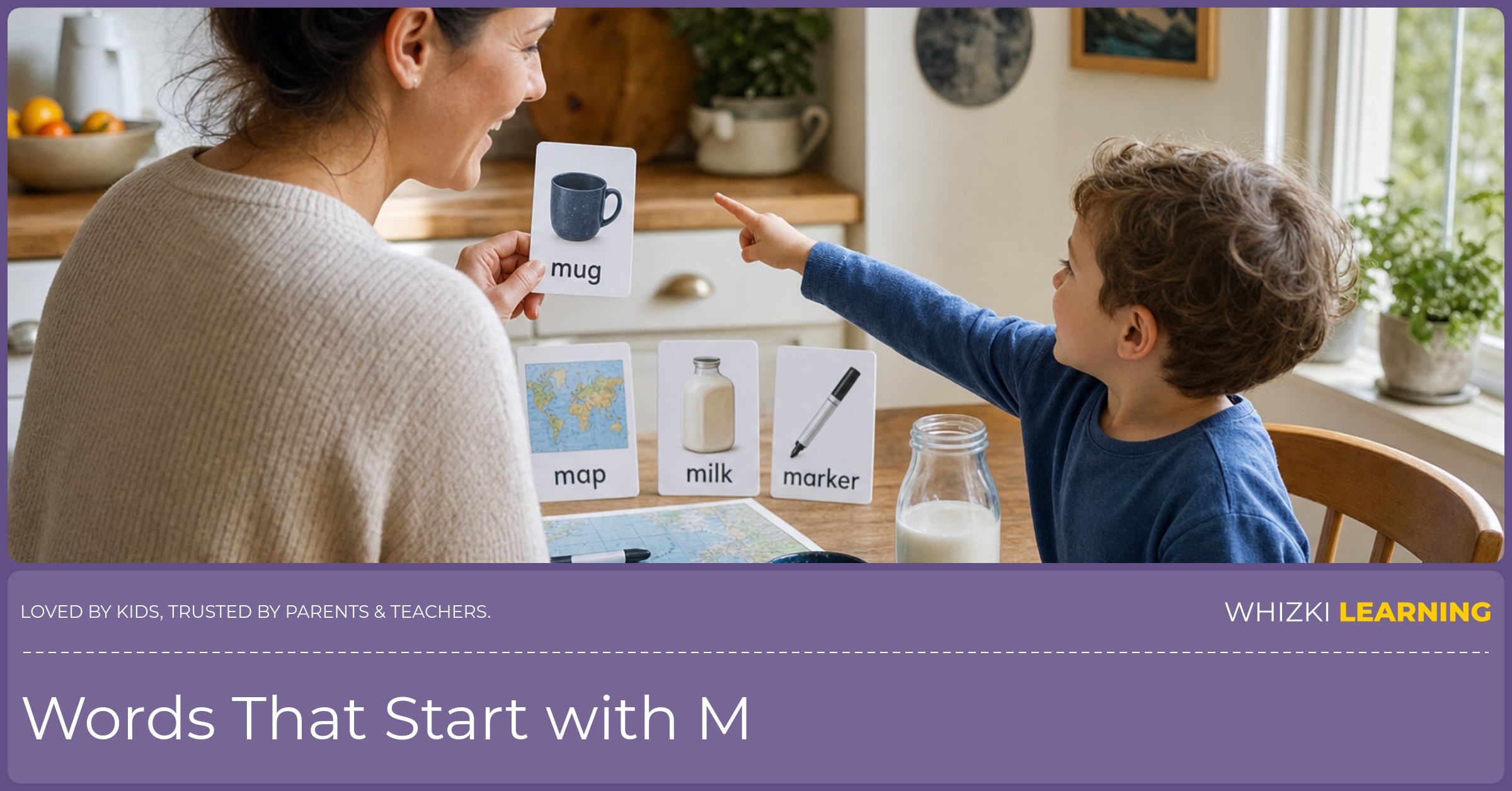
- mug
- map
- marker
- milk
- muffin
- mud
Big words for curious kids
- meadow
- mountain
- museum
- monkey
- motor
- microphone
- mosquito
- moon
Parent script: “I see a mug. Can you point to the mug, say mug, and hand me the mug?” Keep the routine to three tries, then swap to the next object when the child is still interested.
Action words with M for movement and meaning
Action words are where kids get to “show” meaning, and that is a strong fit for therapy-informed practice like modeling, imitation, and quick practice cycles. The NAEYC principle of active learning supports using movement and props, because kids remember what their body already did. Action words also give you a natural way to reduce pressure, since the child can succeed by participating.
Everyday words
- make
- move
- mop
- melt
- mix
- march
- measure
Big words for curious kids
- manufacture
- maintain
- migrate
- memorize
- model
- mobilize
- murmur
- multiply
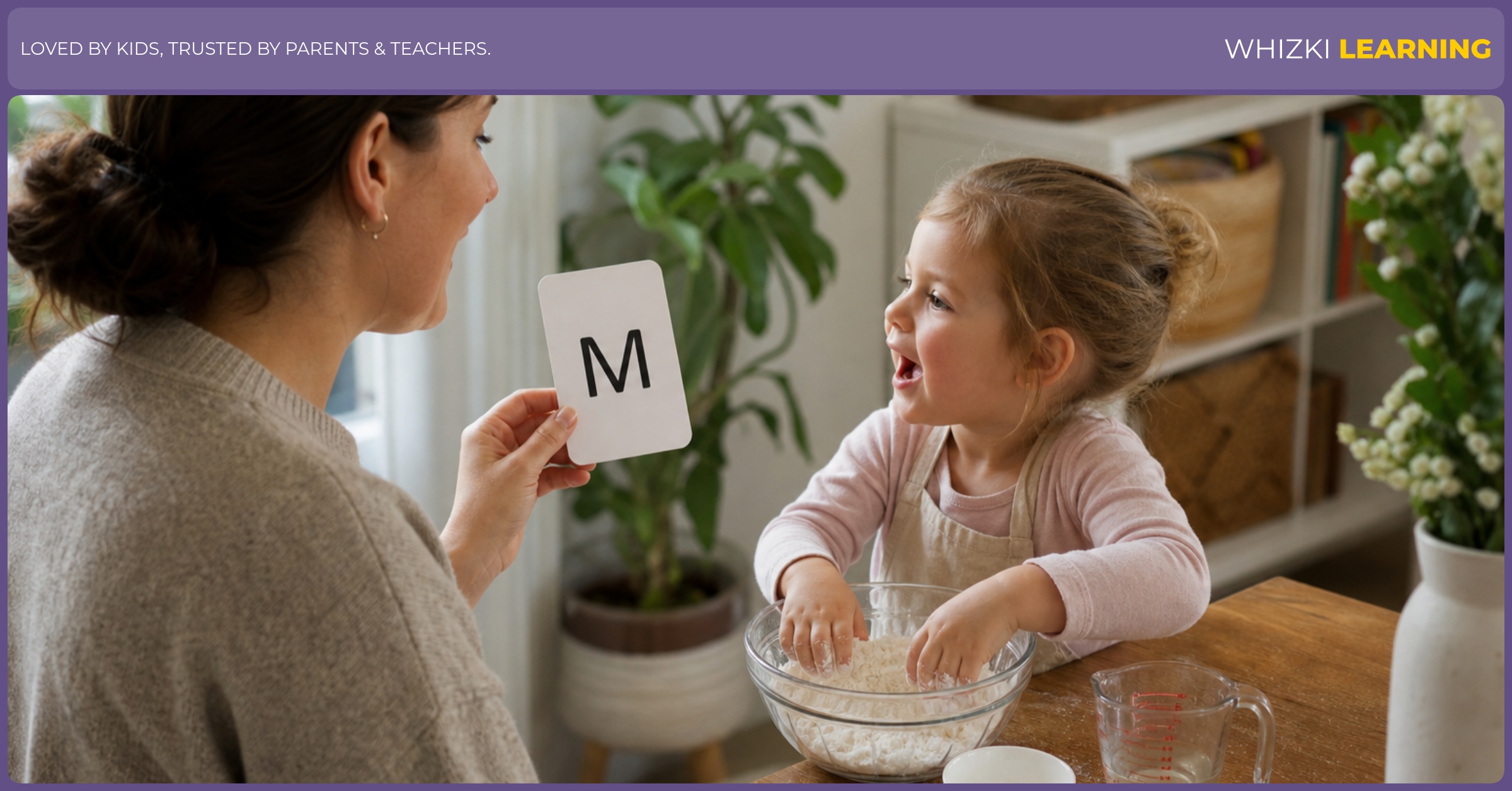
Parent script: “Let’s mix and then say it together, mix, mix. Ready to do it again?” If your child loses focus, end the activity right away and carry the word into the next real task.
First names that start with M
Common names are often easier for kids to learn because names show up in social life, and social language supports early communication goals in speech-language pathology practice. When kids hear a name in context, the brain files it as meaningful and safe. This is also a great place for a quick, low-pressure check-in with the child’s interests.
Everyday words
- Matt
- Mary
- Micah
- Mia
- Mitchell
- Max
- Mo
Big words for curious kids
- Mackenzie
- Madison
- Marissa
- Melanie
- Miranda
- Montgomery
- Murphy
Parent tip: Use names during real talk, “Max, bring me the marker,” then pause and let the child respond. This kind of turn-taking supports language practice without turning it into a quiz.
Spot the M word walking game and bedtime flashlight
Orton-Gillingham-informed routines work well when you keep practice consistent, so this walking game uses the same script every time. Reggio-inspired observation helps you notice what the child is already paying attention to, then you label it with an M word. If the child can find it, the child can say it, and confidence grows.
Walking game script: “I spy an M thing. You get one turn to spot it.” Try prompts like mug, map, milk, marker, moon, or museum, then switch roles so the child gets to choose the next word. For describing words starting with M, add describing words starting with M after your child is comfortable with the nouns and verbs.
Bedtime flashlight variation: take the flashlight, turn off the overhead light, and use the beam to “hunt” for an M word around the room, like marker, milk, moon, or map on a shelf. Parent script: “I shine the light on something that starts with M, tell me the word, then we whisper it.” This keeps the practice gentle and ends with calm language.
For the whole alphabet routine, use the alphabet learning hub to keep letter work organized across the week, one small chunk at a time.
Whizki Learning can help you keep M practice moving with printable practice that matches how young kids learn, short and hands-on. If you want extra repetition without extra talking, add a few minutes of letter and word work from the learning hub alongside your daily routines, then repeat the same key words in your home language.
Letter M practice on the hubKeep the letter-M routine small, like three words, one action, and one name, then stop while your child still wants “more.” Vocabulary sticks best when the child feels successful and the word shows up again later that day in a real moment.