When letter days start to feel like one more thing on your already-full plate, it helps to keep it simple and hands-on. The letter R can be taught in small, everyday moments that fit real preschool life, not a perfect schedule.
Reviewed by Sarah Mitchell, M.S., CCC-SLP, Speech-Language Pathologist.
For our letter R learning page, use the sound first, then add a few words your child can touch, do, and name. If you want more practice with the letter sound and letter shape, visit our letter R learning page.
R words that fit real life (and real attention spans)
In an Orton-Gillingham approach, the letter sound comes first, then a small set of consistent words, so the brain can connect sound to meaning without overload. For letter R, pick a few words from the everyday routine and repeat them across the day, like a gentle pattern.
In NAEYC guidance, vocabulary grows best through warm back-and-forth talk, not long worksheets. The everyday objects list below is built for that, because a preschooler can point, hold, and use the word right away.
In occupational-therapy basics, sensory input helps learning stick, so try a quick “touch and say” moment. The letter R words work especially well when fingers are on the object and the mouth is making the sound.
Everyday objects (nouns) for letter R
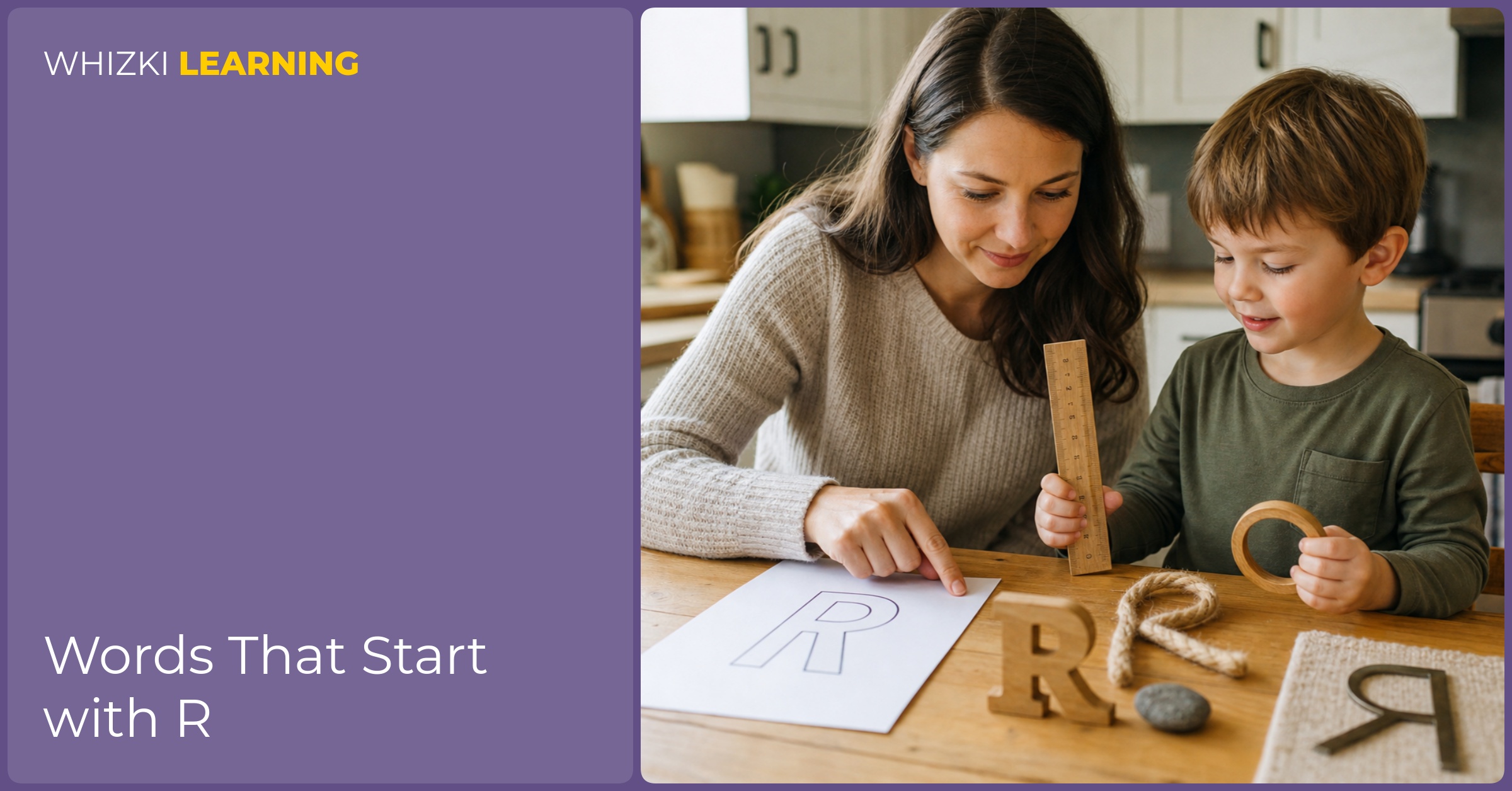
In Reggio-inspired teaching, children learn through materials and choice, so everyday objects make the letter R feel meaningful. Choose 6 to 10 items your child already sees, like bath time or book time.
Everyday words
- rabbit
- rain
- rock
- ring
- roller
- ruler
- road
- room
Big words for curious kids
- river
- rocket
- rooster
- rubber
- restaurant
- reindeer
- rainbow
In speech-language pathology practice, clear naming plus a short pause helps children process and respond. Script idea: “Touch the rocket. Say ‘R’.” Then let your child point to the next object.
Action words (verbs) for letter R
In an Orton-Gillingham approach, verbs are great because children can act, then hear the word in the same moment. Action words also support expressive language, because children can answer with movement.
In NAEYC play-based learning, action talk happens naturally during pretend and cleanup. The action list below is perfect for “do it with me” routines that do not feel like a lesson.
In occupational-therapy heuristics, movement helps attention, so keep the actions short and repeatable. A quick round of “say it, do it” is usually enough for one turn.
Everyday words
- run
- ride
- roll
- read
- rub
- raise
- repeat
- rip
Big words for curious kids
- recycle
- rescue
- repair
- reflect
- rehearse
- rebuild
In speech-language pathology practice, modeling the verb with a clear facial expression supports understanding. Script idea: “I roll the ball. Your turn, roll.” If your child freezes, slow down and do the action again.
First names that start with R
In Reggio-inspired observation, children connect letters to people they know, so first names are a natural bridge into print. When a child hears their friend’s name, the letter sound feels personal.
In NAEYC guidance, social language grows through real conversation, so first names work during playdates, classroom routines, and family talk. Use names during greetings and turn-taking.
In an Orton-Gillingham approach, consistent sound practice helps accuracy, so keep the name practice short and repeat it the same way each time.
Everyday words
- Riley
- Ryan
- Rosa
- Ruth
- Rose
- Ramon
Big words for curious kids
- Rachael
- Rafael
- Rory
- Raven
- Renee
- Ramon
In speech-language pathology practice, repeating a name in context supports recall and clarity. Script idea: “Renee is here. Say ‘Renee’.” If your child mixes up sounds, model the name once, then let the child try.
For extra practice with describing words, see describing words starting with R, because adjectives are a different skill than naming and doing.
Whizki Learning has letter R resources that match this same hands-on routine, including our sight-words printables for short, repeatable practice. Pair a few letter R words from this post with a quick sight-word moment during calm time, then stop while your child still wants more.
Spot the R word walking game
In NAEYC play-based learning, games are how kids learn without feeling like they are “being taught.” This walking game turns letter R into noticing, which is a strong early literacy habit.
In occupational-therapy basics, a little movement helps regulation, so keep the game moving and light. You can do it in the hallway, at the mailbox, or around the living room.
In an Orton-Gillingham approach, consistent prompts help children succeed, so use the same question each time. “Do you see something that starts with R?”
How to play: Pick 1 everyday object word from the list, like ruler or ring. Walk together and point, then say the word once. Give your child a turn to point and say it, even if it is just the first sound.
Flashlight bedtime variation: During bedtime, use a flashlight to “search” for letter R things in the room, like a rock book cover, a ring on a shelf, or a ruler in a drawer. The flashlight game keeps it playful and gives the letter R a calm, predictable ending to the day.
For letter shape practice, the letter R learning page is a helpful next step, especially when you pair tracing with saying the sound out loud. When you keep the word set small and repeat it across the day, the letter R becomes familiar, not stressful.