PreschoolKindergartenFirst Grade

30+ Words That Start with Q: First Words for Kindergarten Readers

May 29, 2026
30+ Words That Start with Q: First Words for Kindergarten Readers

When you are trying to get one more “Q” word out of your child and it turns into a tug-of-war, you are not alone. A calm, hands-on routine helps kids learn new vocabulary without pressure, and it fits right into everyday moments at home.

Reviewed by Sarah Mitchell, M.S., CCC-SLP, Speech-Language Pathologist.

Start with the letter Q, then use it in real life

In speech-language pathology practice, vocabulary sticks best when children hear and use words during meaningful routines, not just during worksheets. For letter Q, the sound can feel tricky, so the goal is steady practice with short, repeatable moments.

In the Orton-Gillingham approach, teachers often keep instruction structured and multisensory, like seeing the letter, saying the word, and touching something connected to the word. Our letter Q learning page can help you pair the letter shape with simple Q words, so the sound and the sight match up: our letter Q learning page.

In NAEYC guidance, play-based learning wins when adults follow the child’s lead and keep sessions short. A quick “say it, touch it, find it” routine works well for ages 3 to 7, especially when attention is moving fast.

Everyday Q words your child can touch

In Reggio-inspired teaching, children learn through materials and exploration, so everyday objects are a great starting point. Everyday Q words give your child something concrete to point to, hold, and name.

In occupational-therapy basics, many kids learn best when language is tied to a sensory action, like reaching, stacking, or washing. Try one object at a time, then let the child “choose” the next word.

Everyday words

  • quail
  • quart
  • quarter
  • quilt
  • quiver
  • quay

Big words for curious kids

  • quartz
  • quiverful
  • quonset
  • quarantine
  • quench
  • quiverer
  • quiverfulness

Tip script for the kitchen: “Touch the quartz. Say ‘quartz.’ Now find another Q thing.” Keep it to two turns, then switch to play.

Action Q words for play and movement

In speech-language pathology practice, children benefit when adults model a word during an action, then invite the child to copy the action. Action words also help kids connect meaning to movement, which reduces the “just memorize it” feeling.

In the Orton-Gillingham approach, repeating the same word in the same routine builds automaticity. Action Q words are perfect for quick games like “do it, say it,” especially when your child is already moving.

Everyday words

  • quit
  • quack
  • quilt
  • quench
  • quiver
  • quail

Big words for curious kids

  • qualify
  • quicken
  • quarrel
  • question
  • queue
  • quibble

Tip script for the living room: “Watch me quicken. Now you quicken.” If your child resists, switch to a turn-taking version, “My turn, your turn,” and keep the pace slow.

First names that start with Q

In NAEYC guidance, children learn names through social play, like pretend introductions and family games. First names also help kids practice Q sounds in a friendly, personal way.

In Reggio-inspired observation, adults notice what the child is interested in, then build language around it. If your child loves dolls or stuffed animals, use Q names for pretend play characters.

Everyday words

  • Quinn
  • Quincy
  • Quade
  • Quentin
  • Quill

Big words for curious kids

  • Quilliam
  • Quint
  • Quintus
  • Quintina
  • Quintella

Tip script for pretend play: “This is Quinn. Say hi to Quinn.” If your child gets stuck, model the name once, then let the child point and repeat.

Want a little extra practice without turning it into a chore? Whizki Learning has our sight-words printables that pair nicely with letter Q routines, so children can see and use new words in short, repeatable sessions.

Spot the Q word, then shine it with a flashlight

In occupational-therapy basics, scavenger hunts work because they combine attention, movement, and language in one activity. The “spot the Q word” walking game is also a great way to keep your child engaged when sitting still is hard.

In speech-language pathology practice, children often do better when adults give a simple choice instead of a demand. Try this: “Do you want to find the quartz word or the quench word?”

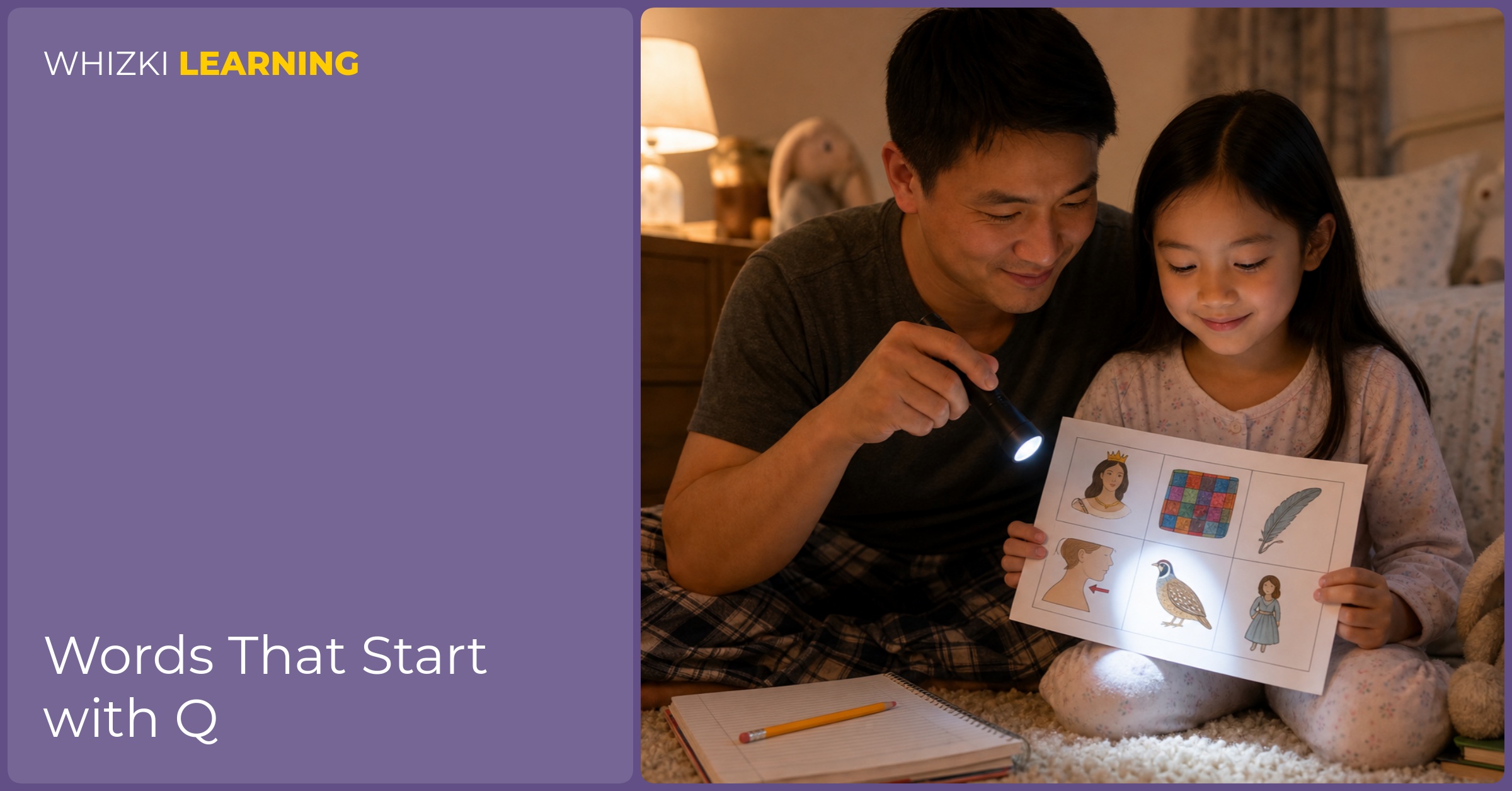
For bedtime, use a flashlight variation and keep it gentle, like a calm “search” for Q words on paper. The flashlight game works well alongside letter-shape practice on our letter Q learning page.

If your child is ready for more Q vocabulary, add describing words starting with Q on a separate day, so nouns and verbs do not get crowded out.
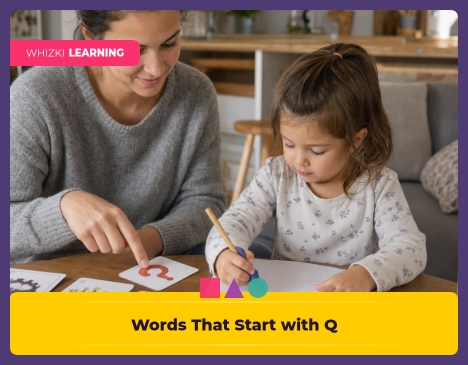
A parent and child at home play a screen-free scavenger hunt for Q words, with hands on paper and a gentle flashlight search in warm natural light.
A parent and child sit together at bedtime, using a small flashlight to point at Q words on a page while practicing gently with paper.

When letter Q feels hard, keep the routine small and repeatable, and let your child win the moment by choosing the next word. The alphabet learning hub can help you plan the next letters after Q, so vocabulary practice stays steady and not overwhelming: the alphabet learning hub.

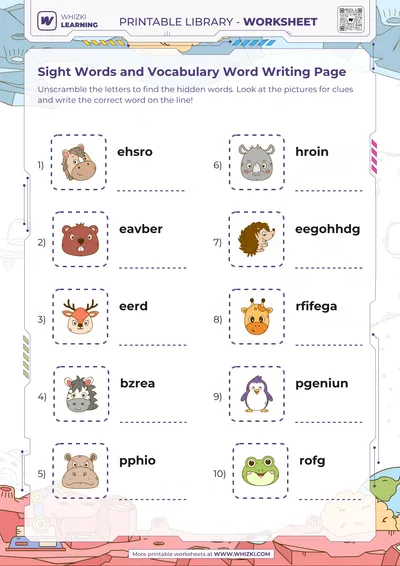
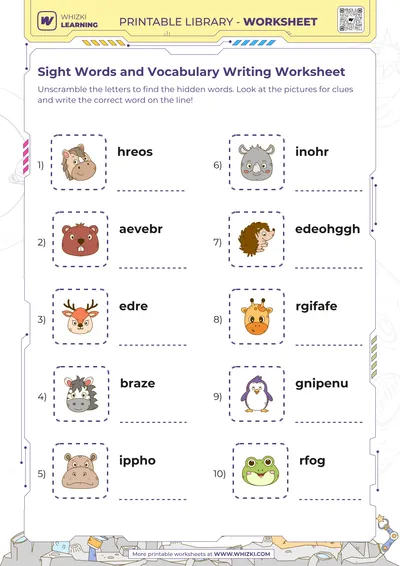
Sight Words and Vocabulary Writing Worksheet Worksheet Cover BackgroundSight Words and Vocabulary Writing WorksheetA printer-friendly sight words and vocabulary worksheet for 1st grade learners around 7+ years old. Use it for quick home practice, homeschool review, classroom centers, or a calm screen-free warm-up when your child needs focused word recognition.
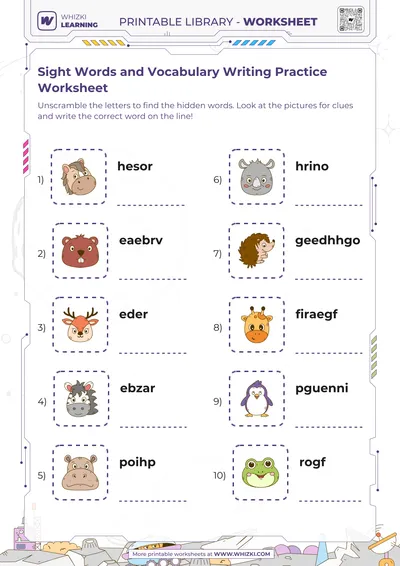
Picture Word Writing: Sight Words and Vocabulary Worksheet Cover BackgroundPicture Word Writing: Sight Words and VocabularyA printer-friendly sight words and vocabulary worksheet for 1st grade learners around 6 years old. Use it for quick home practice, homeschool review, classroom centers, or a calm screen-free warm-up when your child needs focused word recognition.
Sight Words and Vocabulary Writing Worksheet Worksheet Cover BackgroundSight Words and Vocabulary Writing WorksheetA printer-friendly sight words and vocabulary worksheet for Kindergarten learners around 5 years old. Use it for quick home practice, homeschool review, classroom centers, or a calm screen-free warm-up when your child needs focused word recognition.

Frequently asked questions

What is the easiest way to teach Q words to a 3-7 year old?

Use Q words during everyday routines, like pointing to an object and saying the word once or twice. Kids learn best when adults model the word during a real action, then invite a short repeat. If your child consistently avoids speaking or cannot make progress after steady practice, ask a speech-language pathologist for guidance.

Why does the letter Q sound feel confusing for kids?

The letter Q can make different sounds depending on the word. Many kids mix up Q with K because the spelling pattern is unusual and the sound is not always the same. If your child struggles with many letters or speech sounds, a speech-language pathologist can help you sort out what to target first.

How long should Q word practice last each day?

Aim for 3 to 5 minutes, with two or three word turns. Short practice reduces frustration and helps kids stay focused, especially for preschool and kindergarten attention spans. If frustration builds quickly, shorten the session and focus on one word for several days.

Where can I find printable practice for early vocabulary?

Use the sight-words and vocabulary printables for preschool routines. Printables work best when paired with real-life speaking, like finding the word in your home or during play. If your child needs more support, combine printables with a speech-language pathologist’s home suggestions.

Limited Time Sale
Kids’ Workbooks!

Boost your child’s skills with our discounted workbooks. Engaging activities for preschool, kindergarten, and grade 1 - now at special sale prices!

June Summer Learning Workbook for Kindergarten to 1st Grad... Workbook Cover BackgroundJune Summer Learning Workbook for Kindergarten to 1st Grade: Math, Reading, Writing, Science, Brain QuestsA workbook for the slow weeks of June. Reading, math, writing, science, and brain quests for kids stepping from kindergarten into 1st grade.

-27% $10.99

List Price: $14.99
Buy Now
July Summer Learning Workbook for Kindergarten to 1st Grad... Workbook Cover BackgroundJuly Summer Learning Workbook for Kindergarten to 1st Grade: Alphabet Tracing, Math, Numbers, Preschool ActivitiesA July workbook for the middle of summer. Alphabet tracing, early math, number practice, and pencil work for kids moving from kindergarten i...

-27% $10.99

List Price: $14.99
Buy Now
August Summer Learning Workbook for Kindergarten to 1st Gr... Workbook Cover BackgroundAugust Summer Learning Workbook for Kindergarten to 1st Grade: Numbers Tracing, Alphabet, Writing, Science, Social StudiesAn August workbook for the last stretch of summer. Number tracing, alphabet review, writing, science, and gentle social studies for the week...

-27% $10.99

List Price: $14.99
Buy Now
Animal Coloring Adventures Workbook for Kids Ages 3-7: Fac... Workbook Cover BackgroundAnimal Coloring Adventures Workbook for Kids Ages 3-7: Facts, Mazes, Quizzes, and Coloring ActivitiesAn animal-themed coloring and brain-quest book for ages 3 to 7. Facts, mazes, and quizzes about jungle, ocean, and backyard animals.

-31% $8.99

List Price: $12.99
Buy Now

Join the Screen-Free Movement.

Get exclusive activities, expert tips, and inspiration for a more meaningful, offline family life.

Copyright © 2025 - 2026 Whizki Learning. All rights reserved.