Some nights it feels like you are repeating the same words and nothing sticks, and that can make you want to quit. When you teach letter S words in small, hands-on chunks, learning feels calmer and more doable for both of you.
Reviewed by Sarah Mitchell, M.S., CCC-SLP, Speech-Language Pathologist.
Why start with S words first
Letter S practice works best when the kindergarten teacher uses a steady, explicit routine, like the Orton-Gillingham approach style of clear sound-to-word connections. For many kids, the letter sound is easier when the words are concrete, familiar, and repeated in the same way each day.
NAEYC guidance reminds us that early literacy grows through play, not pressure, so the worksheet or book should feel like something your child chooses. Action words and everyday objects help kids use the vocabulary right away, which supports understanding and recall.
Speech-language pathology practice also supports short practice sessions, because young children learn best with frequent, brief turns. If your child gets wiggly, pause and switch to a movement game with S words.
Everyday objects that start with S
For everyday objects, use a Reggio-inspired approach, where the child’s senses lead the learning, and the parent follows the child’s interest. Hold up the object, say the word once, then let your child touch it and repeat it.
Occupational-therapy basics suggest using real items and steady routines, because hands-on input helps attention. When the object is in front of your child, the word becomes easier to remember.
To keep the learning consistent, practice the same set for a few days, then add a few more. If you want more word types later, describing words starting with S live on describing words starting with S.
Everyday words
- snake
- shoe
- shirt
- sock
- sand
- sun
- star
- stone
- stick
Big words for curious kids
- sandwich
- sail
- seas
- sub
- school
- station
Try this script during cleanup: “I see the sock. Put the sock in the basket.” The kindergarten teacher can keep the sentence pattern the same each time.
Action words your child can do
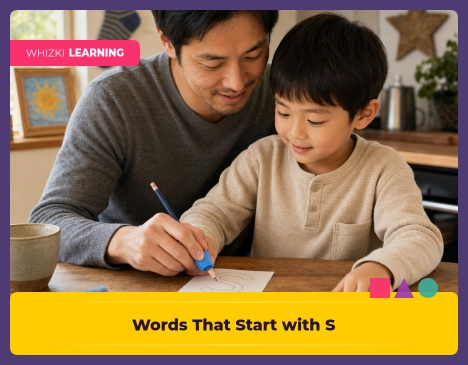
Action words are a great fit for a Montessori-style observation, because the child can choose an activity and practice the word while doing it. When the child says the word during the action, the meaning sticks.
Orton-Gillingham-informed teaching uses clear, repeated prompts, so the parent can model the word, then ask for the child’s turn. Keep it short, like one action at a time, and celebrate the effort.
Speech-language pathology practice often recommends pairing words with movement, because it supports attention and language use. If your child is tired, switch to one action word and do it slowly.
Everyday words
- sit
- stand
- smile
- sing
- sleep
- spin
- shake
- skate
Big words for curious kids
- sail
- save
- share
- show
- serve
- spray
Make it a turn-taking game: “My turn, you turn.” Say the action word, then ask your child to do it, like “shake” or “sing.”
Whizki Learning has our letter S learning page and our sight-words printables that pair nicely with these first words, so you can practice in small chunks without hunting for materials.
First names that start with S
Common names help kids connect language to real people, which fits NAEYC’s emphasis on meaningful communication. When your child hears a name in a familiar context, the word feels purposeful, not like a memorization task.
Reggio-inspired teaching also values child choice, so let your child pick which name to practice during pretend play. Use the name during role-play, like “Sofia, come here,” while you act it out together.
If your child is learning letter sounds in order, the alphabet learning hub can support the routine, especially when the parent keeps the same daily timing. For letter-shape practice, use the alphabet learning hub.
Everyday words
- Sam
- Sarah
- Sean
- Sofia
- Stella
- Steven
Big words for curious kids
- Sal
- Sharon
- Sid
- Sylvia
Try a “name hunt” at home: “I’m looking for Sam.” Then point to a photo, a toy label, or a sticky note with the name.
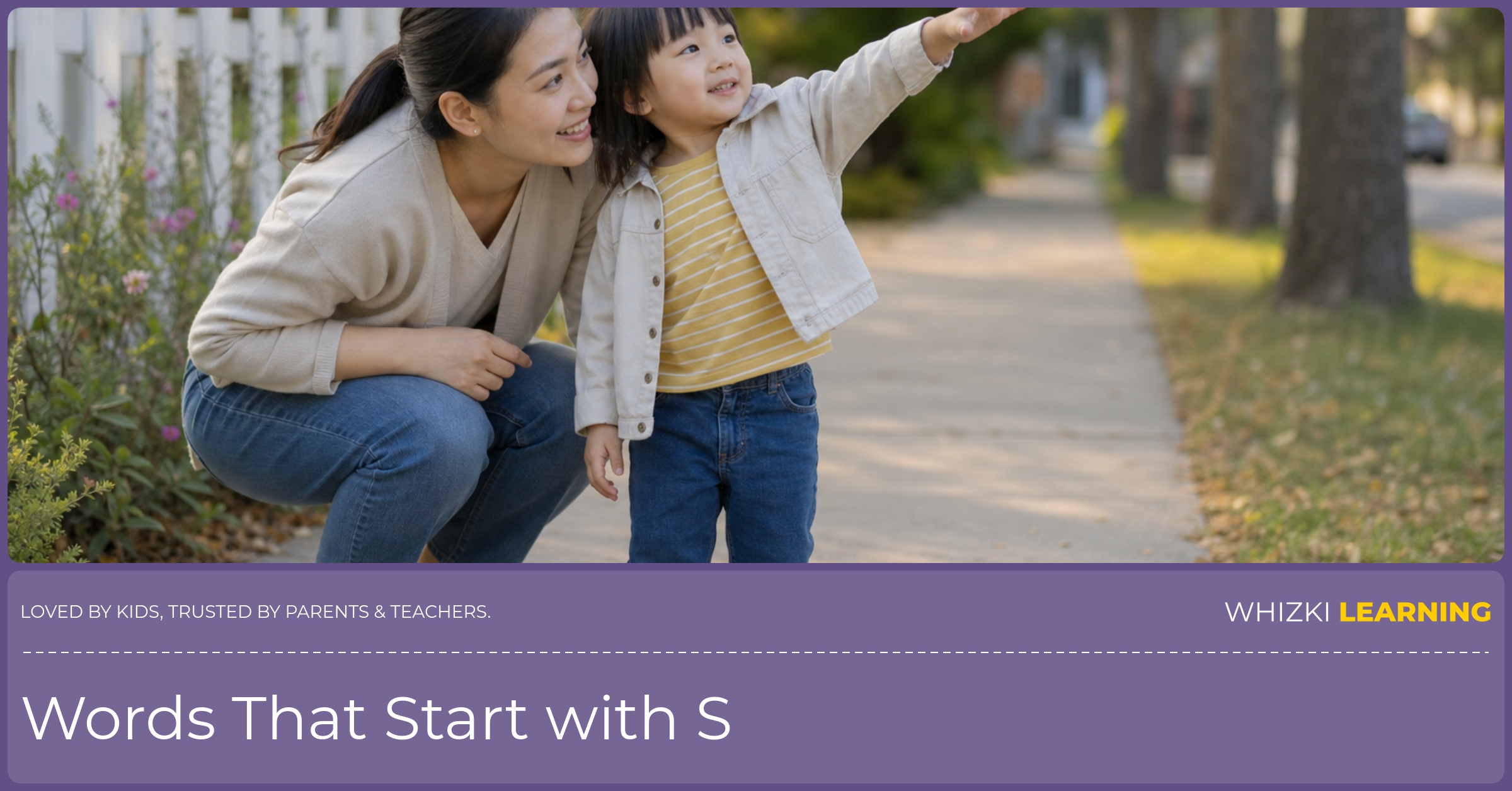
Spot the S word walking game
For this game, use a simple NAEYC-friendly routine, short and repeatable, so your child stays engaged. Bring a small paper and pencil, and let the child draw a quick circle when they find an S word.
Orton-Gillingham style prompts help here, because the parent can model the word, then ask for the child’s turn. “I see sun. Your turn, sun.”
Occupational-therapy basics suggest using movement to support attention, so the walk is part of the learning, not a break from it. If your child rushes, slow down and do fewer finds.
How to play: Pick 3 S words from the lists, then look for them during a short walk. Examples you can try are shoe, sock, sun, or star.
Flashlight bedtime variation: Turn off the lights, then use a flashlight to point at bedtime items that start with S, like sheet or sock. Say the word once, then ask your child to point and say it back.
A quick practice plan for busy days
When the kindergarten teacher uses a consistent routine, children know what to expect and anxiety goes down. Speech-language pathology practice often supports “model, prompt, praise,” so the parent can keep feedback simple and warm.
Reggio-inspired observation helps the parent notice what the child is already interested in, then attach the S word to that moment. If the child keeps reaching for a certain object, that object becomes the next word.
For letter-shape practice, connect the sound to the form, using our letter S learning page as a guide for short tracing sessions.
Try this 3-step routine: Say the word, touch the object or do the action, then repeat during the next natural moment. If your child resists, pause and try again later with fewer words.
One last tip, keep the S word practice small enough that your child can win, then repeat it tomorrow. When the words are tied to real objects, real actions, and real names, kindergarten reading starts to feel like something your child can do.