Kindergarten prep can feel like a pile of “one more thing” when your child is already tired, busy, and not always in the mood. When you keep adjective practice small and playful, the words stick without turning into a battle. Today, the letter N helps you build a kid-friendly word bank for feelings, looks, and personality, and you can practice the letter shape too on our letter N learning page: our letter N learning page.
Reviewed by Sarah Mitchell, M.S., CCC-SLP, Speech-Language Pathologist.
Use the describing words below like you would use a flashlight, one word at a time. For extra early reading support, pair adjective talk with our sight-words printables during calm moments, not during rush time.
Feelings adjectives that start with N
In the Orton-Gillingham approach, short, repeated language practice helps children connect sounds to meaning. When you name a feeling with a clear adjective, the child gets a simple label they can use in real life.
NAEYC guidance reminds us that children learn best through everyday interactions, not worksheets alone. Use these N feeling words during snack, cleanup, and bedtime conversations.
Everyday words
- nervous
- numb
- nice
- naughty
- nervy
- noble
- neat
- nurturing
- normal
Big words for curious kids
- nervousness
- numbness
- nonsensical
- negligible
- notable
- necessary
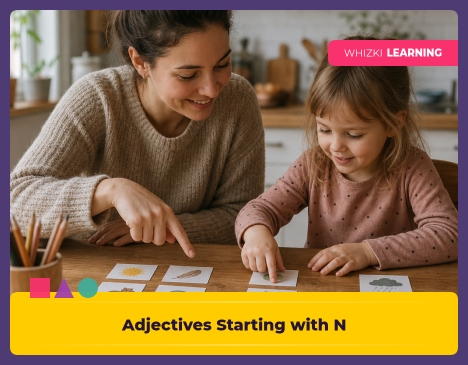
Kitchen-table script: “Show me with your face, then say the N word.” If the child says a feeling word wrong, the parent repeats the correct adjective once, then asks for a second try.
Read-aloud tip for feelings: pause and pick the describing word. “The character feels ____. Nervous or nice?”
Look-and-size adjectives that start with N
Occupational-therapy basics often point to sensory-friendly learning, and adjective talk is a gentle way to notice details. When the child describes what they see, the child practices attention and language at the same time.
Reggio-inspired observation also fits here, because children learn by looking closely and naming what they notice. Use these N words while you dress, build, or compare objects.
Everyday words
- near
- narrow
- nearly
- neat
- new
- noble
- normal
- nifty
Big words for curious kids
- nonretractable
- noncollapsible
- nonreturnable
- noncompetitive
- nonflammable
- nonsensical
Tip: keep comparisons concrete. “This one is near, and that one is far,” then add one N look-and-size word only.
Read-aloud tip for looks and size: pause and pick the describing word. “The box is narrow or wide?”
Personality adjectives that start with N
Speech-language pathology practice often uses “label and model” so children can retrieve words when emotions or situations change. Personality adjectives help children describe people without blaming, and that matters during play.
The alphabet learning hub idea is simple, connect the letter sound to the word meaning. When the child hears /n/ and chooses an N adjective, the language becomes easier to access later, especially during story time on the alphabet learning hub.
Everyday words
- nice
- nurturing
- noble
- neat
- nifty
- normal
- naughty
- nervous
- new
Big words for curious kids
- notable
- necessary
- negligible
- noncompetitive
- nonflammable
- nonreturnable
Kitchen-table sorting activity, three piles: set up three bowls labeled “N feelings,” “N looks,” and “N people.” The parent reads one adjective card, and the child places it in the matching pile, then says one sentence: “She is ____.”
Letter N tie-in: while sorting, trace the letter N in sand or on paper, then choose one adjective that starts with N and say it out loud.
Whizki Learning printable practice can support the same N word work you do at home, especially when you pair letter shape tracing with quick vocabulary moments. Check out our sight-words printables for calm, short sessions that fit real schedules.
If you want to keep the same practice going on paper, take a look at our alphabet tracing workbook for preschool and kindergarten.
nouns and verbs starting with N can come next, so the child has a full sentence toolkit for stories and play.
Final tip: keep adjective practice to one minute at a time, then stop while the child is still interested. The goal is confident word use, not perfect answers, and the letter N practice on our letter N learning page helps the sound stick.