PreschoolKindergartenFirst Grade

30+ Adjectives Starting with P: Kindergarten Words for Feelings, Looks, and Personality

May 29, 2026
30+ Adjectives Starting with P: Kindergarten Words for Feelings, Looks, and Personality

Some days it feels like your child can’t find the right word, and you end up guessing what they mean. When you give a small set of P describing words, language gets easier and calmer. Our letter P learning page can support the sound and shape while your child uses real words in real talk.

Reviewed by Sarah Mitchell, M.S., CCC-SLP, Speech-Language Pathologist.

For more practice, visit the alphabet learning hub and then use our letter P learning page for quick, repeatable drills.

Feelings and emotion P words

In everyday speech, early-childhood teachers and speech-language pathologists often model feelings words with simple choices, so children can label what they notice. Using a few P options helps your child move from “I don’t know” to “I feel…”

Try these P adjectives for feelings during transitions, play breaks, and bedtime. Keep the words visible on a small card, and let your child point or say one word at a time.

Everyday words

  • peeved
  • pouty
  • panicky
  • plucky
  • pensive
  • pleasant

Big words for curious kids

  • perplexed
  • perturbed
  • preoccupied
  • painful
  • pained
  • penitent

Kitchen-table script: “Show me the P feeling word that matches your body right now.” When your child picks a word, add one sentence, “You feel peeved, and we can take three slow breaths.”

Looks and size P words

Occupational-therapy basics for preschool language include pairing describing words with what the child can see and touch. When children compare size and look, they practice vocabulary without pressure.

Use these P adjectives while you sort toys, build with blocks, or get dressed. A quick “point and name” moment is enough.

Everyday words

  • pale
  • pinky
  • plump
  • padded
  • pointy
  • polished

Big words for curious kids

  • pendulous
  • pinpoint
  • pristine
  • pint-sized
  • perceptible
  • pocket-size

Read-aloud tip: pause and pick the describing word. “Look at the picture, is it pointy or padded?” Then let your child answer with one word.

Personality P words

Reggio-inspired observation and NAEYC guidance both remind us to notice the child in front of us, not the behavior we wish we saw. Personality words help children talk about character, effort, and choices.

Use these P adjectives when you praise the process, not just the outcome. “You were proud of your work,” or “You stayed patient while we waited.”

Everyday words

  • patient
  • polite
  • playful
  • proud
  • practical
  • prompt

Big words for curious kids

  • persevering
  • principled
  • proficient
  • persistent
  • proactive

When your child says, “I’m not good at this,” offer a personality word choice: “Are you persistent or preoccupied right now?” For more early-reader practice, see nouns and verbs starting with P.

Whizki Learning has P-focused practice pages that pair letter-sound work with simple vocabulary. Pair the worksheet with a quick sorting game at the table, then use our sight-words printables for short, confident reading moments.

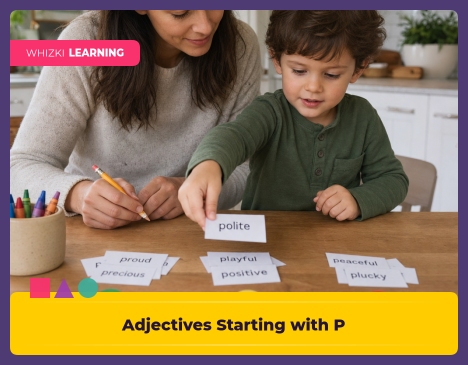
A parent and child sorting P adjective cards on a kitchen table, with crayons and a pencil nearby.

One kitchen-table sorting activity

For language growth, children do best with hands-on categories and quick wins, which fits speech-language modeling and early literacy routines. Set out three piles and let your child move cards with their fingers.

Make three piles: feelings, looks, and personality. Use the word cards from the lists above, and ask your child to place each word where it belongs.

Try this script: “Pick one card. Say the word. Point to what it matches.” If your child gets stuck, offer two choices, “Is it a pensive feeling word, or a pointy look word?”

After sorting, do a letter moment for the letter P. Trace a big P with a finger in shaving cream or sand, then say, “P, peeved,” so the sound and meaning stick together.
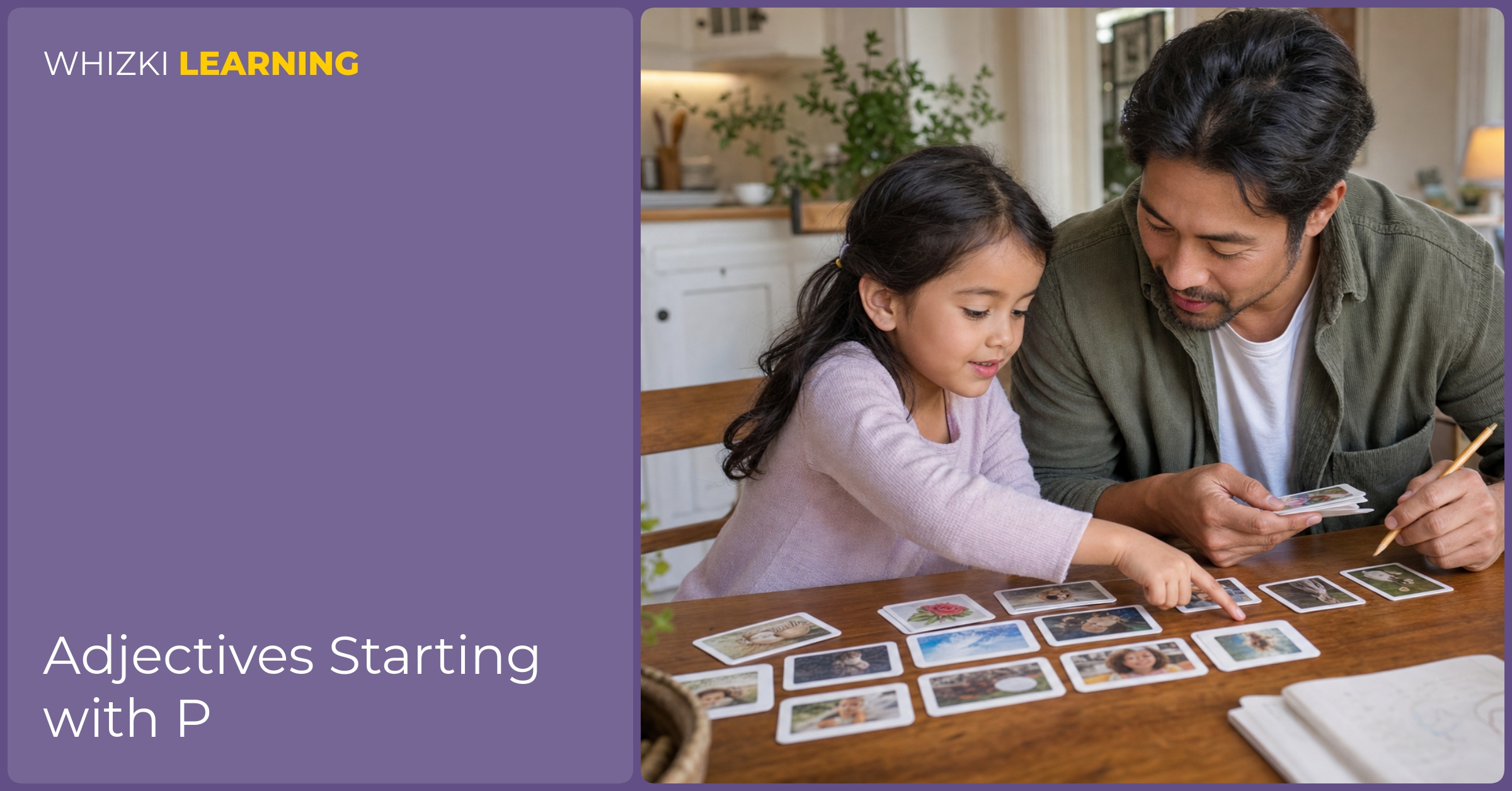
Parent and child calmly practicing P adjective sorting with paper cards and a pencil at a kitchen table.

Keep the routine small and repeatable: one sorting round, one read-aloud pause, and one letter P trace. When your child uses a P adjective, celebrate the word, then connect it to the moment, “You’re polite, and you used your words.”

For daily practice, return to our letter P learning page and use the alphabet learning hub to keep the letter work consistent.

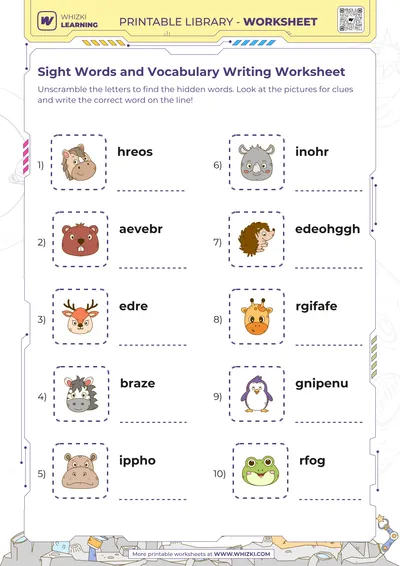
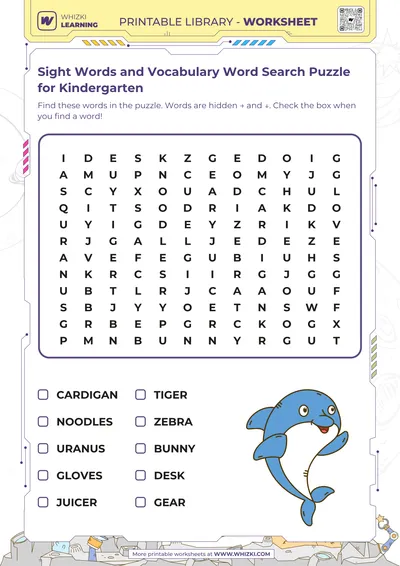
Sight Words and Vocabulary Writing Worksheet Worksheet Cover BackgroundSight Words and Vocabulary Writing WorksheetSight words writing can feel sticky when kids stall on letter shapes. Use this Whizki Learning printable for a quick, screen-free routine: name the picture, say the word, then use the scrambled letters to write the word once on the line. Keep it short, repeat for a few minutes, and stop while motivation is still up.
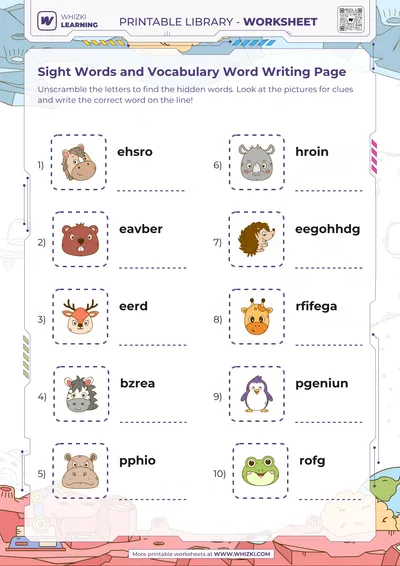
Sight Words and Vocabulary Picture Writing Worksheet Worksheet Cover BackgroundSight Words and Vocabulary Picture Writing WorksheetKids sometimes stall on letter shapes, and five-year-olds can get bored fast with long writing tasks. Grab this Whizki Learning picture worksheet, look at the picture together, and ask your child to name the object from memory, then write that one word on the line. Keep it short, then celebrate the attempt.
Sight Words and Vocabulary Writing Worksheet Worksheet Cover BackgroundSight Words and Vocabulary Writing WorksheetKids often stall on letter shapes, and five-year-olds can get bored fast when spelling practice drags on. On this Sight Words and Vocabulary page, start by pointing to the picture, say the word out loud, and have your child copy just the first letter from the scrambled hint before writing the full word. From Whizki Learning, this kind of short, guided step keeps the focus on the word.

Frequently asked questions

What if my child refuses to use the P feeling words?

Offer two choices and let the child point instead of talk. Children often need control over the response, and pointing still builds vocabulary. If refusal stays strong for weeks or comes with big communication frustration, ask a speech-language pathologist for input.

Why do sorting activities help with adjectives?

Sorting turns describing words into a clear job the child can do with their hands. Hands-on categories reduce guessing and support word meaning. If your child consistently can’t match words to pictures or situations, consider an evaluation through a speech-language pathologist.

How can I use P adjectives during real life?

Use P adjectives during everyday moments like getting dressed, waiting, or cleaning up. Short, specific comments help the child connect the word to the moment. If your child rarely uses any describing words, start with one pile and one word per day.

When should I ask a professional about adjective delays?

Consider a professional when a child’s describing language is far behind peers and causes frequent frustration. Speech-language pathologists can check word retrieval, sentence building, and understanding. If you notice persistent difficulty, request a screening or evaluation.

Limited Time Sale
Kids’ Workbooks!

Boost your child’s skills with our discounted workbooks. Engaging activities for preschool, kindergarten, and grade 1 - now at special sale prices!

June Summer Learning Workbook for Kindergarten to 1st Grad... Workbook Cover BackgroundJune Summer Learning Workbook for Kindergarten to 1st Grade: Math, Reading, Writing, Science, Brain QuestsA workbook for the slow weeks of June. Reading, math, writing, science, and brain quests for kids stepping from kindergarten into 1st grade.

-27% $10.99

List Price: $14.99
Buy Now
July Summer Learning Workbook for Kindergarten to 1st Grad... Workbook Cover BackgroundJuly Summer Learning Workbook for Kindergarten to 1st Grade: Alphabet Tracing, Math, Numbers, Preschool ActivitiesA July workbook for the middle of summer. Alphabet tracing, early math, number practice, and pencil work for kids moving from kindergarten i...

-27% $10.99

List Price: $14.99
Buy Now
August Summer Learning Workbook for Kindergarten to 1st Gr... Workbook Cover BackgroundAugust Summer Learning Workbook for Kindergarten to 1st Grade: Numbers Tracing, Alphabet, Writing, Science, Social StudiesAn August workbook for the last stretch of summer. Number tracing, alphabet review, writing, science, and gentle social studies for the week...

-27% $10.99

List Price: $14.99
Buy Now
Animal Coloring Adventures Workbook for Kids Ages 3-7: Fac... Workbook Cover BackgroundAnimal Coloring Adventures Workbook for Kids Ages 3-7: Facts, Mazes, Quizzes, and Coloring ActivitiesAn animal-themed coloring and brain-quest book for ages 3 to 7. Facts, mazes, and quizzes about jungle, ocean, and backyard animals.

-31% $8.99

List Price: $12.99
Buy Now

Join the Screen-Free Movement.

Get exclusive activities, expert tips, and inspiration for a more meaningful, offline family life.

Copyright © 2025 - 2026 Whizki Learning. All rights reserved.