When your 4-year-old is screaming under the table and dinner is burning, lower your voice, plant your feet, and offer one tiny choice: "Sit by me or squeeze the pillow."
Calm-down strategies for kids work best when an adult goes first, because children ages 3 to 7 borrow calm before children can make calm. The five strategies below are the ones I keep using in preschool rooms, kindergarten corners, and my own kitchen because the strategies survive noise, tired adults, and real tears.
Reviewed by Whizki Editorial Team, Early Childhood Education Editors.
Start with co-regulation before any strategy
Co-regulation means the adult becomes the safe, steady person before asking the child to use a skill. NAEYC guidance on developmentally appropriate practice reminds teachers and parents that young children learn self-control inside warm relationships, not from a lecture during a storm.
A co-regulation script should be short enough to say while holding groceries or kneeling beside a bunk bed. Try: "I am here. Your body is having a hard time. I will keep you safe." If words make the child louder, use fewer words and let your calm face, slow hands, and quiet body carry the message.
Mindful scripts help adults avoid the common trap of matching a child sound for sound. The mindful parenting scripts I like are plain enough for a tired parent to remember, and plain language matters when a preschooler cannot process a long explanation.
Use breathing shapes that busy bodies can see
Breathing shapes give a child something to look at, trace, or hold while the breath slows down. The Orton-Gillingham approach uses multisensory teaching because young children often learn better when eyes, hands, ears, and movement work together, and the same idea helps breathing practice feel concrete.
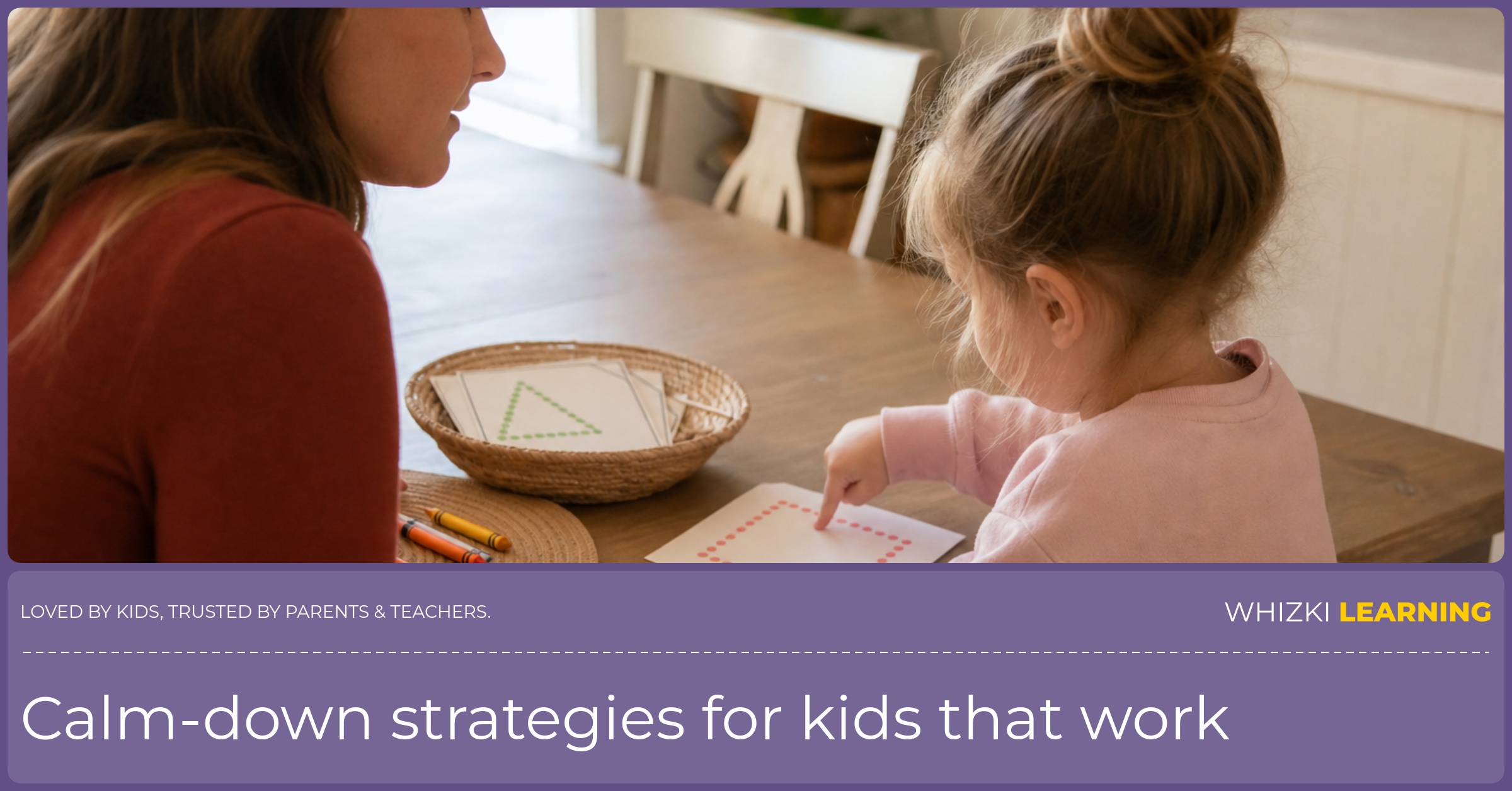
A breathing shape can be a square drawn on scrap paper, a pretend flower in one hand, or a finger tracing a wavy line across the table. The adult models first: breathe in up the side of the square, pause across the top, breathe out down the side, pause along the bottom. The child may only copy one side at first, and one honest breath is enough during a real meltdown.
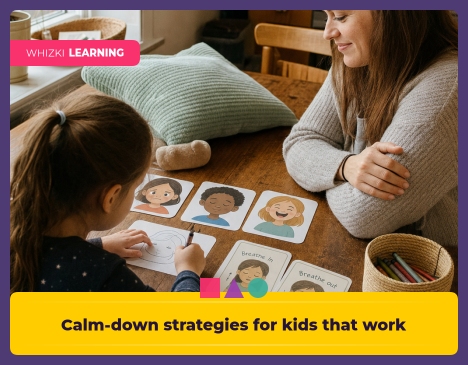
The printable feelings and breathing card set works well when the cards live near crayons, pillows, or a family read-aloud spot. Keep a few favorites from our printable library at child height so a preschooler can point before words are ready.
Make a calm-down corner that never feels like punishment
A calm-down corner is a practice space, not a banishment spot. Montessori and Reggio classrooms often use prepared spaces where children can choose materials with care, and the home version can be as simple as a pillow, a basket, and two picture cards.
The calm-down corner should be introduced on a good day, not during the hardest five minutes. Sit together, touch each item, and say, "The quiet corner helps bodies rest. A grown-up can come with you." When the child hears the corner described as help, the child is less likely to hear shame.
A useful calm-down corner needs fewer materials than most families expect. Choose one soft object, one breathing card, one feelings card, and one quiet job such as tearing paper strips for collage. Too many choices can become another problem for a 3-year-old or 5-year-old who already feels flooded.
Add heavy work when the body needs a job
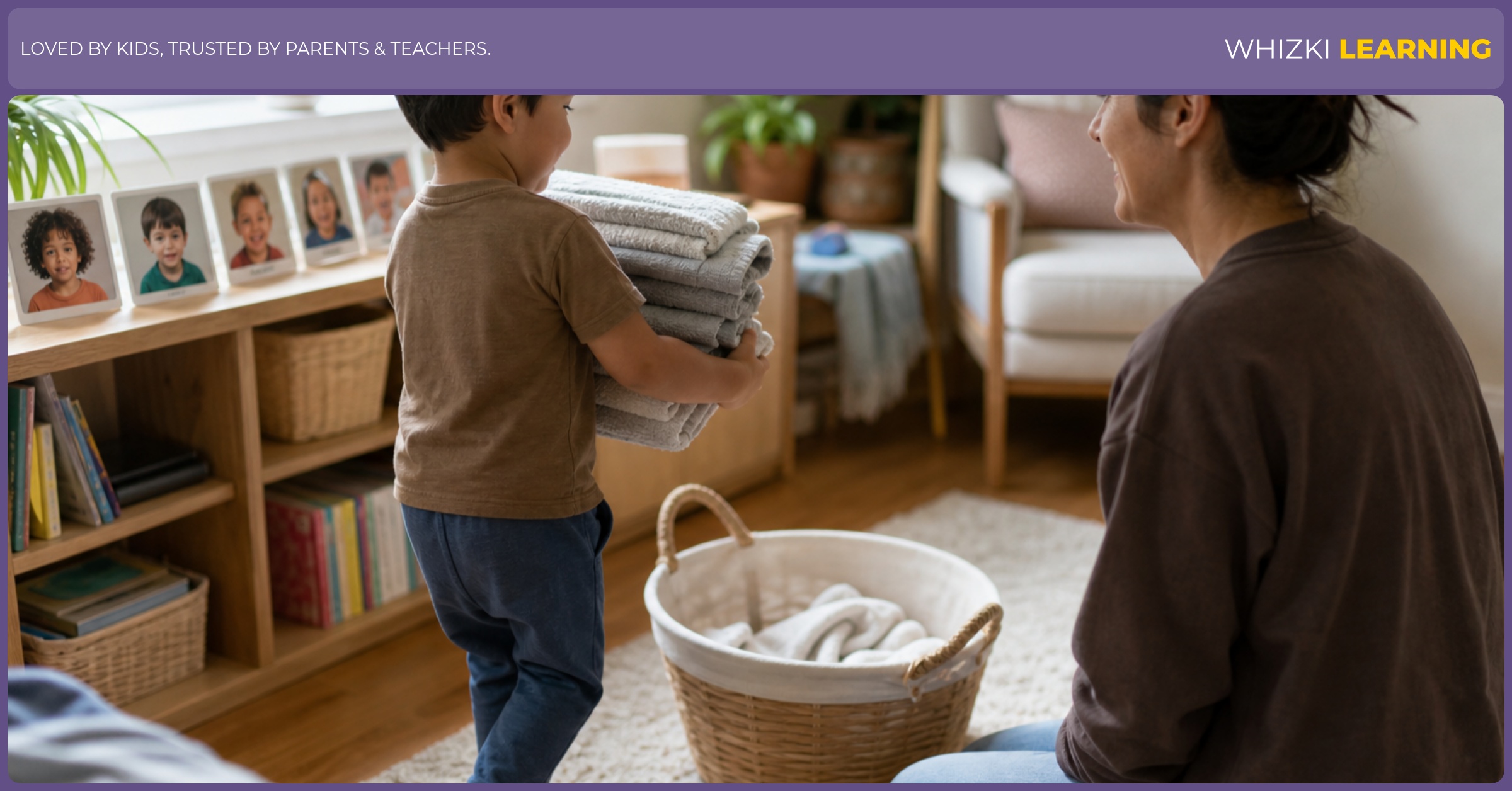
Heavy work gives muscles and joints a strong job, and occupational therapy basics often describe heavy work as calming input for many children. The home version does not need special equipment because wall pushes, laundry carrying, chair stacking, and bear walks can give the body clear information.
Heavy work should sound like an invitation, not a command. Say, "Your body needs a job. Push my hands five times," or "Carry these towels to the basket." The job works best when the adult joins for the first round and stops before the activity turns wild.
After-school meltdowns often respond well to movement before talking because young children have held many rules in one small body all day. A short menu of after-school calming activities can help families plan the first 20 minutes at home before snacks, homework talk, or sibling negotiations.
Name feelings after the storm, not during the roar
Feeling words help after the loudest part has passed. Speech-language pathology practice often pairs simple labels with pictures because young children can point, match, or repeat a word before children can explain a whole story.
A feelings card set should start with a few everyday words: mad, sad, scared, tired, calm, and proud. Hold up two cards and ask, "Was your face more mad or more scared?" The either-or choice gives the child a bridge into language without demanding a perfect answer.
Reggio-inspired observation helps adults look for patterns instead of blaming the child. Notice whether big feelings come before meals, after noisy rooms, during clothing changes, or when plans shift quickly. The pattern tells the adult which strategy to set up earlier tomorrow.
What to do during a real meltdown
A real meltdown plan should fit on the back of an envelope. Safety comes first, so move breakable objects, block unsafe hits with a pillow, and keep the adult voice low. The adult goal is not a fast fix, because the adult goal is a safe child and a steadier room.
The first minute can be only co-regulation, the second minute can add a breathing shape, and the next few minutes can offer heavy work or the calm-down corner. A child may refuse every option, and refusal does not mean the strategy failed. Refusal often means the adult needs to wait nearby and try again with fewer words.
The repair after a meltdown matters as much as the strategy during a meltdown. When the child is calm, use one feeling word, one boundary, and one next step: "You were angry. Hitting hurts. Next time, push the wall or call for me." The repair teaches without turning the meltdown into a courtroom.
Small calm-down practice on quiet days makes loud days easier, and no family needs a perfect script to begin. If kitchen-table help is useful, join the weekly newsletter for one small parent-friendly idea each week.