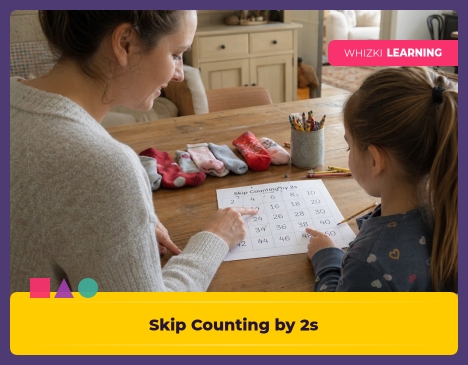
If your child can count to 20 but freezes when a worksheet asks for 2, 4, 6, grab ten socks and make pairs before you hand over a pencil. Skip counting by 2s is easiest when the pattern starts in a real pile of objects, not on a blank page. A calm two-minute game gives the brain and the hands a path into the chart.
Reviewed by Dr. Anna Klein, EdD, Early Childhood Curriculum Specialist.
What skip counting by 2s means
Skip counting by 2s means saying every other counting number in order, such as 2, 4, 6, 8, and 10. In NAEYC-aligned early math, young children need to see the quantity first, hear the words often, and then connect the pattern to numerals on paper.
Two comes before five because pair-making is visible to a child: two socks, two shoes, two eyes, and two hands make the pattern concrete. Counting by 5s often depends on a larger group that a child cannot check as quickly, so 2s give a steadier first step into skip counting.
The numbers learning hub can support that bigger path when a child needs review beside the 2s pattern. I like to pair a quick look at the numbers learning hub with a close-up review of the number 2 page before asking for written answers.
Printable chart and worksheet routine
A skip counting by 2s chart should show the full path from 2 to 20 before a child writes missing numbers. Montessori practice reminds adults to move from concrete objects to pictured quantities to written symbols, so the chart is a bridge rather than a test.
The 100 chart is helpful when a child is ready to notice that every 2s number lands in a steady column pattern. Use the 100 chart with a crayon dot on 2, 4, 6, 8, and 10, then stop before the page turns into a stamina chore.
A simple worksheet routine works best in three short passes: trace the 2s path with a finger, say the numbers aloud, and write only a few missing numbers. The Orton-Gillingham approach uses multisensory practice for reading, and the same listen, say, touch, and write rhythm helps early math facts feel less slippery.
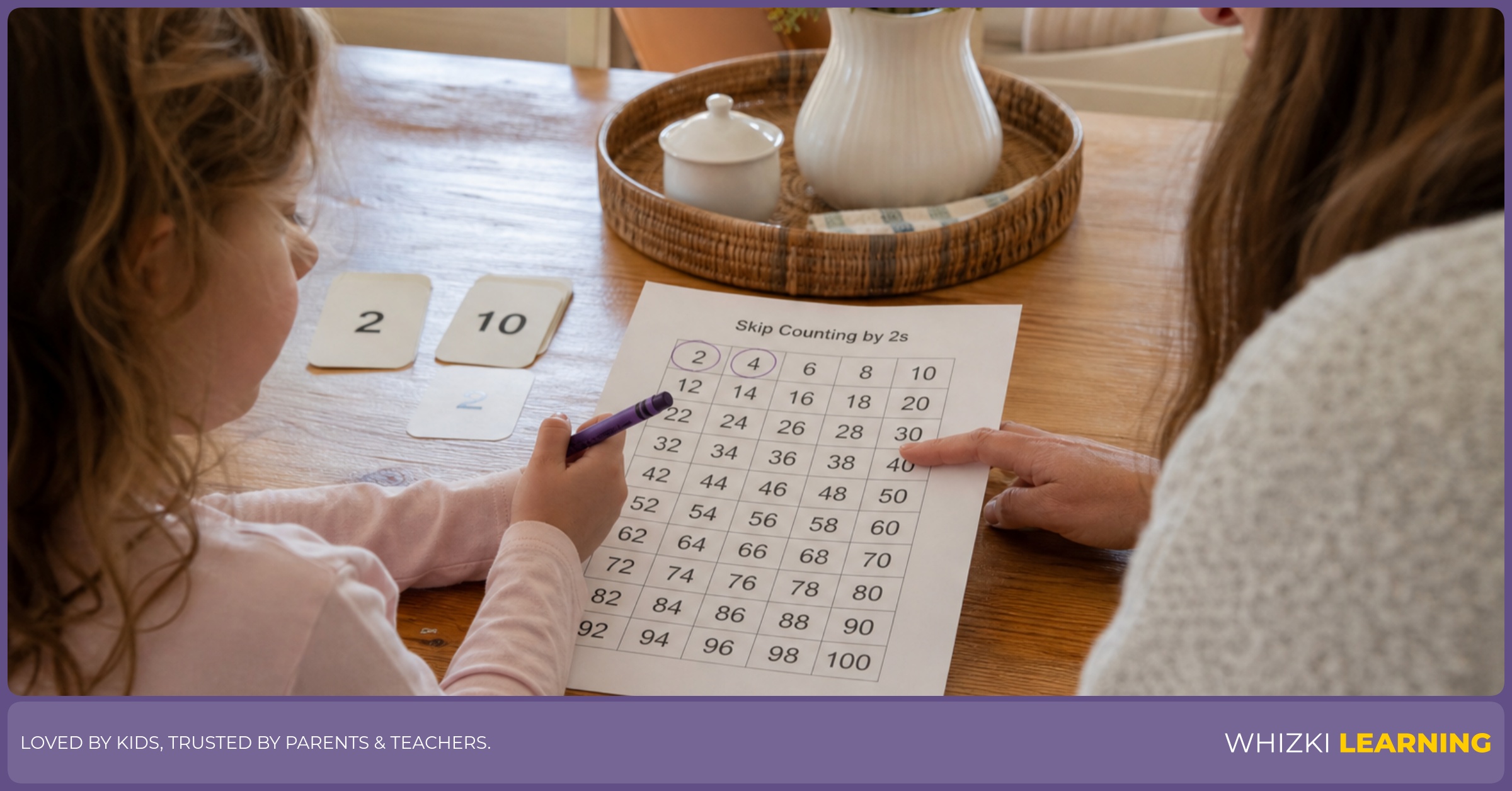
For ready-to-print practice, our printable library includes early number pages, and the premium Skip Counting by 2s Worksheet Set adds chart work, missing-number practice, and picture counting. The complete pack lives in Whizki Plus.
Three games for counting by 2s
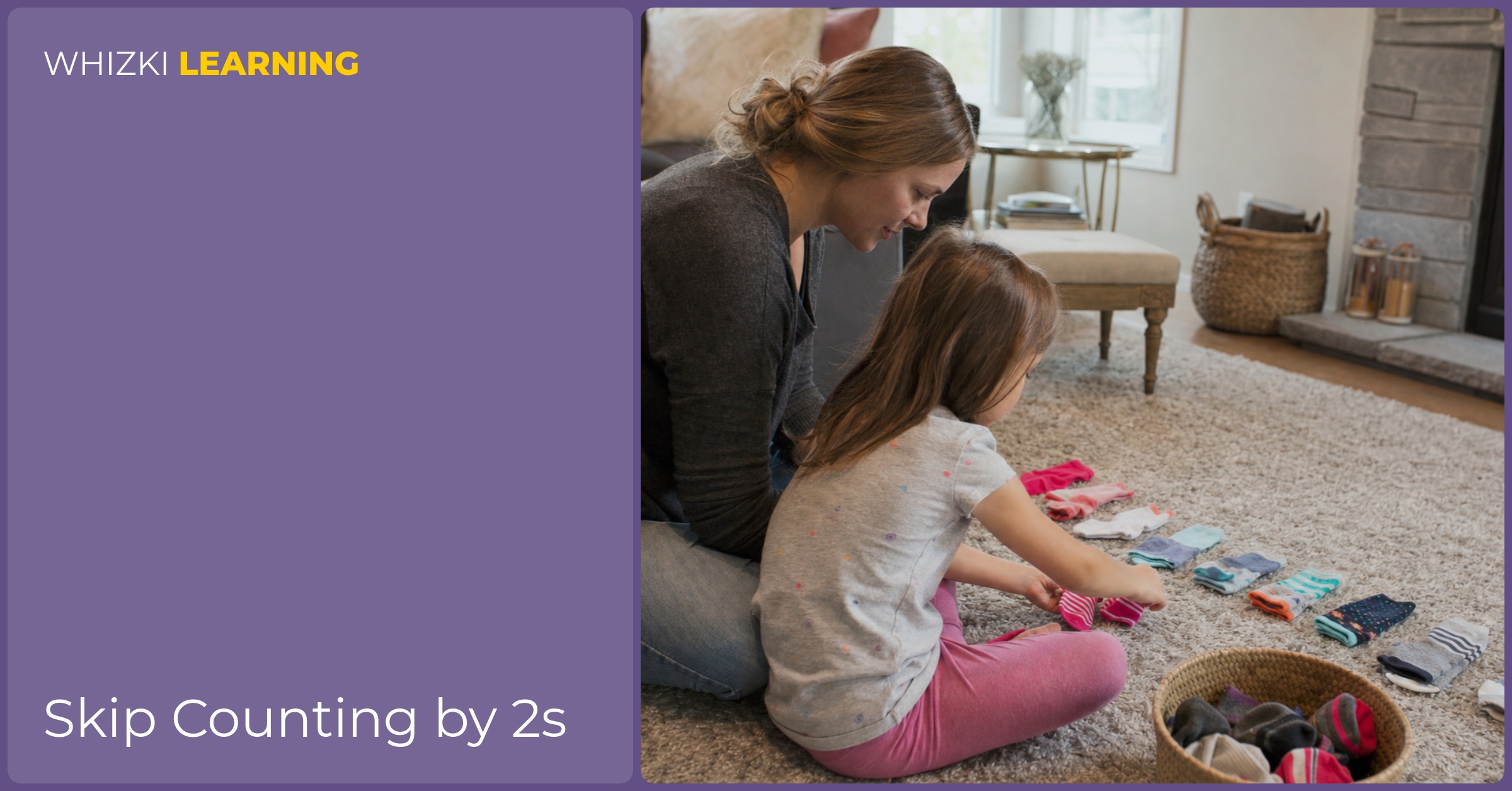
The sock pairs game is my first choice when a child needs the pattern to make sense. Occupational-therapy basics remind adults that hand movement, sorting, and crossing the midline can support attention, so a child can pair socks and tap each pair while saying 2, 4, 6, 8, and 10.
The sneaker count game works well near the door because the shoes already come in pairs. A child lines up sneakers, touches each pair with two fingers, and counts 2, 4, 6, 8 while the adult keeps the pace slow enough for accuracy.
The echo counting game is perfect for the car, the hallway, or a transition between tasks. The adult says “2,” the child echoes “2,” the adult says “4,” and the child echoes “4,” which mirrors speech-language practice that builds rhythm through call and response.
Reggio-inspired observation helps the adult choose the game by watching which material holds the child’s attention longest. A child who loves laundry may stay with socks, while a child who likes movement may count sneakers and step to each pair.
What to do when a child skips or guesses
A child who says 2, 4, 7 is usually showing that the pattern is still new, not that the child is being careless. Speech-language practice often uses a slower model and a repeated echo, so the adult can say “2, 4, 6” and invite the child to repeat only those three numbers.
A worksheet with too many blanks can push a young learner into guessing. NAEYC guidance favors playful, meaningful practice for early learners, so a parent or teacher can cover half the page and ask for three correct answers instead of a full sheet.
Handwriting can also get in the way of math. An occupational-therapy heuristic I use is to separate the counting skill from the pencil skill, which means a child may point, stamp, circle, or place counters before writing the final numerals.
How to use this first skip-counting post
This skip counting by 2s guide is the first post in a three-part skip-counting series for early learners. Montessori and Reggio practice both value careful sequencing, so 2s come first, then 5s, then 10s after a child has had many chances to count real objects.
A preschooler may simply pair socks and hear the rhythm, while a kindergartener may fill in a chart to 20 or 30. A first grader in the 6 to 7 age band may extend the same pattern on a 100 chart, but the practice should still feel quick, concrete, and checkable.
Skip counting by 2s does not have to become a kitchen-table battle. Start with pairs, add the chart, and keep the worksheet short enough that your child finishes with one accurate pattern to remember.