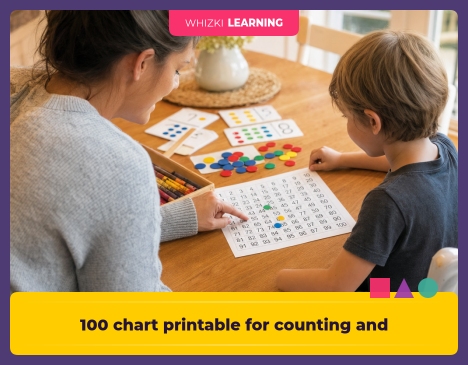
If the 100 chart turns into a crumpled-paper battle, print one full chart and one blank chart, then use the full chart as a calm pointing map for two minutes before asking your child to write anything. Children ages 3 to 7 often need the chart to feel like a tool, not a test. A short, playful routine can do more than a long worksheet session at the end of a hard day.
Reviewed by Whizki Editorial Team, Early Childhood Education Editors.
What a 100 chart printable includes
A 100 chart printable is a ten-by-ten grid that shows the numbers 1 through 100 in order. A full 100 chart gives children a visual map for counting forward, counting backward, and seeing how numbers sit in rows. A blank 100 chart gives children space to fill in the sequence with support nearby.
A missing-number 100 chart leaves selected spaces empty so children can use nearby numbers as clues. In my classroom, the full chart comes first because NAEYC guidance asks teachers to build from concrete, meaningful experiences before expecting independent paper work. The missing-number page comes later, after children have touched, pointed, counted, and talked through the pattern many times.
The 100 chart also connects nicely with number recognition practice in the numbers learning hub. Young children learn best when the same number appears in more than one place, such as on a chart, on a card, on a block, and in a spoken counting game. Repeated, low-pressure exposure helps the printed symbol become familiar.
How to print and set up a 100 chart
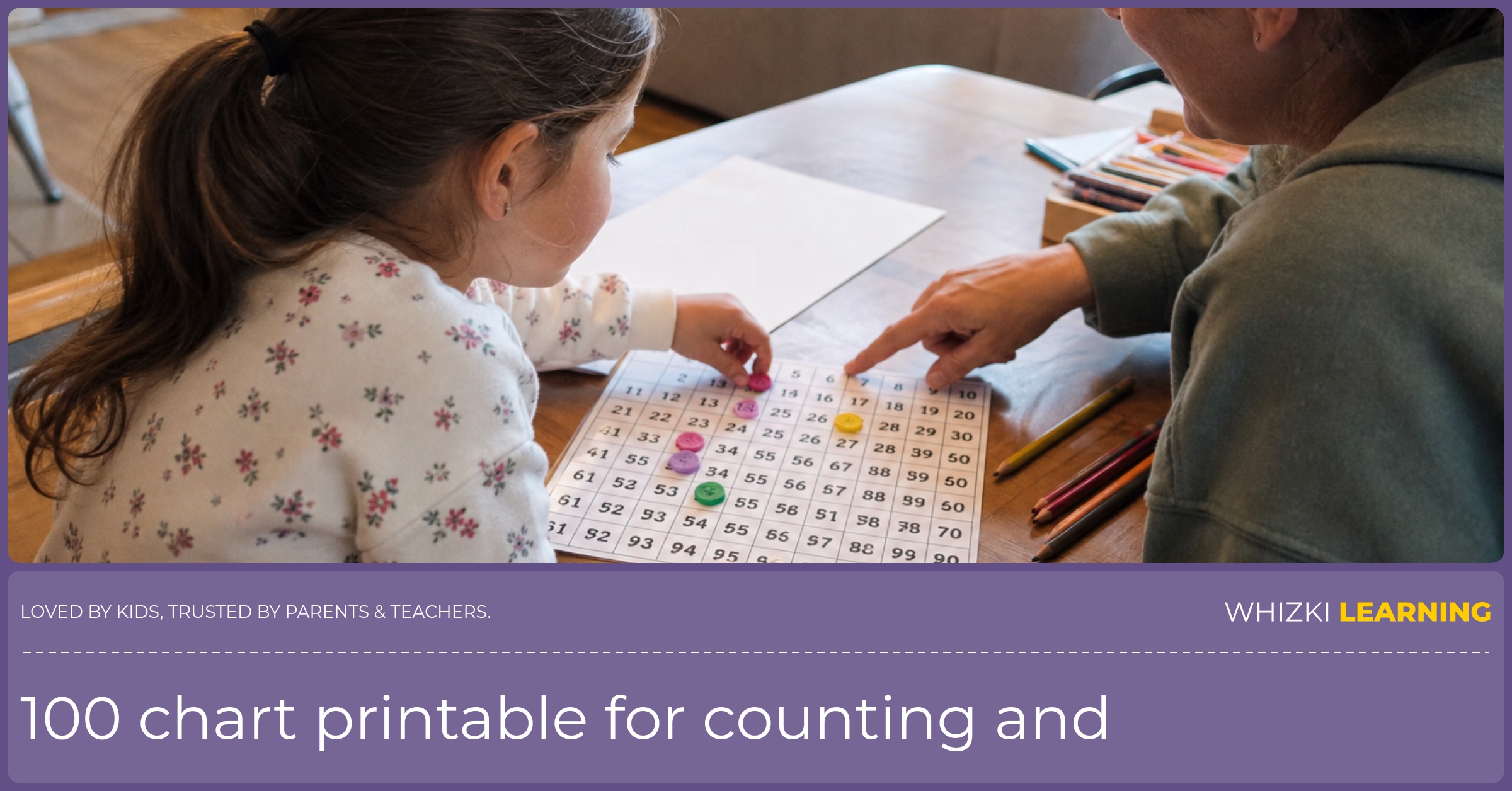
The 100 chart printable works best when the page is easy for small hands to manage. Occupational-therapy basics remind teachers and parents to notice posture, paper position, and pencil grip before blaming a child for messy writing. A clipboard, a slanted binder, or a page taped to the table can keep the chart from sliding around.
The full 100 chart can be printed on regular paper for quick practice or on cardstock for repeated use. A clear page protector turns the chart into a dry-erase mat, which is helpful for children who worry about mistakes. A small cup of buttons, cereal pieces, or plastic counters gives the child something to move while counting.
The printable setup should match the child in front of you, not an ideal lesson plan. Families who like keeping math pages in one spot can gather counting pages from our printable library and store the 100 chart in the same folder. A predictable folder lowers the daily hunt for paper, which matters when everyone is already tired.
For families who want the pages already sorted, the 100 Chart Practice Pack is the relevant premium worksheet set, with full charts, blank grids, and missing-number practice in one place. You can find the pack alongside our worksheet sets. The complete pack lives in Plus.
Ten hands-on 100 chart activities
The 100 chart becomes more useful when counting involves the eyes, ears, hands, and voice together. The Orton-Gillingham approach is best known for reading, but the same multisensory idea helps early math because children connect symbols with movement and speech. Keep each activity short enough that the child can finish with a little energy left.
Count and tap asks the child to touch each number while saying the number aloud. Cover one square lets the adult hide a number with a counter while the child uses the row to name the hidden number. Number hunt gives the child a target, such as 17 or 42, and the child circles or covers the number without racing.
Skip count by twos, fives, and tens helps children hear the rhythm of repeated counting. Color every tenth square shows the column pattern that many children notice before children can explain the pattern in words. Before-and-after practice asks for the number just before 36 or just after 64, which builds flexible counting rather than memorized chanting.
Race to 100 works well with one die, one marker, and a rule that the child says the landing number before moving again. One more and one less practice uses neighboring squares, while ten more and ten less practice uses the square directly below or above. Build-the-number play asks the child to place that many counters near a chosen number, and pattern talk asks the child to describe what the colored or covered squares show.
Blank and missing-number chart ideas
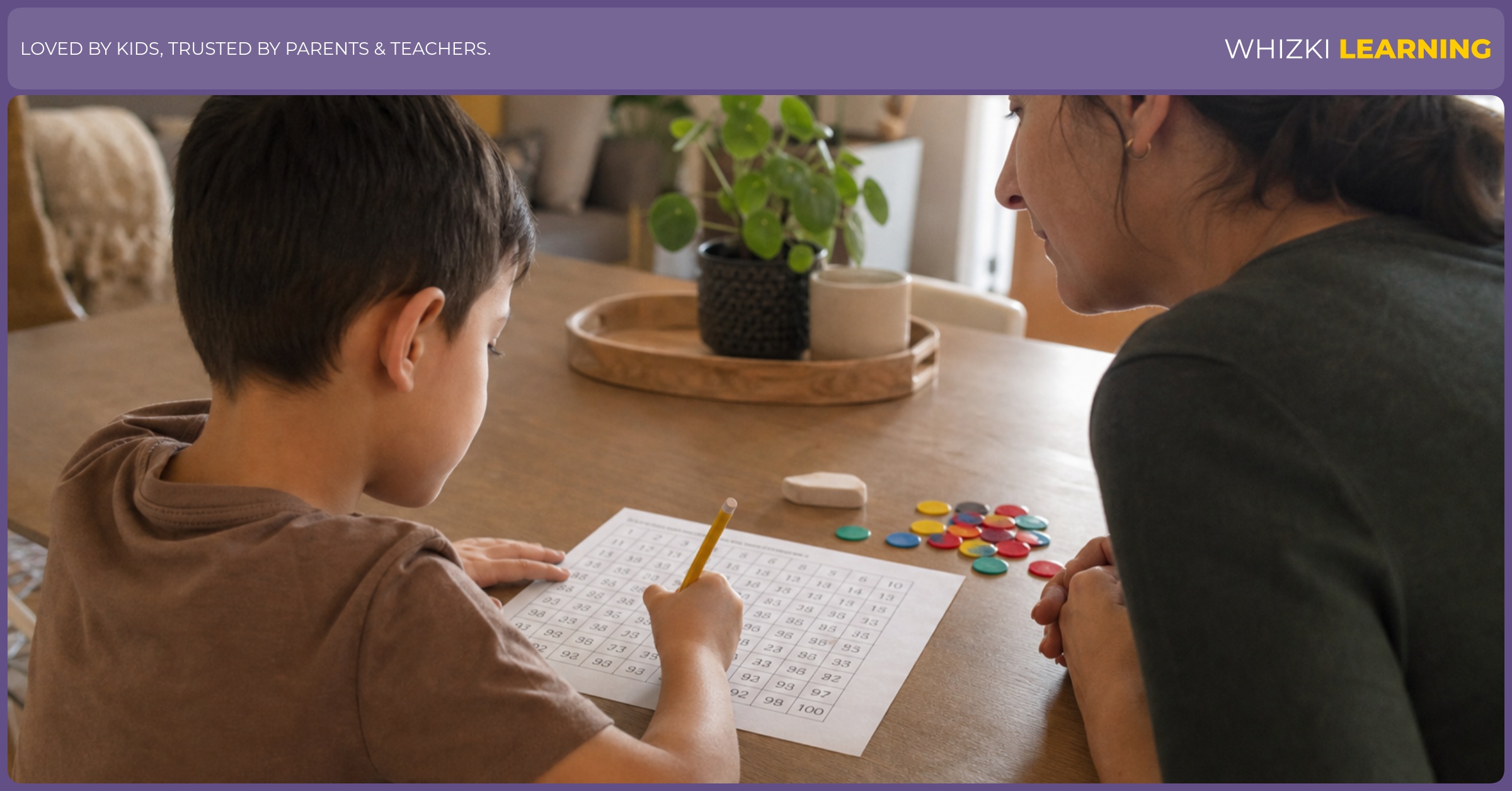
A blank 100 chart is best after a child has used the full chart enough to understand the row pattern. NAEYC-aligned practice favors building confidence through familiar materials before raising the challenge. For many children, filling only one row is a better first goal than filling the whole page.
A missing-number chart lets a child use nearby numbers as clues instead of starting from memory alone. Speech-language pathology practice often uses verbal reasoning prompts, and the same idea helps here when an adult asks, “What number comes right before the empty box?” The child learns to explain the answer, not just guess the answer.
Preschoolers may use the 100 chart mainly for finding numbers, covering spaces, and counting small sets. Kindergarten children may begin filling blanks, naming ten more, and noticing that each row adds ten. A child who becomes upset can return to the full chart and point, because pointing is still math work.
Troubleshooting common 100 chart snags
Number reversals are common in the 3 to 7 age range, especially with 2, 3, 5, 6, and 9. Orton-Gillingham-style teaching handles reversals with clear modeling, tracing, saying, and comparing rather than scolding. The adult can write the number once, let the child trace the number, and then ask the child to try again on a clean space.
Squirming during 100 chart work usually means the activity is too long, too still, or too hard for the moment. Occupational-therapy heuristics suggest changing the body demand before changing the child’s character story. Let the child stand, use a bigger marker, place counters with two fingers, or finish after one row.
A child who skips numbers may need more oral counting before more pencil work. Montessori and Reggio traditions both honor close observation, so watch whether the child loses the sequence, loses the place on the grid, or loses interest. The answer tells the adult whether to practice counting aloud, use a row marker, or shorten the task.
The 100 chart is a small tool, but the chart can carry a lot of early math practice when the adult keeps the work concrete and kind. Start with the full chart, add a few counters, and stop before the child is worn out. Blank and missing-number charts can wait until the full chart feels familiar under the child’s finger.