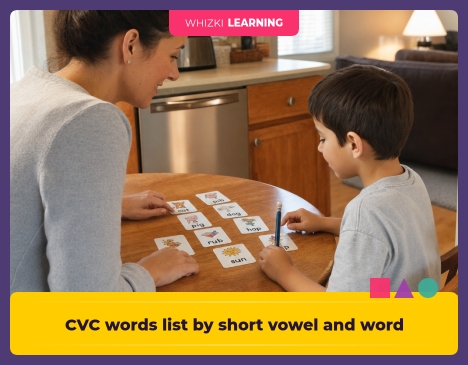
If your child guesses every word or gets stuck naming letters one by one, start with five CVC words, say each sound, then slide the sounds together like a slow rubber band. A short, calm practice round beats a long lesson, especially for preschool and kindergarten readers who still need movement, pictures, and grown-up support.
Reviewed by Whizki Editorial Team, Early Childhood Education Editors.
How to use a CVC words list
A CVC word has a consonant, a short vowel, and another consonant, such as a simple sound pattern of /m/ /a/ /p/. In Orton-Gillingham practice, the adult points under each letter from left to right, the child says the sounds, and the adult prompts a smooth blend rather than a letter-name spelling routine.
The best first step is to choose one short vowel for the whole session. The child hears the vowel more clearly when the word group stays consistent, and the adult can watch for the exact place where the blend falls apart.
The NAEYC guidance I lean on in classrooms is simple, young children learn best through short, meaningful, playful practice. Pair the CVC list with magnetic letters, a dry-erase board, or a few picture cards from our sight-words printables when the child needs a picture clue after blending.
The alphabet knowledge behind CVC reading still matters, so keep sound review quick and clear. If letter sounds are shaky, spend two minutes in the alphabet learning hub before reading the word list, then return to blending while the attention window is still open.
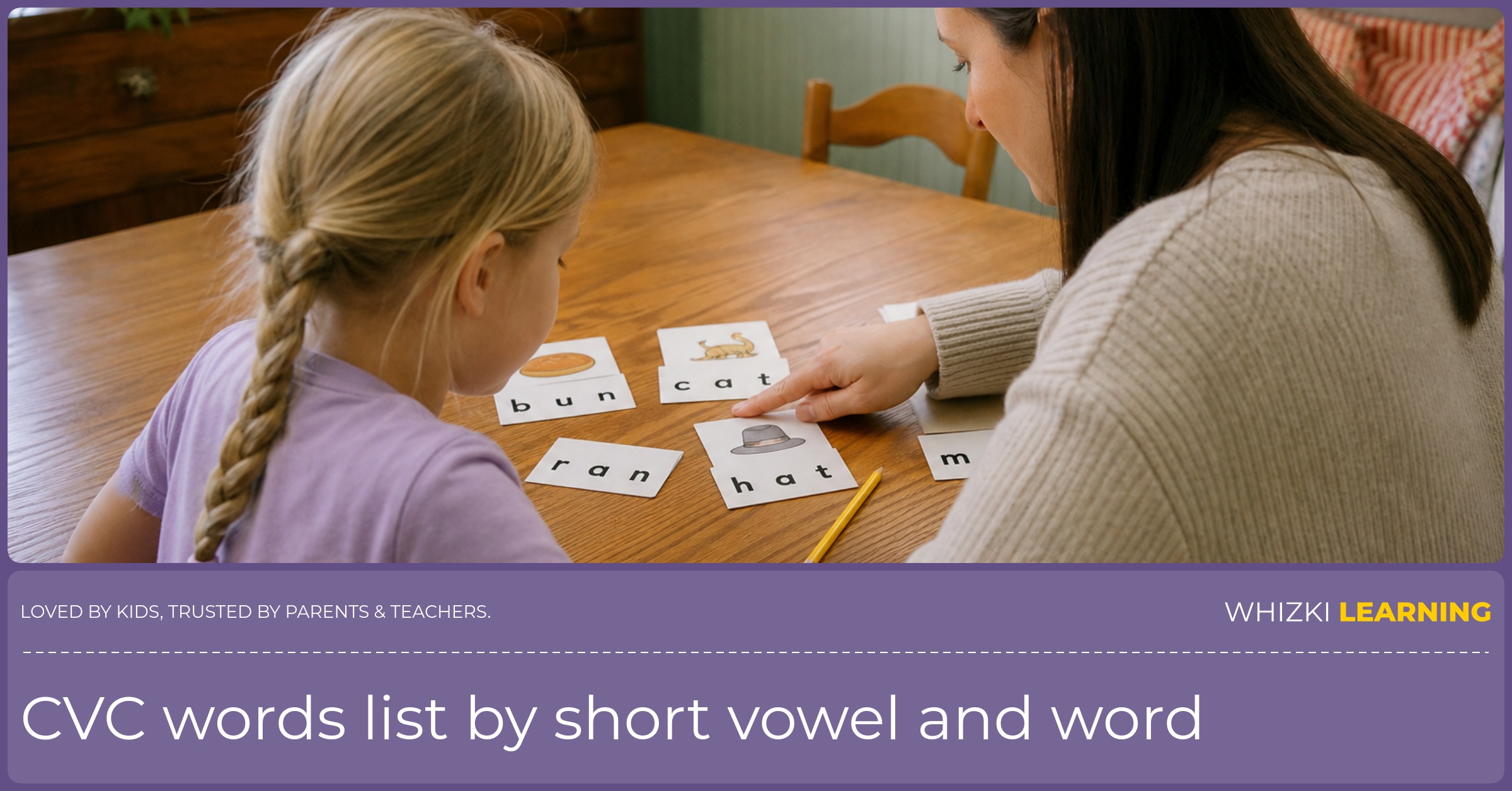
Short a CVC words
Short a is often a friendly starting point because many children can feel the open mouth shape. A speech-language pathology habit that helps is to have the child watch the adult model the vowel sound once, then the adult points to the letters without over-talking.
Read across one family before moving to the next family, because the ending sound stays steady while the first sound changes. Short a families: -ab: cab, dab, gab, jab, lab, nab, tab; -ad: bad, dad, had, lad, mad, pad, sad; -ag: bag, gag, lag, rag, sag, tag, wag; -am: bam, ham, jam, ram, yam; -an: ban, can, fan, man, pan, ran, tan, van; -ap: cap, gap, lap, map, nap, sap, tap, yap.
A Reggio-inspired observation lens helps the adult notice which words invite real interest. If the child laughs at an animal word or points to a household object, add a quick sketch beside the word and let the meaning carry the reading work.
Short e CVC words
Short e can feel less obvious than short a, so the adult may need to model the vowel carefully without turning the lesson into mouth drills. In Orton-Gillingham teaching, I keep the vowel card in the middle and tap the three sounds with a steady beat.
Read the short e list slowly at first, because many children want to swap the vowel for a more familiar sound. Short e families: -ed: bed, fed, led, red, wed, ted, ned, zed; -eg: beg, keg, leg, peg, meg; -en: den, hen, men, pen, ten, ben, ken, jen, yen, fen; -et: bet, get, jet, let, met, net, pet, set, vet, wet, yet; -eb: web, deb; -em: gem, hem; -ex: hex, vex, rex, tex.
Word families reduce the memory load because the child keeps one rime pattern in mind while changing the first sound. For a fuller explanation, read how word families speed up reading when planning the next week of lessons.
For a longer paper path, the CVC Word Families Worksheet Set in our worksheet sets pairs picture clues, tracing, blending, and simple dictation. The complete CVC practice pack lives in Whizki Plus.
Short i CVC words
Short i often needs extra ear training because the vowel can slide toward short e in everyday speech. An occupational-therapy basic I use is to add finger tapping, because the small motor pattern gives the child a clear place for each sound.
Keep the hand motion simple, tap thumb to finger for the first sound, middle sound, and last sound, then sweep the hand to blend. Short i families: -ib: bib, fib, rib; -id: bid, did, hid, kid, lid, rid; -ig: big, dig, fig, jig, pig, rig, wig; -im: dim, him, rim; -in: bin, fin, pin, sin, tin, win; -ip: dip, hip, lip, pip, rip, sip, tip, zip; -it: bit, fit, hit, kit, lit, pit, sit, wit; -ix: fix, mix, six.
A Montessori-style control of error helps here, because the child can match the blended word to one picture after reading. The picture should confirm the reading after the blend, not replace the sound work before the blend.
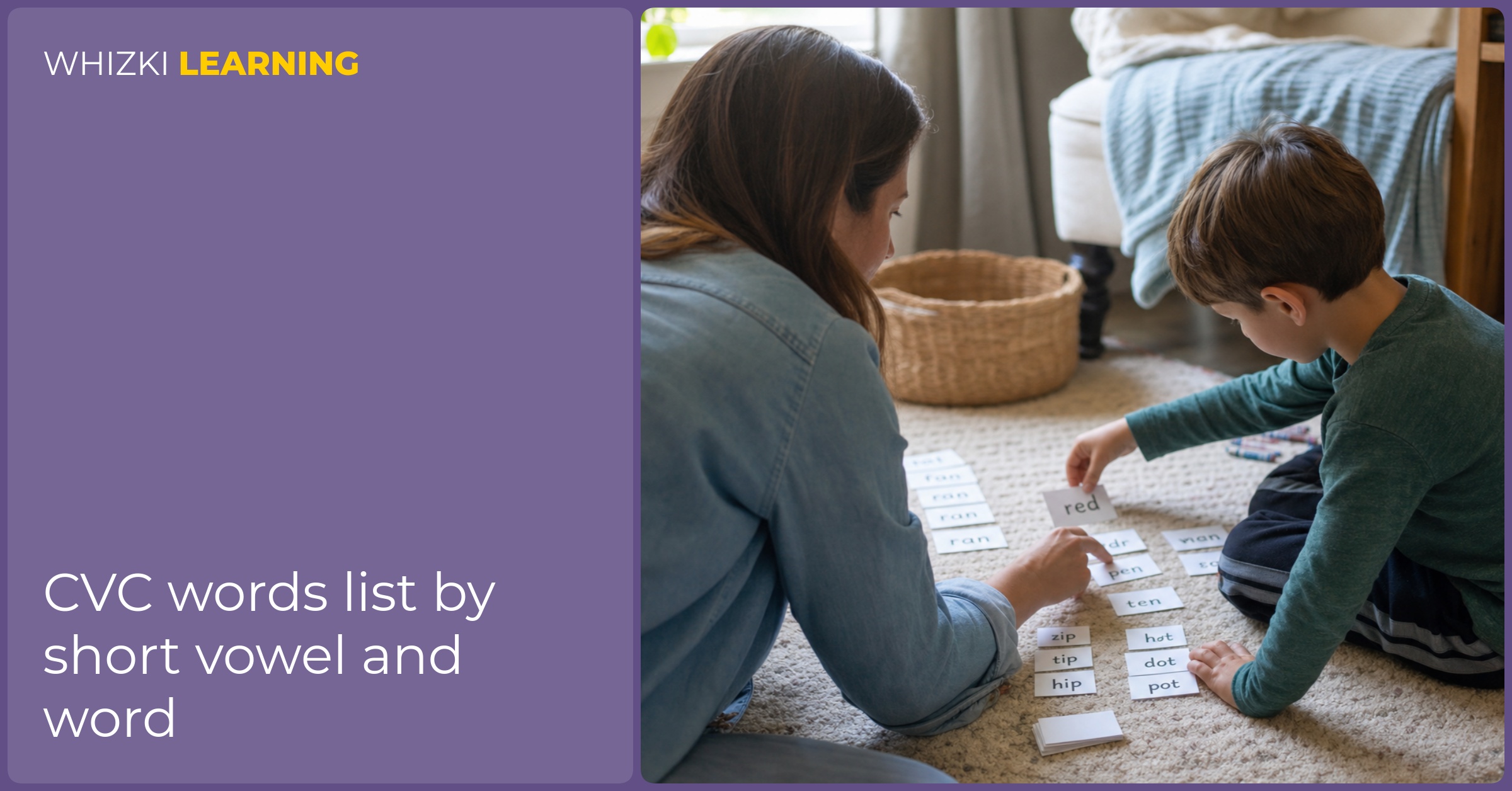
Short o CVC words
Short o is a good place to slow down and listen, because some regional accents change the vowel sound. In real classroom practice, I accept a child’s home speech pattern while still teaching the print pattern that the child will meet in books.
Use the short o families for oral blending, letter tiles, and quick dictation on a small whiteboard. Short o families: -ob: cob, job, lob, mob, rob, sob, bob; -od: cod, nod, pod, rod, mod, hod; -og: bog, dog, fog, hog, jog, log, cog; -op: cop, hop, mop, pop, top, bop, fop, lop, sop; -ot: cot, dot, got, hot, lot, pot, rot, bot, jot, not, tot; -ox: box, fox.
NAEYC-aligned practice keeps correction gentle and specific. Say, “Check the middle sound,” rather than “No,” because the child needs a clear next action more than a verdict.
Short u CVC words
Short u can be playful because the sound shows up in many action words and everyday nouns. A Reggio habit that works well is to follow the child’s interests, so a pretend picnic, toy cleanup, or block road can become a reading moment.
Read the short u list in small bites, because several words are easy to confuse when the child is tired. Short u families: -ub: cub, dub, hub, nub, rub, sub, tub; -ud: bud, cud, mud; -ug: bug, dug, hug, jug, mug, pug, rug, tug; -um: gum, hum, mum, sum, yum, bum; -un: bun, fun, gun, nun, pun, run, sun; -up: cup, pup, sup; -us: bus; -ut: but, cut, hut, nut, rut, gut, jut; -ux: tux.
Orton-Gillingham practice usually moves from sound to print to meaning, and that sequence works well at the kitchen table too. The adult says the sounds, the child blends the print, and both people use the word in a quick spoken sentence.
Printable routines for CVC practice
A printable routine works best when the adult keeps the paper load light. One page, one pencil, and one short vowel group is usually enough for a child age 3 to 7, especially after a long school day.
For a five-minute routine, ask the child to point, blend, circle the picture that matches, and read the same word once more. The occupational-therapy heuristic I follow is to reduce visual clutter, because busy pages make pencil control and sound tracking harder.
After the child reads several CVC words with ease, mix in high-frequency words from our sight-words printables so early books feel more natural. CVC decoding and sight-word practice are different skills, and both skills help a young reader handle a simple sentence.
A CVC words list is most useful when the adult treats the list as a practice menu, not a race. Pick one vowel, read a few families, stop while the child still feels successful, and return tomorrow with the same calm routine.