
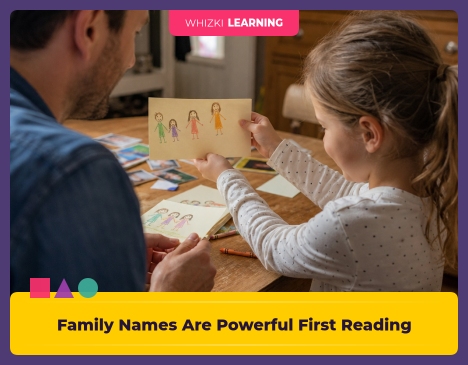
When the table needs place cards, a grandparent wants an easier spelling, and your child is sliding off the chair, write one real family name on a scrap of paper today and say the name the way that person prefers. Family names carry belonging, so the reading practice feels useful before the letter lesson even begins. A three-minute name label can do more for attention than a fresh stack of worksheets because the print already matters.
Reviewed by Sarah Mitchell, M.S., CCC-SLP, Speech-Language Pathologist.
Why family names work first
Family names are environmental print with a person attached. A child who may ignore a random word card often looks twice at Nana, Amir, Sofia, or 김 because the print points to someone loved. NAEYC guidance on developmentally appropriate practice reminds educators to begin with meaningful, familiar material before asking young children to handle abstract tasks.
Reggio-inspired teaching uses the child's real world as curriculum, and family names fit that stance beautifully. A place card, a drawing label, or a photo caption gives the child a reason to ask what the marks say. The adult can answer with warmth instead of turning the moment into a quiz.
Bilingual and multilingual families can use names as a bridge across home language, school language, and community language. A child who answers in a mixed language is still giving information, which is the same calm stance I shared in the previous bilingual home guide. Family names let the adult notice language choices without treating home language as a problem to fix.
Set up a five-minute name routine
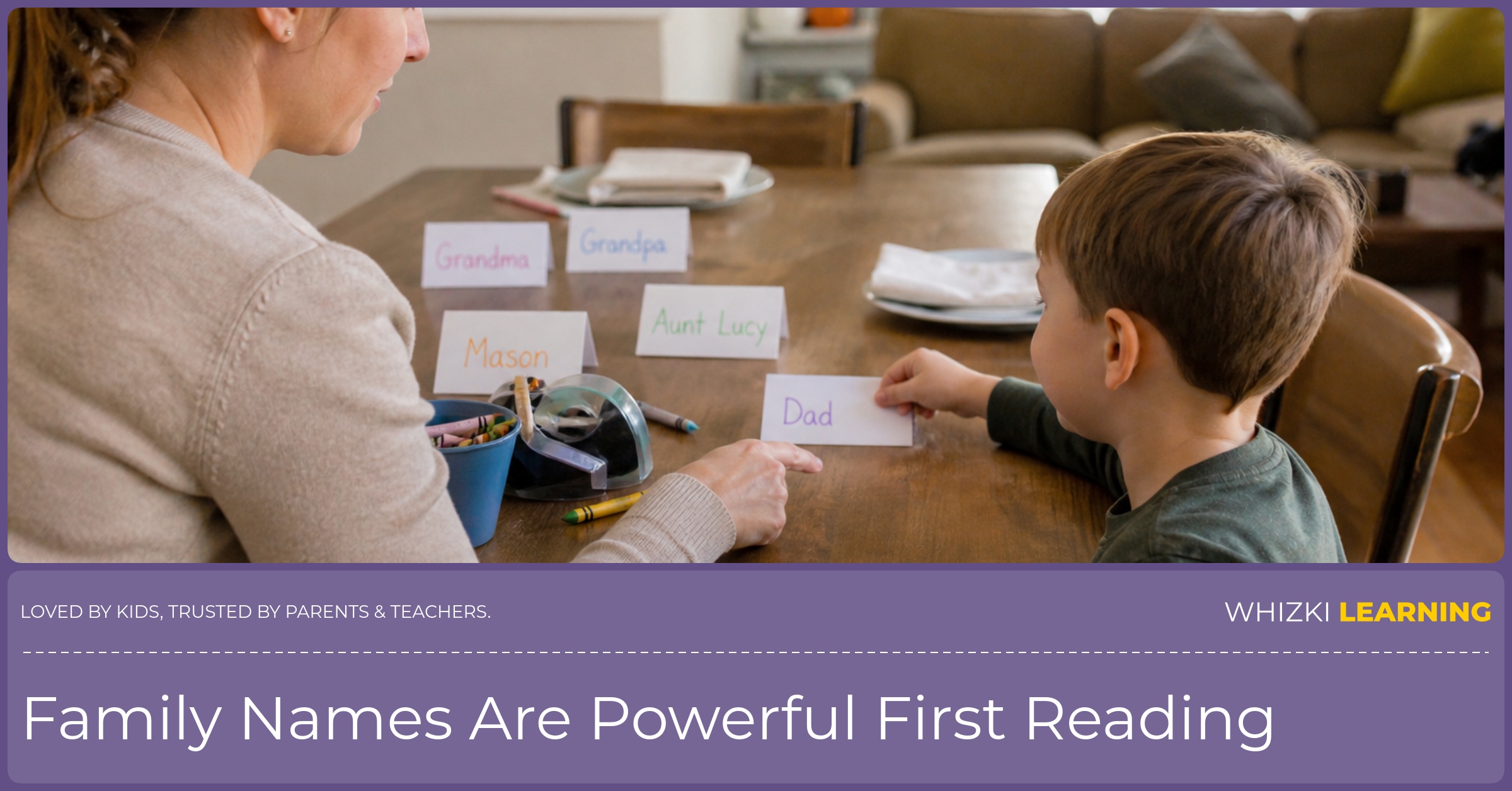
The five-minute routine needs index cards, a marker, tape, and two or three family photos or drawings. The adult writes each person's name in the spelling that person uses, then reads each name slowly while pointing under the print from left to right when the script is read that way. The child can choose where each card goes, such as beside a plate, under a drawing, or near a photo frame.
The first minute is for naming people, not testing letters. The adult can say the name, pause for the child to echo or listen, and then say one sound that is easy to hear, such as the first sound in Maya. A 3-year-old may only match the card to the person, while a 6- or 7-year-old may notice that Marcus and Mateo start the same way.
The Orton-Gillingham approach teaches reading through clear, multisensory links between sound, symbol, and movement. Name cards can borrow that idea in a gentle way when the child says a sound, traces one letter with a finger, and hears the whole name again. If the adult wants a quick letter reference before sitting down with the child, the alphabet learning hub can help with letter names and common sounds.
For families who want ready-made letter pages near the table, Whizki Learning offers printable alphabet practice in the main learning hub that can sit beside homemade name cards. The printable pages work best as a short add-on after a real name has been noticed, read aloud, and used for a job.
Honor spelling, scripts, and sounds
Preferred spelling is part of the reading lesson. The adult should write Cristina if the person uses Cristina, not Christina because the adult expects that spelling. Respecting the name tells the child that print belongs to people, families, and histories.
A speech-language pathology habit that helps at home is to listen first, then model clearly, and then give the child another chance without pressure. The adult can say, I hear you saying Tio Lalo, in our family we say Tío Lalo, and then move on with the place card or photo. The correction stays small because the relationship matters more than a perfect repeat.
Names in Arabic, Hebrew, Hindi, Korean, Chinese, Japanese, or another script do not need to be replaced by English letters to count as reading material. The adult can place the home-script name above or beside a school-language version when the family wants both forms shown. If the adult cannot read the script, the adult can ask a relative for the exact spelling and pronunciation instead of guessing.
Make photo labels and drawings do work
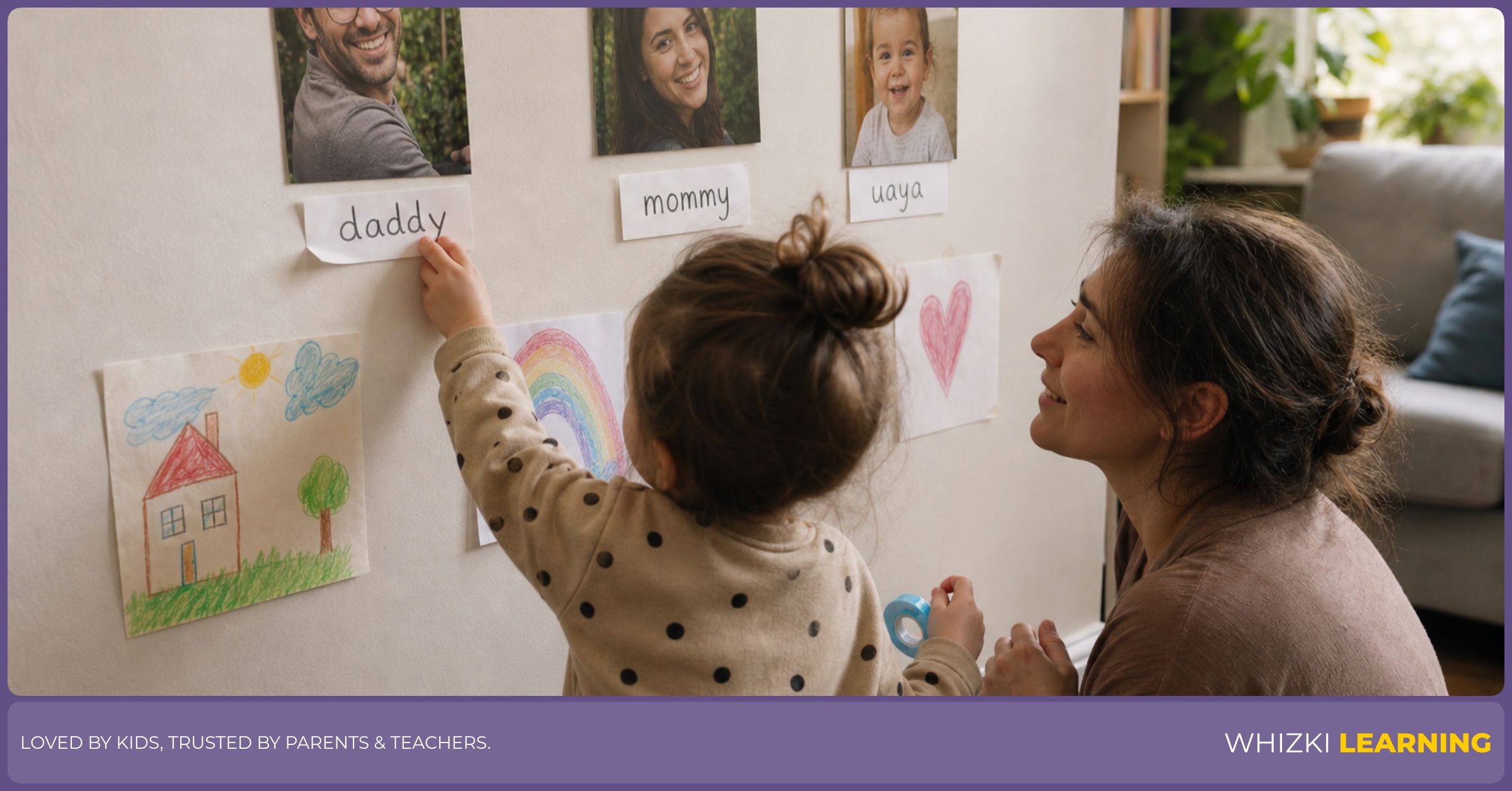
Photo labels are easiest when the print has a clear job. The adult can tape a name under a family photo, point to the face, and say the name while the child touches the label. The NAEYC idea of connecting learning to children's real relationships fits neatly here because the child is reading a label that explains the child's own world.
Montessori practice often asks adults to prepare the environment so the child can return to meaningful work without a long speech. A small family-name shelf can hold three photos, three labels, and a basket of blank cards for new drawings. The child can match a label to a photo, draw a cousin, or ask for a new name to be written.
Age changes matter during photo-label work. A 3- or 4-year-old may point to the first letter and say the person's name from memory, which is still useful print awareness. A 5- to 7-year-old may compare endings, hear shared sounds, or notice that two names look alike in one script and different in another.
Keep the practice warm and small
Occupational-therapy basics remind me to watch the body before asking for more print work. A child who is gripping the marker tightly, leaning on the table, or rubbing eyes may need a shorter turn, a thicker crayon, or a chance to stand while tracing. The name activity should feel like useful family work, not a handwriting endurance task.
Honest limits keep the routine healthy. Family names will not teach every sound pattern, every letter form, or every rule a beginning reader needs. Family names are a doorway into noticing print, and the adult can add songs, read-alouds, phonological games, and explicit letter work across the week.
Developmentally appropriate practice also means the adult does not turn every meal into a lesson. The kindergarten teacher, caregiver, or homeschool parent can use name cards once or twice a week and then let the table be the table. If the child resists, the adult can model one name aloud and stop while the feeling is still friendly.
Family names give early reading a real purpose: someone is being seen, welcomed, and named correctly. Start with one card today, use the spelling and pronunciation the family prefers, and let the child touch, move, and hear the name before asking for any letter answer. The small routine can become a calm bridge between home language, school language, and the first steps into print.