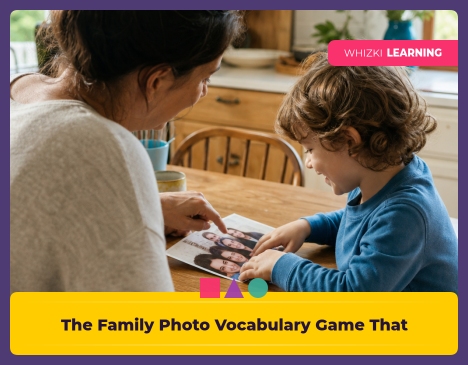
When dinner is late, the laundry is loud, and a child is begging to swipe through family pictures, choose one calm photo and ask, "Who is here?" before the scrolling starts. The family photo vocabulary game gives the busy adult a two-minute language turn with no worksheet, no performance mood, and no need to quiz every detail.
Reviewed by Sarah Mitchell, M.S., CCC-SLP, Speech-Language Pathologist.
Set up one photo in two quiet minutes
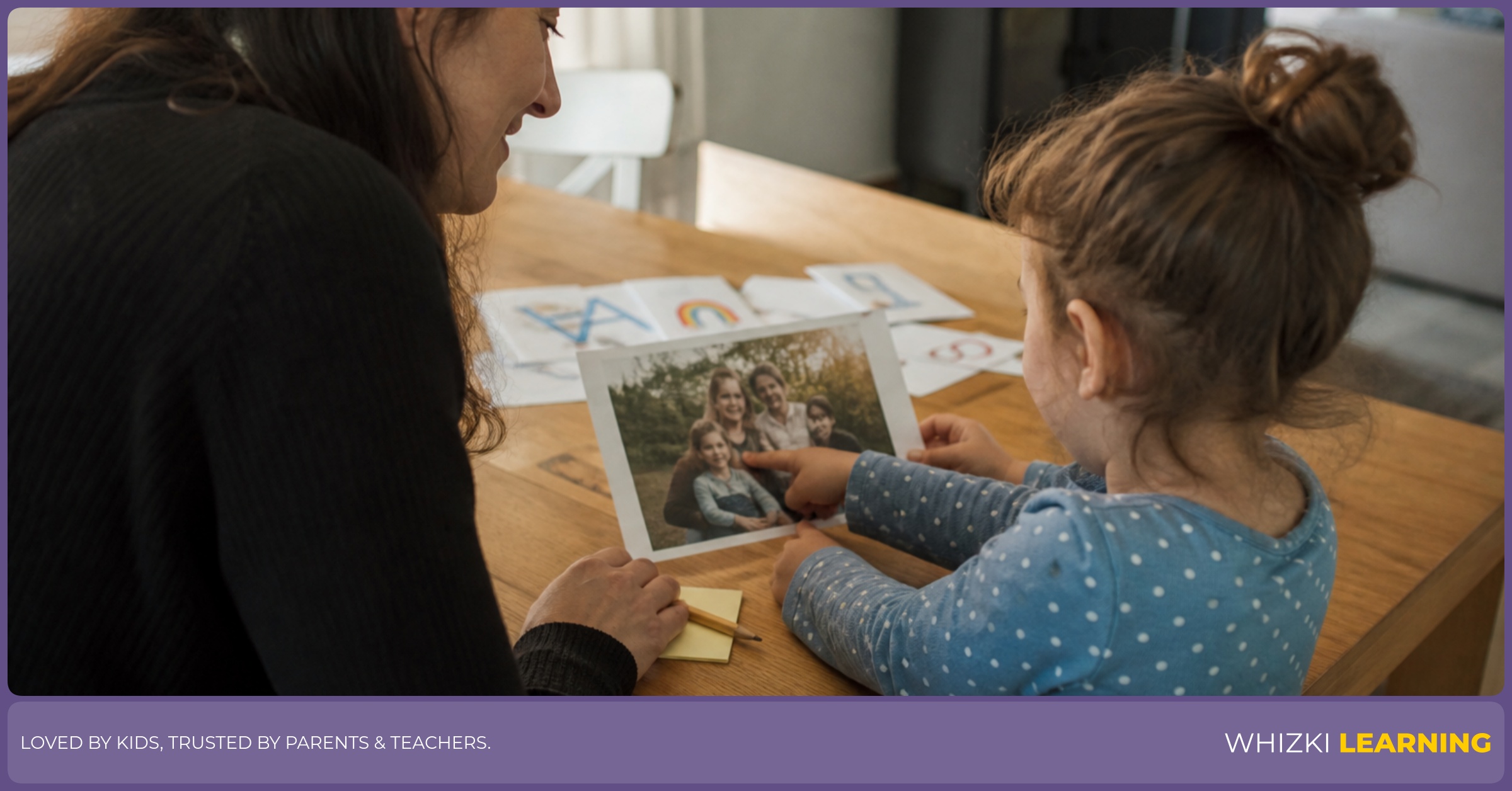
The family photo vocabulary game works best with a picture that already feels safe and ordinary, such as a picnic, a birthday table, a pet on the couch, or a walk outside. Reggio-inspired teaching treats real family images as meaningful materials, because children often talk more freely about familiar faces than about random cards. NAEYC guidance also reminds early-childhood adults to start with the child’s culture, home life, and interests before adding school words.
The material list is small: one printed photo or one paused picture on a device, a sticky note, and a pencil or crayon. An occupational-therapy basic helps the game feel easier, so place the photo flat on the table, support the child’s feet when possible, and let small hands point instead of requiring eye contact. A three-year-old may only tap a face, while a seven-year-old may want to label several parts of the scene.
The bilingual naming option starts with the language that feels most natural at home. Speech-language pathology practice supports rich input in a home language, so the adult can say "abuela" and then add "grandma" without turning the moment into a correction. The child may answer in either language, mix languages, or use a gesture while the adult models a clear phrase.
The sensitive-photo rule comes before the vocabulary goal. If a picture includes a hospital room, a family conflict, a missing relative, a scary event, or a pet that has died, put the photo away and choose another image without asking the child to explain feelings on demand. Safety and trust matter more than getting a longer sentence.
Play the five-question loop
The five-question loop stays simple: who, where, action, feeling, and detail. The Orton-Gillingham approach often moves from clear oral language to sound and print, and the family photo game follows that order by letting children hear and say meaningful words before anyone writes. The adult’s job is to model language, not to fire off questions like a test.
The who question can sound like, "Who do you see?" and the where question can sound like, "Where are we?" The action question can be, "What is Dad doing?" and the feeling question can be, "How does the puppy look?" The detail question can be, "What tiny thing do you notice?" and the child can answer by pointing, naming, or telling a short story.
The age adjustment keeps frustration low. For ages 3 and 4, the adult can offer two choices, such as "Is the baby sleeping or eating?" For ages 5 through 7, the adult can invite a fuller sentence, such as "Tell me one thing Uncle Ray is carrying." Montessori observation reminds adults to watch the child’s hands and face, because restlessness often means the language load is too high for that moment.
The bilingual storytelling option can be a two-voice retell. The caregiver might name the people in Spanish, Arabic, Mandarin, or another home language, and the child might add one English action word from school. A teacher or homeschooler can honor both parts by repeating the idea in a smooth sentence rather than asking for a perfect translation.
Choose or skip the picture with a simple decision tree
The decision tree begins with one adult question: does the picture feel calm for the child today? NAEYC-aligned practice asks adults to respect family stories and emotional privacy, so the adult should skip any image that invites pressure or embarrassment. A child does not owe a story just because a grown-up sees a teaching chance.
The next branch looks at visibility. If faces, places, and actions are easy to see, the photo is a good fit for vocabulary work. If the photo is blurry, crowded, or full of inside jokes, the adult can save the image for casual reminiscing and choose a clearer picture for the game.
The feeling branch needs extra care. Speech-language pathology practice often uses emotion words in context, but the adult can keep feeling language gentle by saying, "Grandpa looks surprised," or "The baby looks sleepy," without demanding agreement. If the child corrects the adult, the child’s version can become the sentence for the day.
The final branch asks whether the photo invites a respectful family story. A Reggio-style teacher might say, "Tell me about the picnic," while a parent might say, "I remember that windy day." If the child changes the subject, the adult can follow the child’s lead and come back to photo talk another time.
Add print only when language is ready
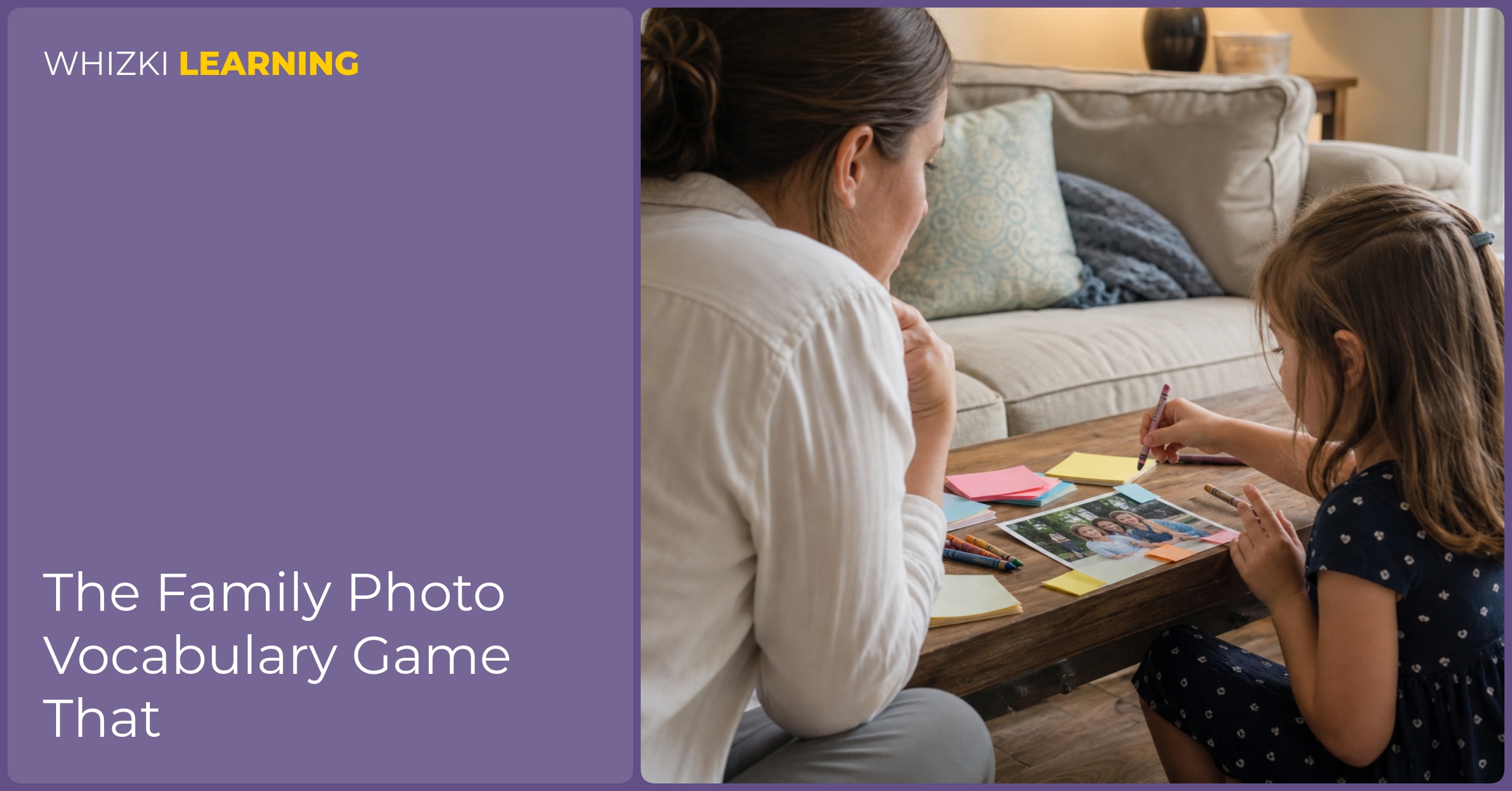
The print step belongs after the talk, not before the talk. Orton-Gillingham practice keeps sound, meaning, and print connected, so the adult can write one useful word from the photo, such as "mom," "park," or "jump," and read the word aloud while the child watches. The child can trace the word in the air, copy the first letter, or simply decorate the sticky note.
The alphabet connection can stay light. When a child notices the first sound in a photo word, the adult can point to the alphabet learning hub for letter names, letter sounds, and simple practice ideas. A child who says "ball starts like Ben" is already making a useful sound link.
The sentence step can wait until the child has something to say. For a next-step writing idea, the previous literacy lab guide shows how a child’s own picture can become a first sentence without rushing handwriting. The same gentle idea works with a family photo: say the thought first, then write only the part the child can carry.
The honest limit is important for families and classrooms. A family photo game can build vocabulary, listening, and story language, but the game cannot replace a speech evaluation, hearing check, or vision check when a caregiver has ongoing concerns. Ask a pediatrician, speech-language pathologist, or early-childhood specialist when a child rarely responds to names, loses words, struggles to understand everyday directions, or becomes upset around ordinary communication routines.
For families who like a printable nearby, the vocabulary and early-reading pages inside the Whizki Learning Hub can sit beside a family photo as a low-pressure follow-up. Choose one page only, and let the child’s spoken story lead the paper work.
Make the game fit real life
The family photo vocabulary game can happen in a waiting room, at the kitchen table, during homeschool morning time, or in a preschool small group. Occupational-therapy basics still apply in each setting, so keep the photo close enough for pointing, keep the body comfortable, and stop before the child is worn out. Two good minutes are better than ten tense minutes.
The teacher version works well with family permission and careful privacy rules. A kindergarten teacher can invite each child to bring one safe photo from home, then ask the same who, where, action, feeling, and detail questions during a small-group turn. A Montessori or Reggio teacher can record the child’s exact words on a note card and display only pictures that the family has approved.
The parent version can stay wonderfully imperfect. If the child says one word, the adult can stretch the word into a sentence, such as "Yes, Grandma is cooking." If the child tells a long story with mixed-up timing, the adult can enjoy the story first and save correction for a calmer literacy moment.
The best family photo game is the one the child wants to revisit. Choose a safe picture, ask one warm question, and let the child point, name, laugh, pause, or tell a story in the language that fits the moment. Vocabulary grows best when connection stays in the room.