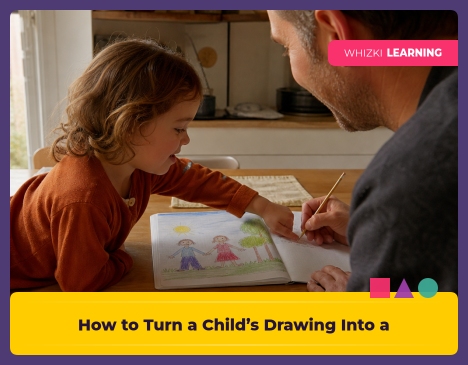
When your child draws a wild rocket-cat and then melts down because you ask, “What does your picture say?”, skip the quiz and say, “Tell me one thing about your picture, and I’ll write your words.” That one move turns the drawing into early writing without asking a tired hand to do grown-up spelling. A preschooler, kindergartner, or young first grader can join at the level that feels steady today.
Reviewed by Sarah Mitchell, M.S., CCC-SLP, Speech-Language Pathologist.
Why drawing talk counts as sentence work
The drawing is the child’s first draft because the picture holds the idea before the pencil has to hold letters. Reggio-inspired teaching treats children’s drawings, block buildings, and pretend play as real communication, so the adult listens before correcting. NAEYC guidance on developmentally appropriate practice also fits here because the writing task starts from the child’s meaning.
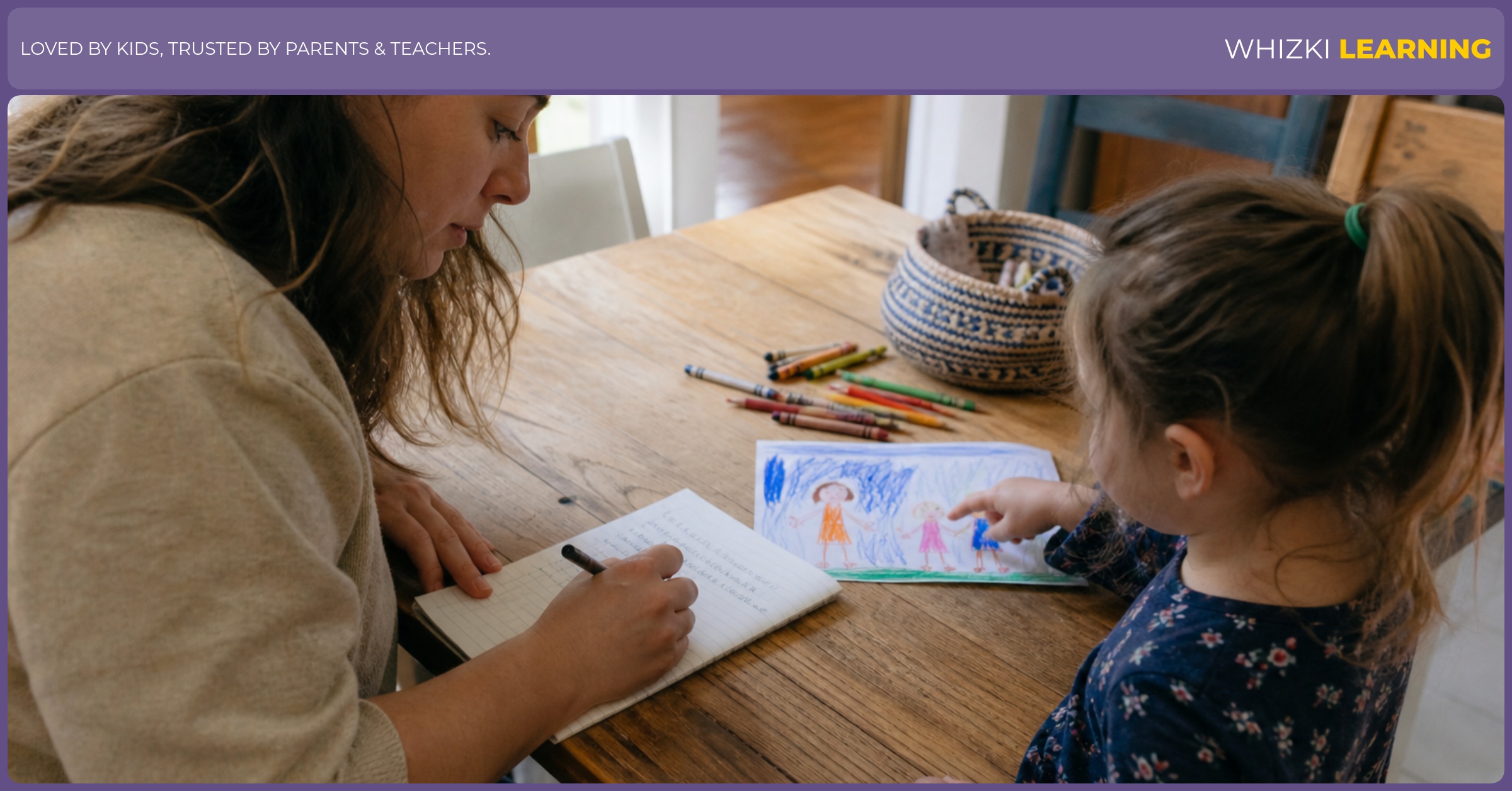
Speech-language pathology practice often values a clear adult model that expands a child’s message without taking ownership away from the child. Adult dictation does that by putting the child’s exact spoken words onto paper, then reading the sentence back so the child hears speech become print. The page becomes a language-to-print bridge, not a spelling test.
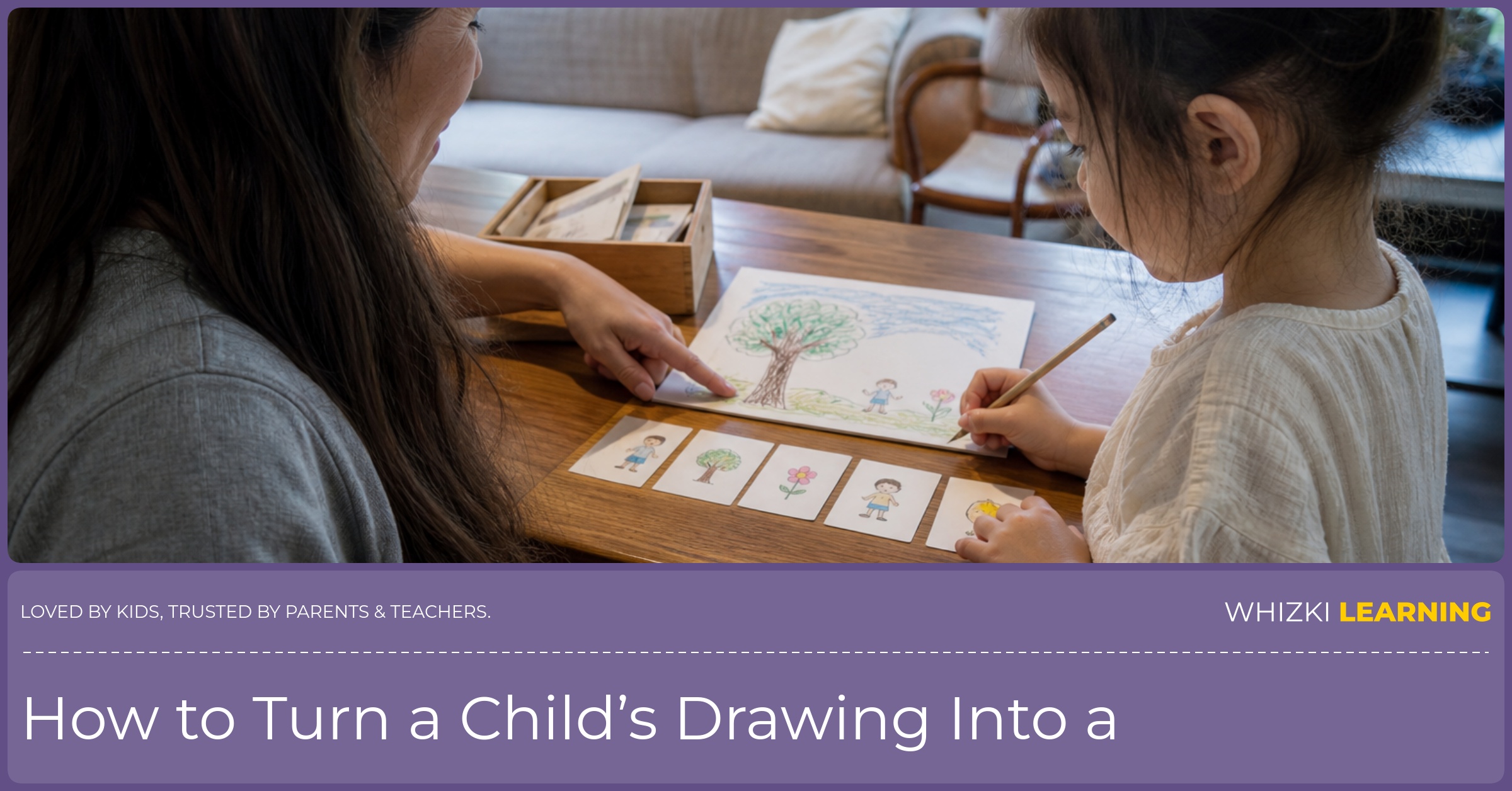
The starting setup is small: one drawing, one pencil for the adult, one marker or crayon for the child, and about five minutes. The adult sits beside the child, points to the picture, and asks one open question such as, “What is happening here?” The adult writes the answer as close to the child’s wording as possible, including charming grammar like “The dog runned fast.”
Choose the right participation level
The decision tree starts with the hand, not the sentence. Occupational-therapy basics remind adults that small hand muscles tire quickly, especially after a long school day, a car ride, or a busy birthday party. If the child’s grip looks tense, the adult writes the full sentence and the child stays in charge of the words.
Level 1 is adult dictation for ages 3 to 4, tired 5-year-olds, and any child who has a big idea but no patience for letter making. The child talks, the adult writes, and the adult reads the sentence back with a finger under each word. If the child says, “My dragon is cooking soup,” the adult writes exactly that sentence and avoids turning the moment into “Say it the right way.”
Level 2 is shared sentence building for many 5- and 6-year-olds. The adult writes most of the sentence, then invites the child to add one safe piece, such as a name, a first letter, a period, or a picture label. The adult can say, “I will write ‘The rocket goes,’ and you can write R for rocket or add the dot at the end.”
Level 3 is optional child writing for 6- and 7-year-olds who want more control. The child may write one known word, copy a short phrase from the adult’s model, or try invented spelling for a word that matters. The adult keeps the child’s message readable by quietly adding an adult-written version underneath when family members or teachers need to understand the page later.
Build the sentence out loud
The shared sentence begins with hearing the child’s words again. The adult says, “You said, ‘The rocket goes to Grandma’s house,’” then taps the table once for each word before writing. The Orton-Gillingham approach uses clear, multisensory links between speech, sound, and print, and the tap-say-write pattern gives young children a body cue for word spacing.
The adult can choose one useful sound to notice rather than stretching every word until the fun drains away. If the child draws a rocket, the adult might say, “Rocket starts with /r/. Your mouth growls a little at the beginning.” For a quick letter-sound refresh, the alphabet learning hub can support a short warm-up before the drawing sentence.
The sound step should stay light because the child’s story is the main event. If the child enjoyed sorting objects by beginning sound earlier in the week, the previous literacy lab guide pairs well with the same kind of listening. The adult can carry one familiar sound into the sentence, then stop while the child still feels proud.
Keep spelling and handwriting fair
Age-appropriate spelling expectations protect the child’s confidence. For ages 3 and 4, marks, pretend writing, letter-like shapes, and a first initial all count as participation. For ages 5 to 7, early spelling can include strong sound choices like “dg” for “dog” or “bote” for “boat,” while the adult model keeps the full sentence easy to read.
Handwriting expectations should match the child’s current motor control. Occupational-therapy heuristics favor short lines, stable seating, feet supported when possible, and tools that fit the hand rather than fancy pencil grips used too soon. A chunky crayon, a half-size pencil, or a marker on a vertical easel can make one word feel possible.
The honest limit is simple: a worksheet or printable cannot carry the whole writing lesson alone. If the child refuses to write, the adult can finish with dictation and try child writing another day. If pain, extreme fatigue, unclear speech, or vision concerns keep showing up across routines, the family should ask the pediatrician, occupational therapist, speech-language pathologist, or classroom teacher for guidance.
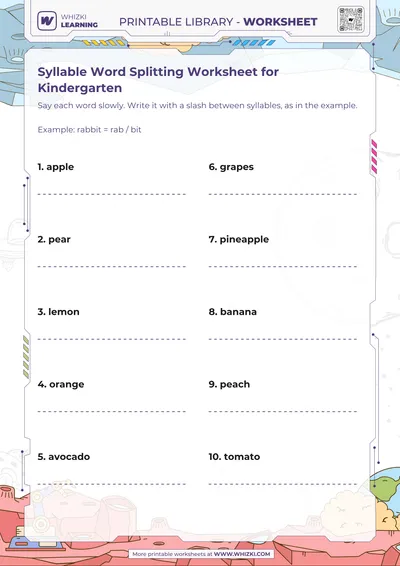
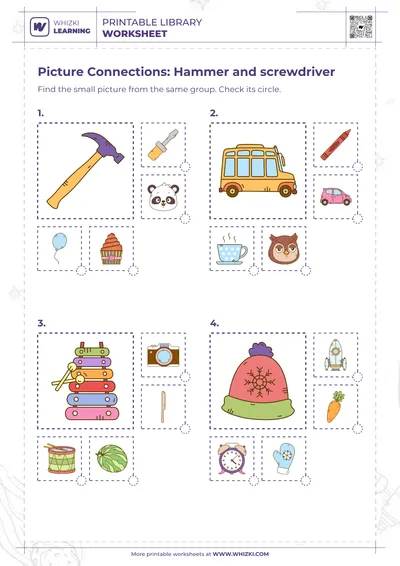
If a blank page makes the routine feel too open, browse the Whizki printable library for simple drawing and writing pages. Pick one page with a big picture space and one sentence line, then treat the page as a conversation mat rather than a spelling test.
Use a five-minute routine
The five-minute routine starts with observation, a practice valued in both Montessori and Reggio classrooms. The adult watches the drawing for a few seconds before asking for language, because the child may already be acting out the story with sound effects or gestures. The adult’s first job is to notice, not to rush the pencil.
Minute one is drawing or looking at a finished picture. Minutes two and three are child explanation and adult dictation. Minute four is shared sentence work, where the child adds a letter, word, space, or end mark if the child wants a job.
Minute five is rereading and celebrating the message. The adult points under each word while reading, then invites the child to read with help or echo one favorite part. The finished page can go on the fridge, into a homeschool folder, or beside a classroom cubby so the child sees drawing and writing as connected work.
A first sentence does not need perfect spelling, quiet posture, or a long lesson. A first sentence needs a real idea, a listening adult, and one small bridge from speech to print. Start with the child’s drawing today, write the child’s own words, and offer a tiny writing job only if the child’s hand is ready.