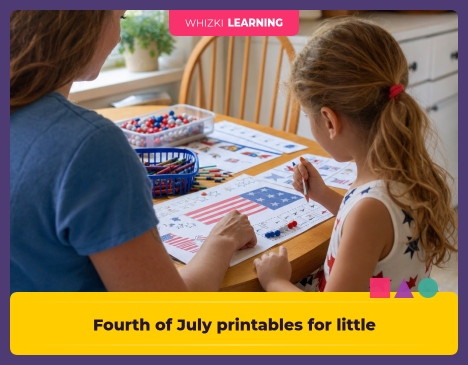
If the week before July 4th already feels crowded with cookout lists, late bedtimes, and a child asking for something to do, print the four-page pack and set out crayons, a pencil, and ten small counters before breakfast. Holiday pages work best when the table task is short, cheerful, and easy to pause when the family plan changes. The goal is a little practice, not a perfect finished page.
Reviewed by Whizki Editorial Team, Early Childhood Education Editors.
What is in the July 4th pack
The Fourth of July printable pack gives preschoolers, kindergarteners, and early first learners four familiar holiday pages: a flag coloring page, a star counting page, a patriotic tracing page, and a fireworks pattern page. NAEYC guidance on developmentally appropriate practice reminds teachers and parents to match the task to the child, so each page can be shortened, repeated, or finished with a grown-up nearby. The printable pack is meant for ages 3-7, with room for scribbles, careful marks, and everything between.
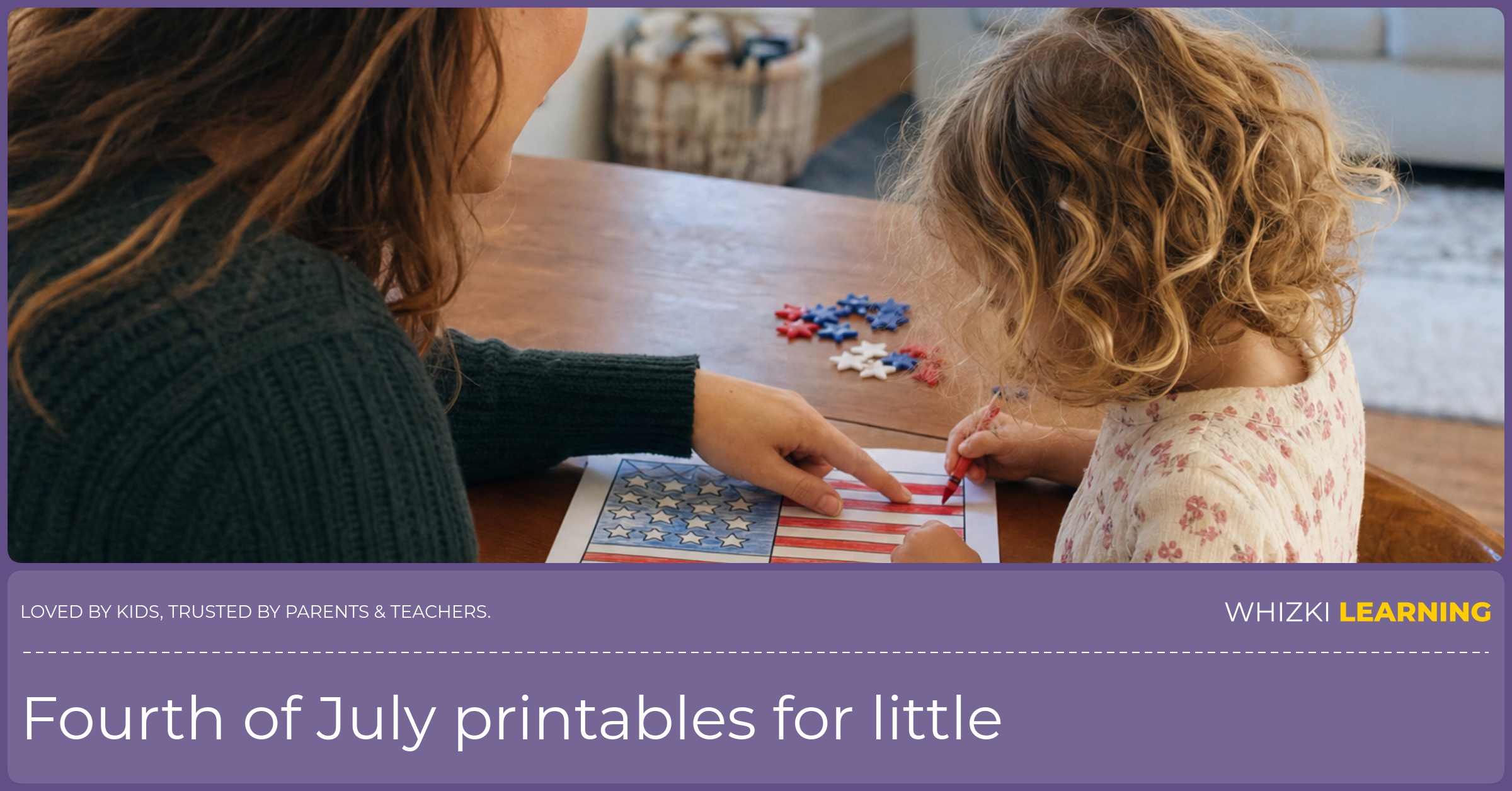
The flag coloring page builds crayon control without turning coloring into a test. The star counting page invites children to touch and count each star, which keeps number words connected to real objects. The patriotic tracing page gives little hands a path for left-to-right movement, and the fireworks pattern page asks children to notice red-blue-red or star-circle-star sequences before drawing the next mark.
For extra choices during a long summer afternoon, families can pull flag coloring options, star counting pages, or patriotic tracing practice from the same printable area. The printable choices work well in a breakfast basket, a travel folder, or a quiet corner after outdoor play. The page order does not matter, because young children often settle faster when the first page is the one that looks fun.
Keep skills warm without school pressure
Holiday-themed practice keeps skills warm mid-summer when the practice feels like part of the celebration. The Orton-Gillingham approach has taught me to keep early learning multisensory, so a child might trace a line with one finger, say the color aloud, count a star, and then mark the page with a crayon. The same short routine can support pencil control, counting language, and visual attention without making July feel like a worksheet marathon.
The week before July 4th is a good time for tiny practice windows because most children are already noticing flags, stars, and fireworks in the neighborhood. A parent can set a timer for eight minutes, choose one page, and stop while the child still has energy. A teacher can place the page beside red and blue crayons as a morning choice, then save unfinished work for later rather than pushing for completion.
For a child who asks for more, the premium Stars and Stripes Fine Motor Set in our worksheet sets gives a longer path for tracing, coloring, and simple counting. The worksheet set fits children who enjoy repetition and need several chances to practice the same hand movement. A child who resists table work may do better with one page today and sidewalk chalk outside tomorrow.
How to use each page with ages 3 to 7
The flag coloring page can be open-ended for a 3-year-old and more careful for a 6- or 7-year-old. An occupational-therapy rule of thumb is to watch the grip, the wrist, and the shoulder before asking for neater work, because tired hands often need a shorter turn rather than a correction. A broken crayon can help small fingers use a tripod grasp, and a clipboard can support children who work better away from the table.
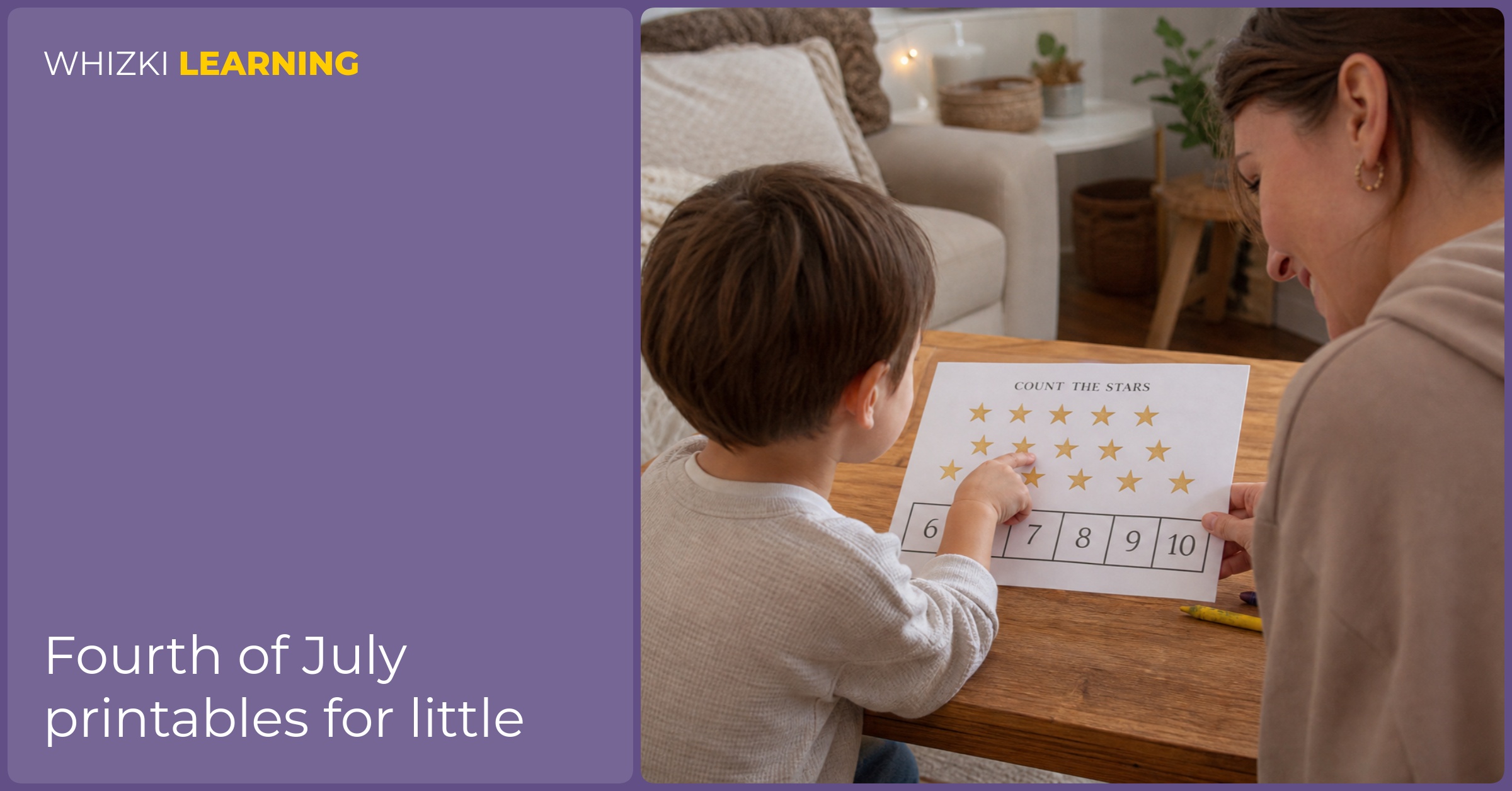
The star counting page works best when the child touches one star for each number word. Montessori counting practice uses real objects and one-to-one matching before abstract symbols, so small buttons, beans, or cereal pieces can sit on the stars before pencil marks begin. A child who skips numbers can start again with fewer stars and a slower adult voice.
The patriotic tracing page gives early writers a predictable path for line practice. In Orton-Gillingham lessons, teachers often pair movement, speech, and sight, so a parent can say start at the top, slide down, and stop while the child traces. The tracing page should feel steady and brief, because repeated tense gripping can make handwriting feel harder the next time.
The fireworks pattern page asks children to notice what comes next, which is early math language in a festive package. A parent can cover the final answer space and ask, what do you see happening again, before the child draws the next shape. A child who invents a different pattern is still practicing observation, as long as the child can explain the new order.
Make the pages feel like a celebration
The printable pages feel more inviting when the adult watches before directing. Reggio-inspired teaching treats children's marks as ideas, so a zigzag firework, a purple flag, or an extra row of stars can become a conversation instead of a mistake. A parent might ask, tell me about your firework, and then write the child's words on the back.
The printable library can also support a calm choice board for a picnic day or travel morning. A caregiver can place one seasonal page beside our printable library choices, a few crayons, and a small snack cup of counters. The limited setup gives a child enough choice without covering the whole table in supplies.
The finished worksheet can become a place mat, a refrigerator note, or a card for a neighbor. NAEYC guidance encourages meaningful work for young children, and a real use for the page often matters more than a perfect line. A child who wants to stop after two minutes may still get a win by coloring one star and telling an adult where to hang the page.
The Fourth of July Skills Mini Pack pairs tracing, counting, coloring, and pattern practice for short holiday table time. Families who prefer paper already bound can find our printed workbooks for screen-free practice. The complete pack lives in Plus.
The best July 4th printable is the page that helps a child settle for a few minutes, use real hands-on skills, and return to family life with a little pride. Print the pack before the holiday week, keep the first try short, and let the crayons stay out for the next quiet pocket of the day. Small practice counts, especially in summer.