If Halloween week makes your room feel one pumpkin sticker away from chaos, set five labeled tubs out today and let each small group visit one calm station for 10 to 15 minutes. The Halloween classroom centers below keep the fun predictable, with counting, language, handwriting, sorting, and story work that still feels seasonal. I use the same rhythm in preschool, kindergarten, and homeschool co-op groups because young children settle faster when the materials stay simple.
Reviewed by Marcus Rivera, M.Ed., Kindergarten Teacher, 12 years.
Plan five centers before Halloween week
A five-center plan gives children enough choice without turning the room into a free-for-all. NAEYC guidance reminds early-childhood teachers to match materials to children's developmental range, which means preschool and kindergarten children can share a theme while doing different work. A practical center plan starts with clear tubs, short directions, and one skill focus per station.
Center tubs need paper copies, crayons, pencils, counters, a few bowls, child-safe tweezers, and two or three seasonal books. A teacher tray with tape, sticky notes, and spare name labels saves the adult from walking across the room during every transition. Setup should take 10 to 15 minutes when materials are stored by station rather than by subject.
Halloween classroom planning can stay respectful and broad when teachers choose pumpkins, leaves, friendly costumes, and nighttime animals instead of scary pictures. For more seasonal pages beyond October centers, browse holidays and culture printables for young learners and keep a small neutral-choice folder ready. Reggio-inspired observation helps here because the teacher watches which images invite talk and which images make children step back.
For teachers who want the printable pages gathered in one place, Whizki Learning includes the 12-page Halloween Learning Activities Pack in the Plus plan. A Plus plan opens the complete 12-page pack, so the weekly centers can be printed from one seasonal set.
Use a simple Monday-Friday rotation
The Monday-Friday rotation table works best when every group visits one station per day and repeats the same clean-up cue. A visual timer, a finished-work basket, and a quiet signal reduce the number of adult reminders. Montessori and Reggio practice both value order in the environment because children can make stronger choices when the room explains the routine.
Simple rotation table: Monday: Group A counts, Group B reads words, Group C traces, Group D sorts, Group E listens; Tuesday: Group A reads words, Group B traces, Group C sorts, Group D listens, Group E counts; Wednesday: Group A traces, Group B sorts, Group C listens, Group D counts, Group E reads words; Thursday: Group A sorts, Group B listens, Group C counts, Group D reads words, Group E traces; Friday: Group A listens, Group B counts, Group C reads words, Group D traces, Group E sorts. The teacher can swap group names for animal icons, colored dots, or table numbers when children do not read names yet.
The rotation table should stay posted at adult eye level and repeated in the same language each day. A homeschool family can treat each weekday as one center day, while a classroom teacher can run two rounds during morning work. The main goal is steady practice, not a race through every worksheet before snack.
Center 1: counting and patterns
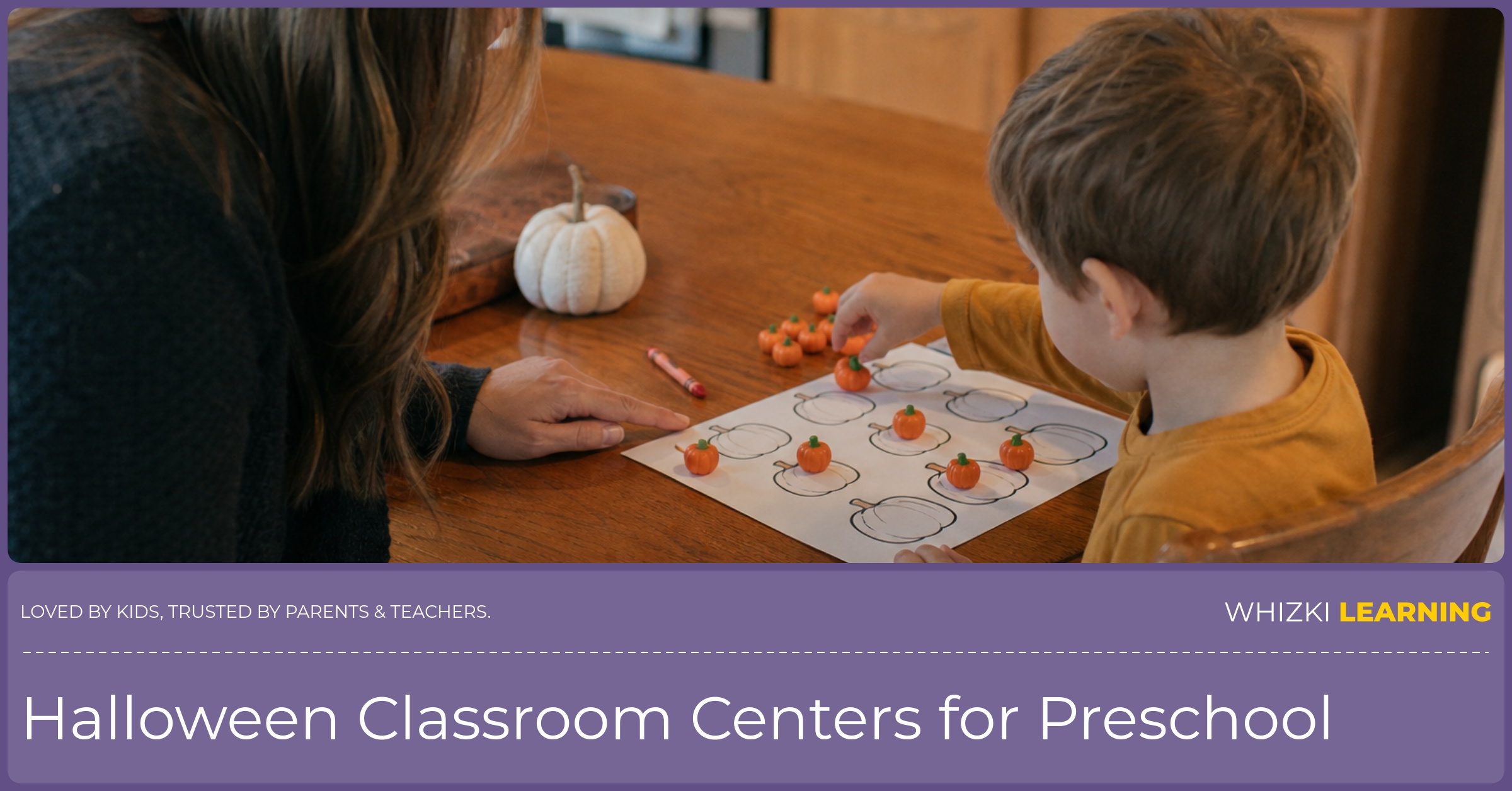
The counting and patterns center uses pumpkin counters, mini erasers, linking cubes, ten-frames, and pattern strips with simple pictures. Setup takes 10 minutes when the teacher places one recording sheet, one bowl of counters, and one pattern card at each seat. Children count sets, build AB or AAB patterns, and mark the matching number with a crayon or pencil.
The skill practiced at the counting and patterns center is one-to-one counting, quantity comparison, and early algebraic thinking through repeated units. NAEYC math guidance encourages hands-on counting before abstract symbols because young children need to touch, move, and check objects. For more focused planning, pair the station with Halloween math center ideas that stay inside the preschool and kindergarten number range.
For preschool children, reduce each set to numbers 1 to 5 and ask children to copy an AB pattern with two colors. For kindergarten children, increase the range to 10 or 20, ask children to explain the pattern rule, and invite children to make a new strip for a partner. The extension can include writing the number after counting, as long as the numeral form is not the only way to show understanding.
Center 2: vocabulary and word search
The vocabulary and word search center uses picture-word cards, a small word search page, crayons, and a pocket chart or tabletop mat. Setup takes 10 to 15 minutes when the teacher preselects six to eight friendly words, such as pumpkin, cat, bat, moon, web, mask, candy, and leaf. Children match pictures to words before hunting for the same words on the page.
The skill practiced at the vocabulary and word search center is oral language, print awareness, visual scanning, and early word recognition. The Orton-Gillingham approach starts with clear sound-symbol connections, so the teacher can say each word, tap the first sound, and point to the printed word before children search. For a fuller language block, connect the station to Halloween literacy center ideas with picture support and short word work.
For preschool children, skip the full word search and ask children to place matching picture cards beside the printed word cards. For kindergarten children, keep the word search small, use left-to-right scanning, and ask children to circle a target beginning sound in a different color. The extension can be a quick oral sentence, such as “The bat is little,” before children move to the next center.
Center 3: tracing and handwriting
The tracing and handwriting center uses name cards, seasonal tracing paths, short word lines, dry-erase sleeves, and thick pencils or crayons. Setup takes 10 minutes when the teacher slides two pages into sleeves and places one cloth square nearby for erasing. Children trace lines from left to right, copy a name or word, and practice stopping at a picture target.
The skill practiced at the tracing and handwriting center is pencil grasp, hand strength, directionality, and letter formation. Occupational-therapy basics favor short practice bursts, feet supported, paper slightly angled, and a writing tool that matches the child's hand size. Handwriting work should feel like a motor station, not a long sit-still test.
For preschool children, choose wide paths, vertical strokes, circles, and first-name tracing with a model nearby. For kindergarten children, add lowercase letter review, spacing between two short words, and a sentence frame with one copied word. The extension should keep quality over quantity because five careful letters teach more than a crowded page of rushed marks.
Center 4: fine-motor sorting
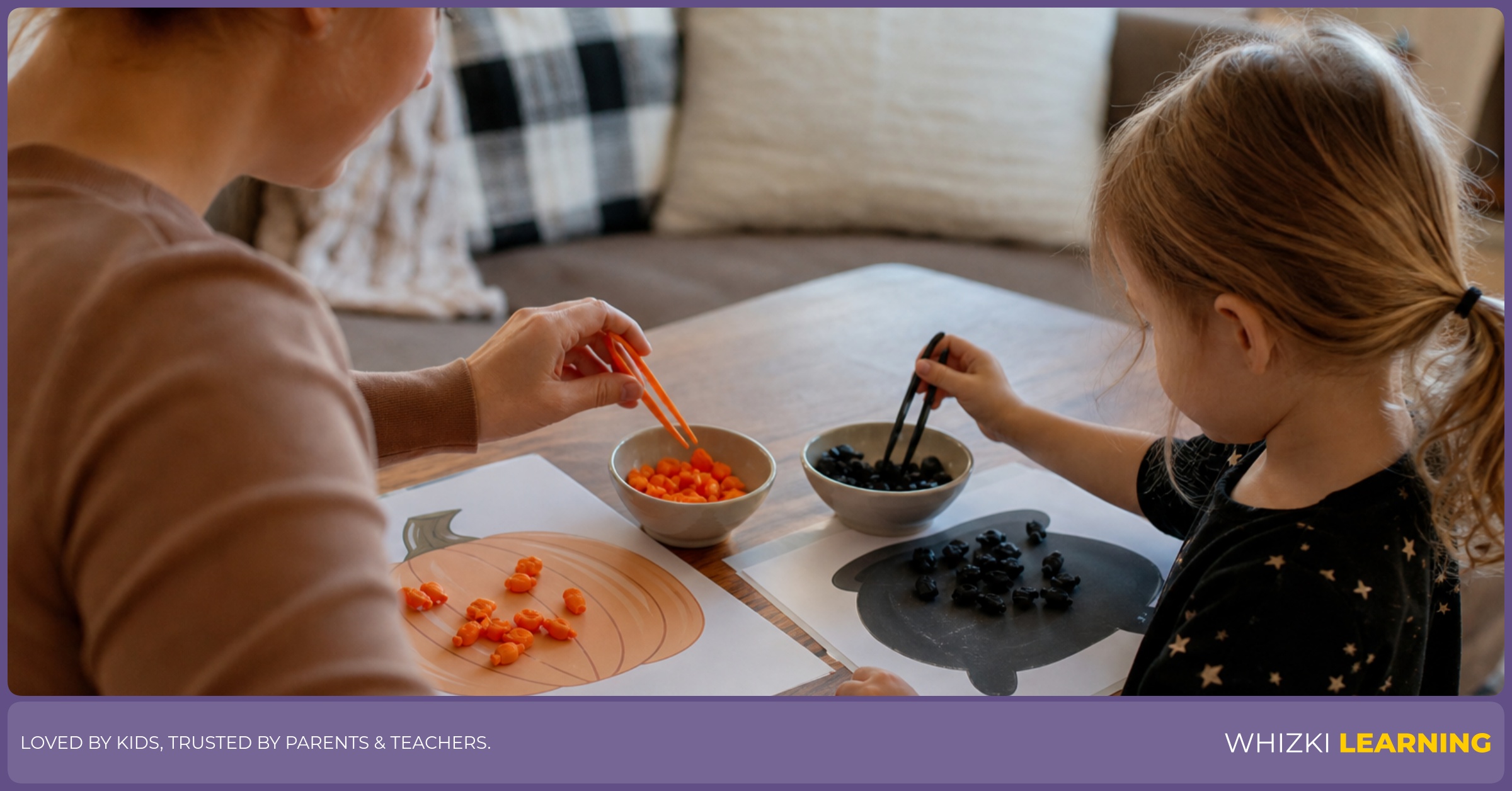
The fine-motor sorting center uses pom-poms, buttons, paper pumpkins, small bowls, muffin tins, child-safe tweezers, and color or size mats. Setup takes 10 minutes when the teacher places a limited number of pieces in each tray and removes tiny items for children who still mouth objects. Children sort by color, size, shape, or picture category and then count each group before resetting the tray.
The skill practiced at the fine-motor sorting center is hand strength, bilateral coordination, visual discrimination, and classification. Occupational therapy heuristics often begin with safe resistance and repeated grasp-release motions, while Montessori sorting work values order and self-correction. A sorting mat with clear spaces helps children see when a set is finished without adult correction after every move.
For preschool children, offer two sorting choices, such as orange pieces and black pieces, with fingers instead of tweezers if needed. For kindergarten children, add a third attribute, ask children to explain the sorting rule, and invite children to record the total in each bowl. The extension can include a partner check, where one child describes the rule and another child finds one item that fits.
Center 5: calm read-aloud and story-prompt corner
The calm read-aloud and story-prompt corner uses two or three friendly seasonal books, a soft rug, picture prompt cards, blank paper, and crayons. Setup takes 10 minutes when the teacher places the book basket beside a simple choice board with “read,” “tell,” and “draw.” Children listen to a short story, retell one part, or draw a beginning, middle, or ending idea.
The skill practiced at the read-aloud corner is listening stamina, vocabulary, narrative order, and expressive language. Speech-language pathology practice often uses picture prompts to support story retell because young children can point before giving a full sentence. Reggio-inspired documentation also fits the corner because a teacher can save one drawing or quote as evidence of the child's thinking.
For preschool children, read one short book and ask children to choose a favorite picture or character. For kindergarten children, use three prompt cards and ask for a first-next-last retell with a drawing or dictated sentence. The extension can be a shared class book on Friday, made from one page each child is willing to share.
Support children who do not enjoy spooky imagery
Children who avoid spooky imagery need a real choice, not a lecture about being brave. NAEYC guidance on belonging supports honoring family culture, sensory comfort, and individual preference in classroom materials. A neutral seasonal bin with pumpkins, apples, leaves, stars, friendly costumes, and lanterns lets children stay in the group without facing pictures that feel unpleasant.
The teacher can replace ghosts, skeletons, and monsters with harvest shapes across all five centers. Counting can use acorns, vocabulary can use leaf and moon cards, handwriting can use curved pumpkin paths, sorting can use buttons, and the read-aloud corner can feature nighttime animal books. The skill stays the same, while the pictures become easier for the child to use.
A simple script helps the classroom stay kind: “Different people like different Halloween pictures, and our room has choices.” The script keeps attention on learning rather than teasing or fixing a child's reaction. When a child's worry spreads beyond seasonal pictures, lasts across routines, or limits daily participation, a family conversation and a school support professional can help choose next steps.
Halloween classroom centers work best when the teacher plans less, repeats more, and watches how children use the materials. Start with the five tubs, post the rotation table, and keep the non-spooky choices visible from the first day. A calm October week is possible when the centers feel familiar, short, and worth doing.