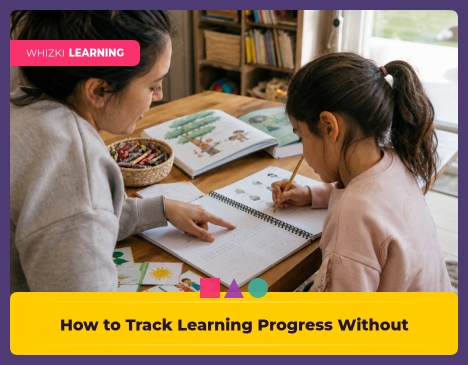
If tracking homeschool progress has turned into one more thing to feel behind on, choose one tiny skill to watch today and write down what your child actually did. A gentle record can be a few honest notes, not a verdict on your child or your parenting.
Reviewed by Whizki Editorial Team, Early Childhood Education Editors.
What progress looks like before age 7
Progress for ages 3 to 7 is often quieter than a grade can show. The NAEYC guideline on developmentally appropriate practice reminds early-childhood teachers to look at growth over time, in play, language, movement, and relationships, not only on a finished page.
Repeated practice matters because young children need many safe tries before a skill feels steady. A child who points to the same letter sound three mornings in a row, builds the same ten-block tower with less frustration, or retells a favorite story with one new detail is showing learning.
Time spent also tells a story when the adult writes down the real minutes without judgment. Ten focused minutes with scissors, five minutes sorting socks by color, or one shared picture book after a hard morning can be a useful home education record.
Keep records private, kind, and useful
Private review is different from ranking a child. Reggio and Montessori observation habits both ask adults to notice what the child is attempting, what materials invite attention, and what support helps the child return to the work.
Grades, public streaks, and leaderboards can turn learning at home into a performance. A missed Tuesday does not erase Monday's read-aloud, Thursday's counting game, or Saturday's question about why ice melts.
The adult manages the planner, and children do not create accounts or sign in. A child can help choose a sticker, dictate a sentence, or show a finished drawing, but the responsibility for the record stays with the grown-up.
For a ready-made place to gather activity notes, photos, and book logs, the family learning planner gives adults one calm place to keep the record. The planner works best when the adult writes what happened in plain words after a real activity.
Use seven signals instead of a grade
Seven useful signals give a fuller picture than a score for preschool and kindergarten children. The Orton-Gillingham approach, for example, values accurate repeated responses, careful review, and multisensory practice before moving a child ahead.
Repeated practice, time spent, growing independence, and completed activities are four strong signals. A child who needs less hand-over-hand help to trace a curve, finishes a sorting tray, or returns to a puzzle after a break is showing progress that a percentage would miss.
Books shared and questions asked are two more signals worth saving. Speech-language pathology practice often pays close attention to child language in context, so a question like "Where did the moon go?" or a new retelling phrase from a picture book belongs in the record.
Adult-noticed wins are the final signal, and small wins count. Occupational-therapy basics remind adults to notice pencil grip, body position, bilateral hand use, scissor control, and stamina, because those foundations support later writing and classroom participation.
A monthly review based on real entries
Monthly review works best when the adult reads real entries instead of trying to remember the month. Occupational therapy uses the idea of a just-right challenge, which means the next activity should be a little demanding without being out of reach.
Step one is to choose what to try for the next week, such as rhyming at breakfast, counting snack pieces, or drawing family members. Step two is to record what actually happened, including short sessions, refusals, surprises, and happy repeats.
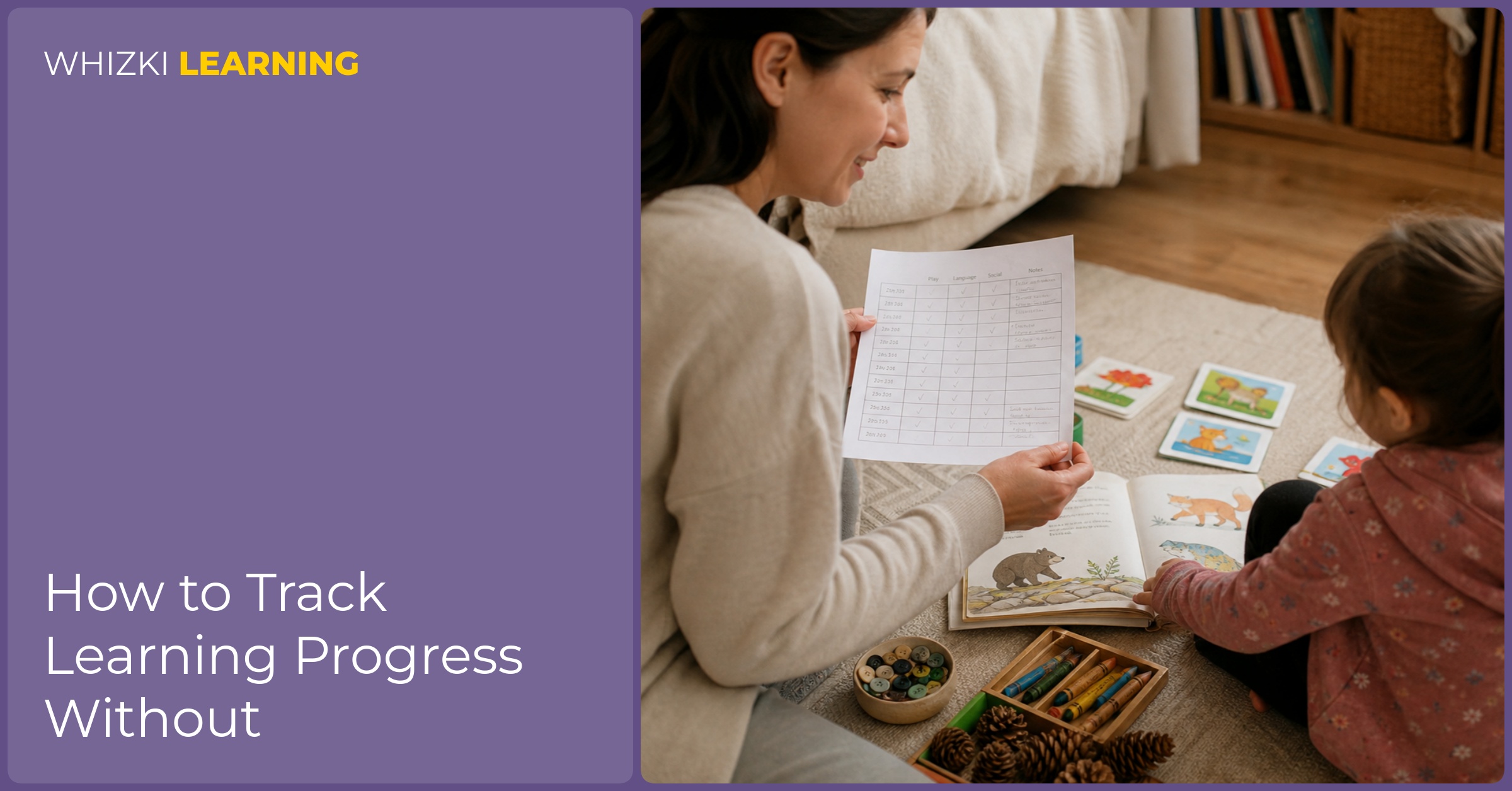
Step three is to review the useful record at the end of the month. A planner like the family learning planner can hold the adult's notes, but the value comes from honest entries, not perfect boxes.
Keep the review short and concrete. Circle one skill that grew, choose one activity to repeat, name one support that helped, and set one next try for the coming month.
What to write when a day gets messy
Messy days still give useful information. A Reggio-style note can say what happened without blame, such as "short attention after poor sleep" or "asked to hear the same book twice, then left the table."
An imperfect entry can protect the adult from all-or-nothing thinking. Learning at home includes errands, siblings, noise, tired bodies, big feelings, and the ordinary friction of family life.
Teachers and homeschool parents can also record support that worked. A movement break, a smaller crayon, a quieter corner, or reading under a blanket may matter more than pushing for a finished worksheet.
Progress tracking should help the adult see the child more clearly, not make the child feel watched for failure. Start tonight with one note from a real moment, then use the next month to choose what to try, record what actually happened, and review the useful record with kindness.