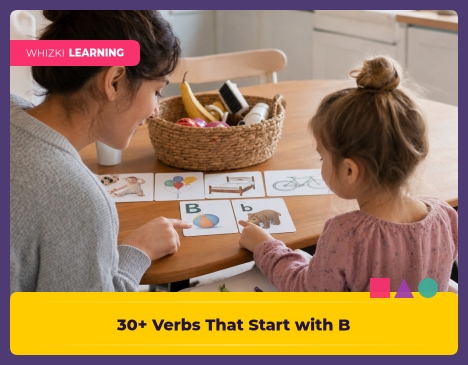
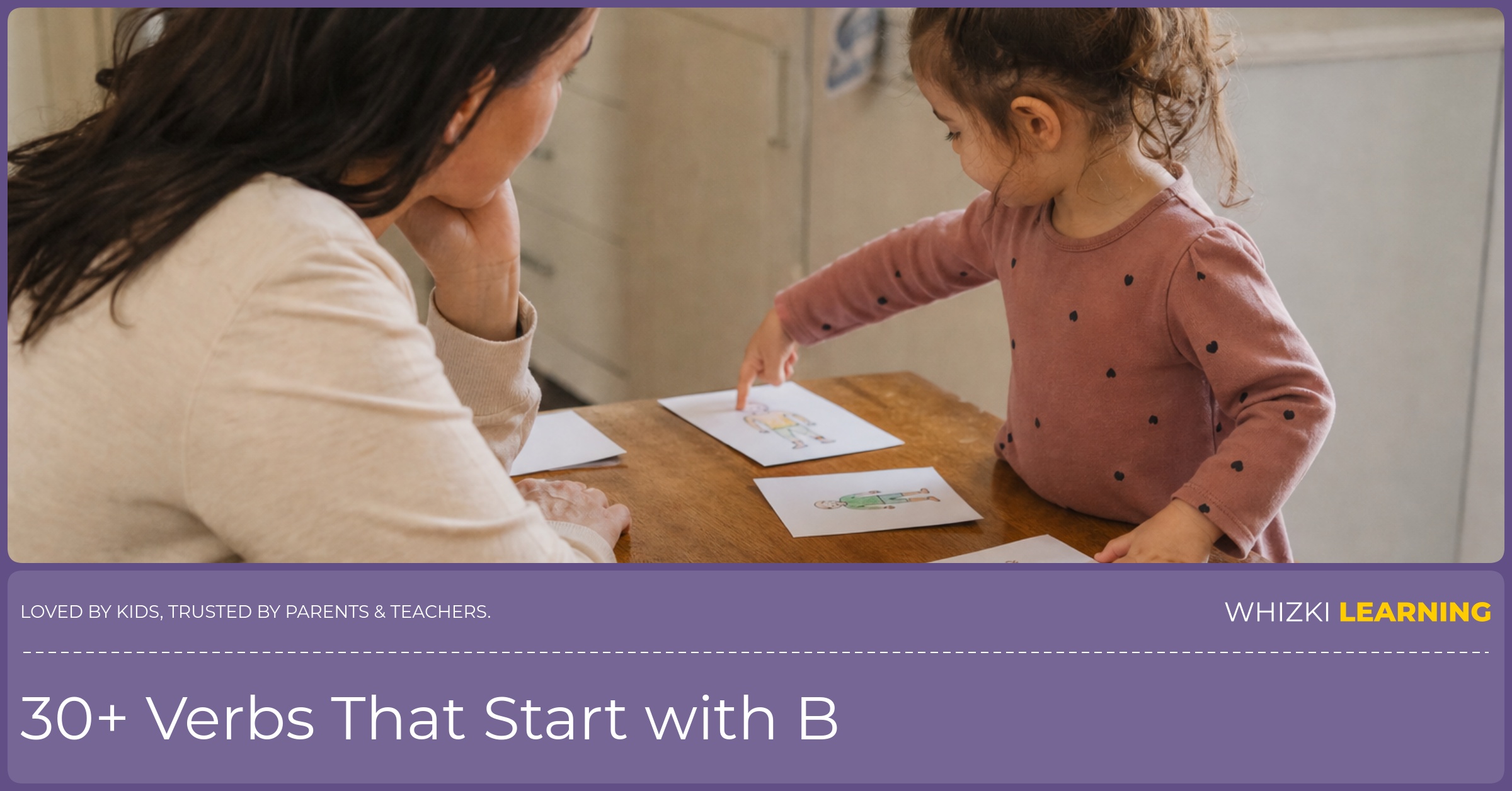
If your child can chant B words but freezes when asked to read one, start with three action words the child can do right now, like bend, bounce, and build. Action words give the mouth, eyes, and body a job at the same time. A short practice round at the kitchen table can feel more like play than a lesson.
Reviewed by Whizki Editorial Team, Early Childhood Education Editors.
Why B verbs help young readers
B verbs work well for ages 3 to 7 because the /b/ sound is easy to feel with closed lips and a little pop of air. In Orton-Gillingham practice, a child often says the sound, traces the letter, and connects the sound to a real word, so an action verb gives the lesson a clear body anchor.
The B verbs below are action words, not object names or describing words. For object labels, use first words starting with B, and for traits like big or blue, use describing words starting with B.
The letter B routine can stay simple: say the verb, act the verb, then point to the first letter. For extra sound practice, pair the action words with our letter B learning page when the child is ready for a few more examples.
Body actions that start with B
Body-action verbs are my first pick when a child has wiggles, because movement gives attention somewhere useful to land. Occupational therapy basics remind teachers and parents to use big muscles before asking for tiny pencil control, especially with preschool and kindergarten learners.
Body B verbs to act out
Bend: Bend your knees. Blink: Blink both eyes. Breathe: Breathe in slowly. Bow: Bow to the crowd.
Balance: Balance on one foot. Bounce: Bounce on toes. Bop: Bop your head. Bike: Bike around the cones.
Boogie: Boogie to soft music. Blow: Blow one gentle kiss. Brush: Brush your hair. Burp: Burp into your elbow.
Household actions that start with B
Household verbs are useful because the child can practice during real routines without a separate lesson plan. Montessori practical-life work and NAEYC guidance both value meaningful, hands-on tasks, so a child can hear a word, do a job, and feel successful.
Household B verbs to act out
Bake: Bake pretend muffins. Bathe: Bathe the baby doll. Bring: Bring the blue cup. Button: Button your red coat.
Buckle: Buckle the little strap. Bag: Bag three toy foods. Box: Box the puzzle pieces. Bundle: Bundle the clean socks.
Blot: Blot the tiny spill. Butter: Butter the warm toast. Bandage: Bandage the teddy bear. Bottle: Bottle the baby doll.
Mid-routine helper: print a small B action sheet from our sight-words printables and tape the page near the backpack hook, sink, or play kitchen. A wall copy lets the adult point to one word, say the sound, and invite one quick action before shoes, snack, or cleanup.
Play actions that start with B
Play verbs are the easiest place to hear real language, because the child is already pretending, moving toys, and telling tiny stories. Reggio-inspired observation starts with what the child is doing, so the adult can name the action the child already cares about.
Play B verbs to act out
Build: Build a block tower. Bang: Bang the toy drum. Beat: Beat the rhythm sticks. Bat: Bat the balloon gently.
Bury: Bury shells in sand. Bump: Bump two toy cars. Buzz: Buzz like a bee. Bark: Bark like a puppy.
Blast: Blast the rocket up. Bowl: Bowl the foam pins. Braid: Braid three yarn strands. Bob: Bob the finger puppet.
Act-it-out B charades game
The B charades game needs only six folded slips of paper and a little open floor space. Speech-language practice often pairs a spoken word with a gesture, so the adult can say the verb after the child acts and then invite the child to repeat the word.
The adult writes six verbs from the lists on slips, places the slips in a bowl, and lets the child pick one card without showing the group. The child acts the verb without talking, and the guesser says, “You are building,” or “You are bouncing,” with the B sound slightly clear at the start.
The charades round should stop while the child still wants one more turn. NAEYC-aligned practice keeps early literacy playful and brief, so two minutes of happy acting is better than ten minutes of correction.
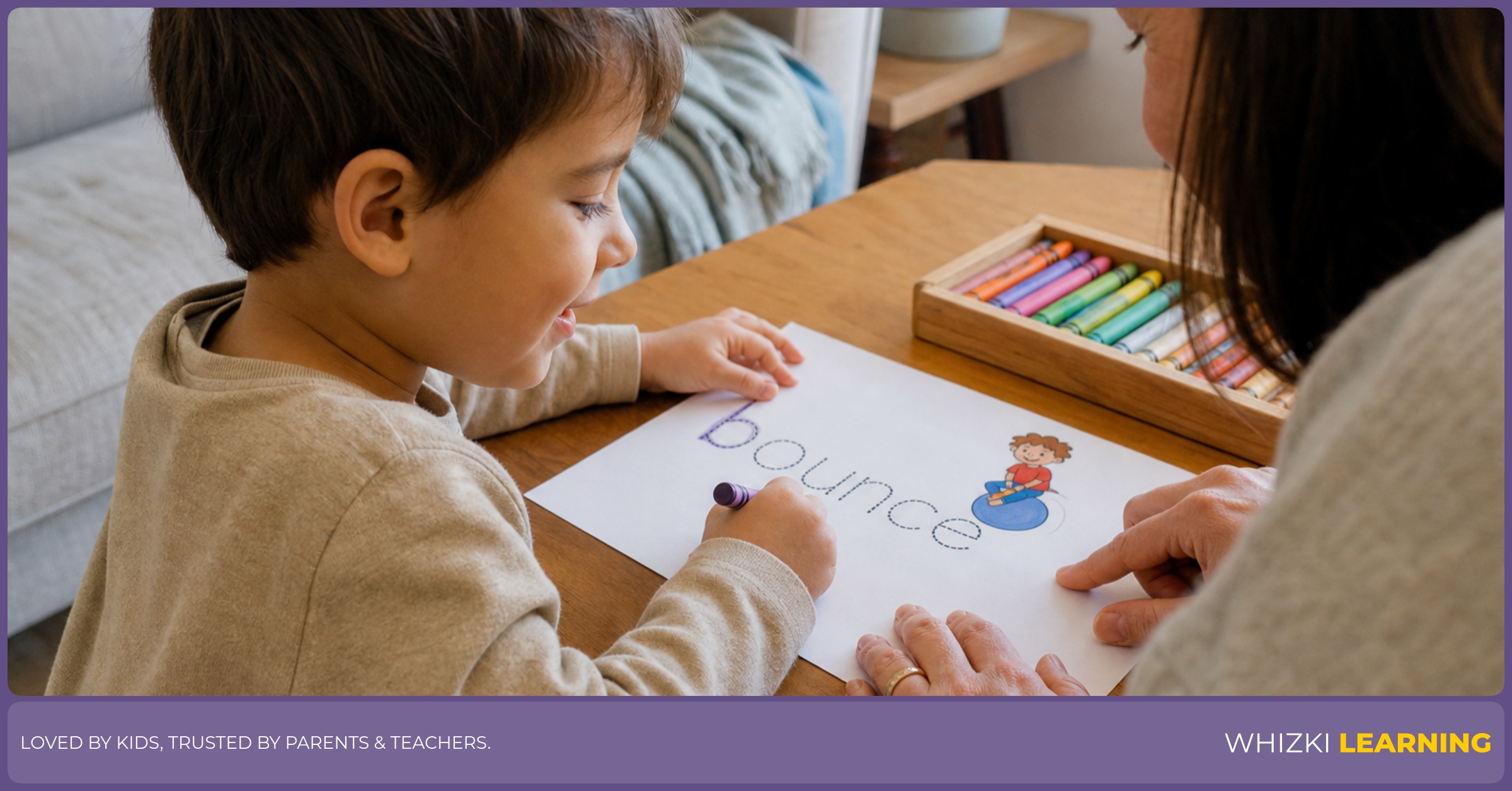
The trace-the-word tip is simple: write one large B verb on paper, let the child trace the first letter with a finger, then trace the whole word with a crayon. Occupational therapy handwriting basics favor big, slow strokes first, so a preschooler can trace on paper, in sand, or on a foggy window before using a pencil.
Keep B verb practice light
The best B verb practice for a young child is short, physical, and easy to repeat tomorrow. In my classroom, the child who refuses a worksheet will often act out four words, laugh, and then touch the first letter because the word already means something.
A parent or teacher can choose one body verb, one household verb, and one play verb for the day. The three-word routine gives the child enough repetition to notice the letter B without turning vocabulary practice into a long performance.
Start with the verbs the child already enjoys, because a familiar action makes the printed word less mysterious. When the child can say and act several B verbs, add the letter card, the tracing finger, and one quick read-aloud moment.