
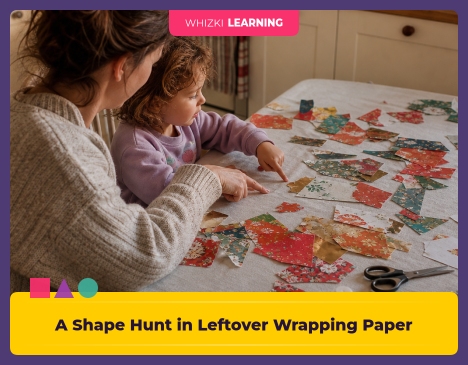
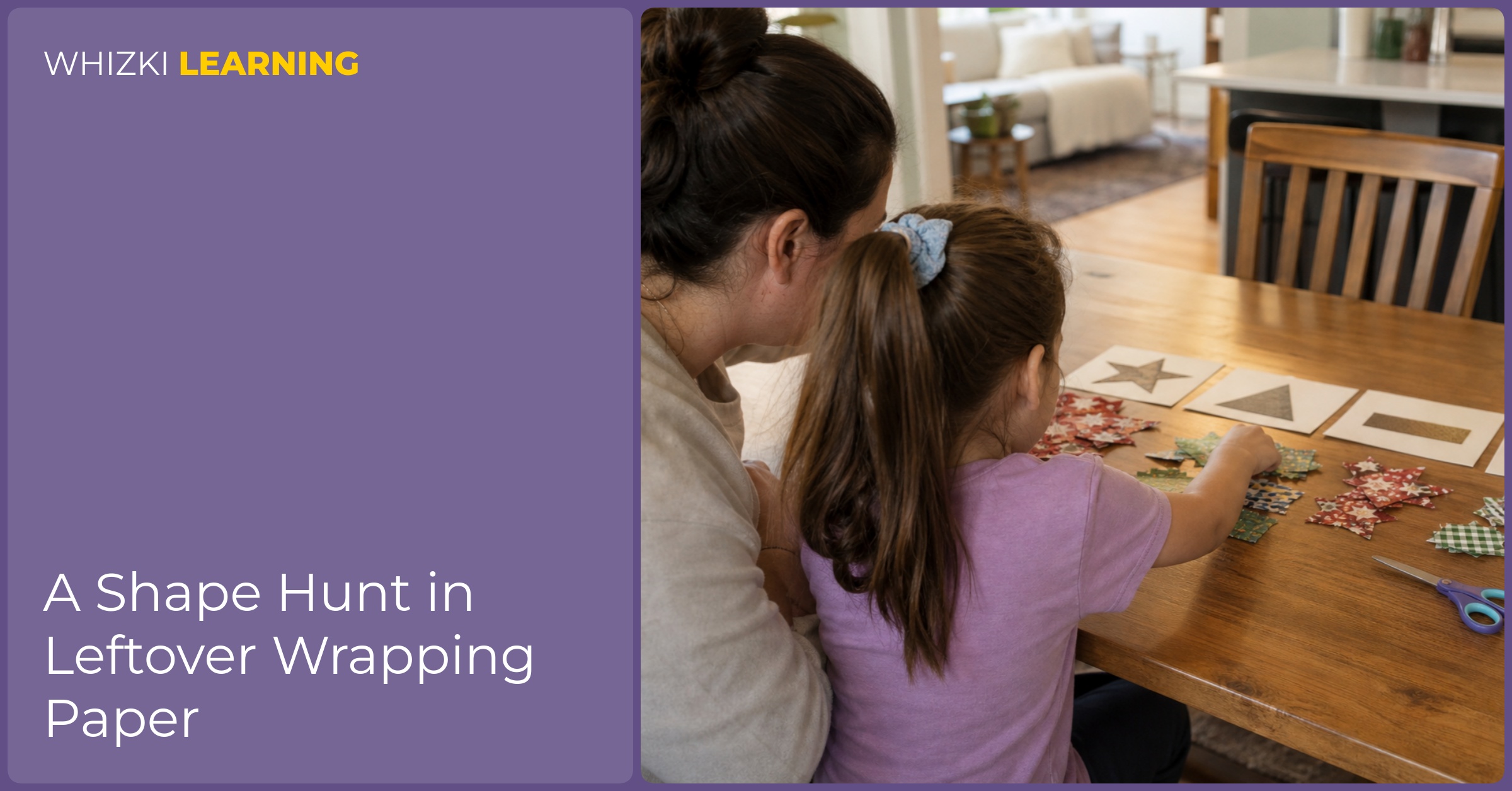
If the Christmas wrapping paper pile is sliding off the counter while a child begs to use scissors, start with one safe job: let the child find one printed shape, and an adult cuts or closely supervises the cut. The wrapping paper shape hunt uses scraps, a glue stick, and a paper plate or sheet of construction paper for 10 to 15 minutes of screen-free early math. Families who celebrate another winter holiday, a birthday, or nothing seasonal can use any patterned paper with the same calm plan.
Reviewed by Whizki Editorial Team, Early Childhood Education Editors.
Set up the shape hunt
The wrapping paper shape hunt needs a few scraps of printed paper, child-safe scissors if the child is ready, a glue stick, one tray or cookie sheet, and plain paper for the collage. The adult can pre-cut large pieces from crinkly or slippery paper before inviting a younger child to join, because shiny gift wrap can slide more than construction paper.
NAEYC guidance reminds early-childhood teachers to offer playful materials with enough adult support for safety and enough child choice for real learning. The adult keeps the scissors plan clear: a 3-year-old may point and tear, a 4- or 5-year-old may snip with close supervision, and a 6- or 7-year-old may cut around a chosen area while the adult stays nearby.
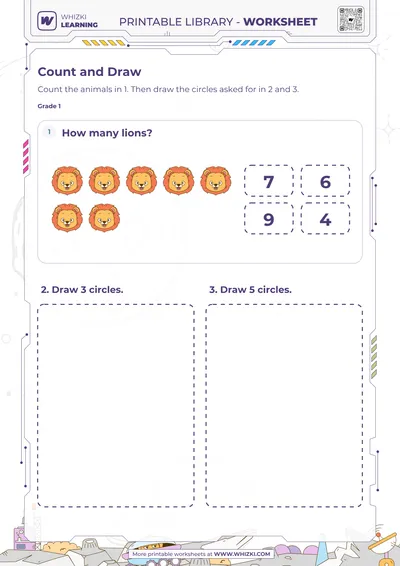
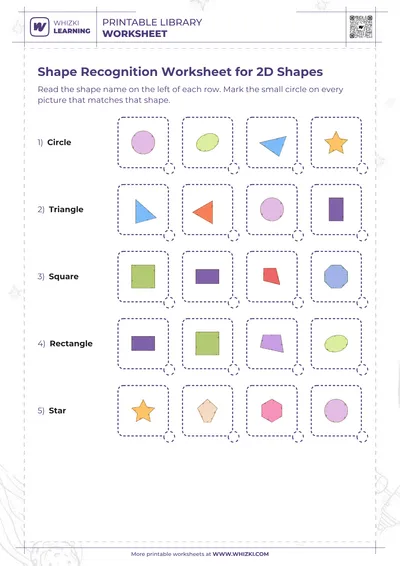
The wrapping paper scraps can sit beside the printable library when a child wants more paper choices later. The shape hunt still works best when the first round stays simple, because one small tray is easier to manage than a table full of options.
Play it like an investigation
The investigation begins with looking, not cutting. Reggio Emilia practice values close observation, so the adult can say, “Use your eyes first, then your finger,” while the child searches for circles in ornaments, rectangles in packages, stars in a Christmas pattern, or triangles in trees.
The adult language stays concrete and short during the hunt. The Orton-Gillingham approach often pairs seeing, saying, touching, and moving, and the same multisensory rhythm helps here: the child sees the printed shape, says the shape name, traces the edge with a finger, and then cuts or tears with adult help.
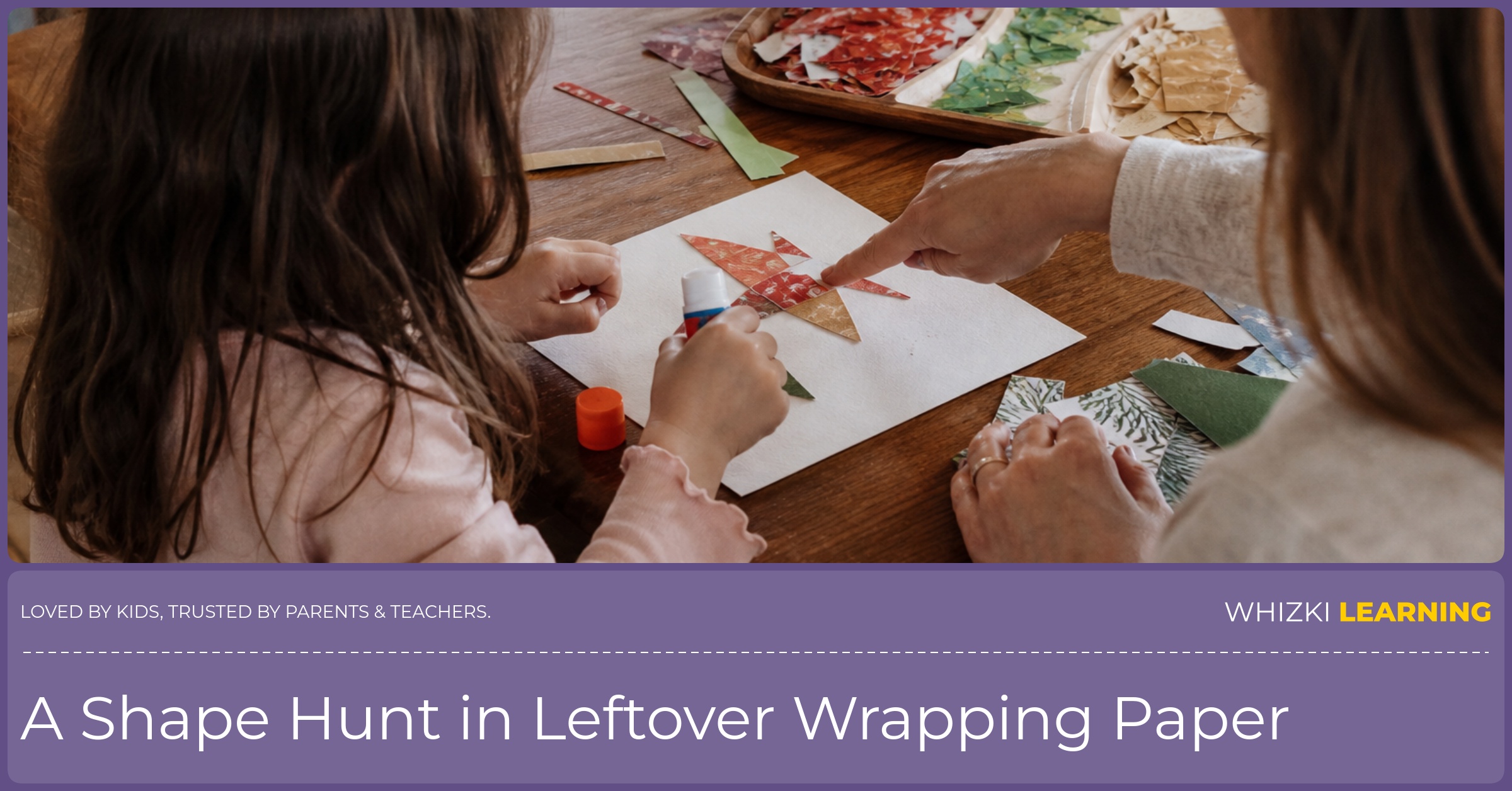
The collage step turns the investigation into visible thinking. The child glues all circles in one area, all rectangles in another area, or all favorite pieces in a free design, and the adult describes the sorting choice without turning the activity into a quiz.
Adjust for age and scissor readiness
The occupational-therapy rule of thumb I use in preschool is simple: the cutting task should match the hand, not the other way around. A 3-year-old can rip around a picture, glue a bumpy piece, and call the paper edge an outline, because tearing still builds hand strength and two-hand coordination.
A 4- or 5-year-old can snip straight lines around a large printed picture while the adult reminds the child to keep thumbs up and elbows near the body. The adult can rotate the paper for the child when the paper turns awkward, because scissor control is still new for many kindergarten-age hands.
A 6- or 7-year-old can try cutting closer to an outline, sorting by more than one feature, or explaining a choice: “The snowflake picture is round-ish, but my cut paper piece has six poky sides.” The adult should still pause the activity when hands get tired, because tired fingers often lead to rushed cutting.
For a quieter follow-up, seasonal pages from the holiday and culture printables can give the child more pictures to cut, sort, or compare. A printable is a helpful add-on, not a replacement for the real wrapping paper scraps that crinkle, slide, and make children adjust their hands.
Talk about picture versus outline
The picture-versus-outline conversation is the math heart of the wrapping paper shape hunt. Speech-language pathology practice often uses expansion, so the adult can take a child’s phrase, such as “snowman,” and gently expand the idea: “Yes, the picture is a snowman, and the paper piece has a curvy outline.”
The printed picture and the cut paper piece can have different shape words. A printed square present may become a wobbly blob after cutting, and a printed candy cane may sit inside a rectangle if the adult cuts a big box around the candy cane picture.
The shape talk should sound like noticing, not testing. The adult can say, “The picture shows a tree, and the outside edge of the paper looks like a triangle,” or “The picture shows a candle, and the piece you cut has four sides,” while children who do not celebrate Christmas can use stars, flowers, animals, or patterned wrapping instead.
Know when to stop
The stopping point matters as much as the setup. Montessori observation encourages adults to watch the child’s concentration, and the wrapping paper shape hunt is usually done when the child starts shredding without purpose, squeezing glue for the fun of puddles, or asking for a different activity.
The leftover pieces can go into an envelope labeled “shape collage scraps” for another day. The activity does not need a prize, a perfect collage, or a gift-related reward, because the useful learning is the looking, naming, cutting, sorting, and comparing.
The wrapping paper shape hunt is small enough for a busy kitchen and rich enough for real early math. Save the usable scraps in an envelope, and the investigation can wait for another calm 10-minute window.