
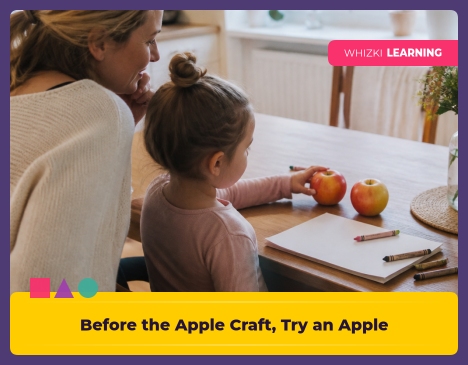
If your child wants the glue-and-glitter apple craft right now, hand over one real apple first and say, “Let’s be apple detectives for seven minutes before the art starts.” The apple observation gives busy hands something useful to do while a parent, caregiver, or teacher gathers paper, crayons, or dinner.
Reviewed by Whizki Editorial Team, Early Childhood Education Editors.
Why observe before crafting
The apple observation slows the rush from supplies to finished product, which is very much in the spirit of Reggio Emilia practice. Reggio teachers often treat real objects as invitations to look closely, talk, wonder, and represent ideas through drawing.
NAEYC guidance for ages 3 to 7 supports hands-on, meaningful learning over adult-made samples that children try to copy. The apple craft can still happen after the observation, but the craft gains more meaning when children have handled a real apple first.
The concrete next step is simple: place one apple, one blank sheet of paper, and two crayons on the table. Tell the child that the drawing will be the record, not a test, and that the apple does not need to look perfect on the page.
Set up the seven-minute apple investigation
The apple investigation needs one or two apples, a blank page, crayons or colored pencils, a paper towel, and an adult knife for later. Seven minutes is enough for a preschooler, while a kindergartener may stay interested for ten to twelve minutes.
The adult setup matters because occupational-therapy basics remind us that young children learn best when bodies feel steady. Put the apple on a non-slip surface, let the child sit with feet supported when possible, and keep the knife out of reach until the cut-surface moment.
The apple investigation can stand alone, or the apple investigation can lead into a seasonal page later in the day. For more off-screen ideas that pair with short science moments, the Learning Hub is a helpful place to browse after the real-object work is done.
Compare the whole apple first
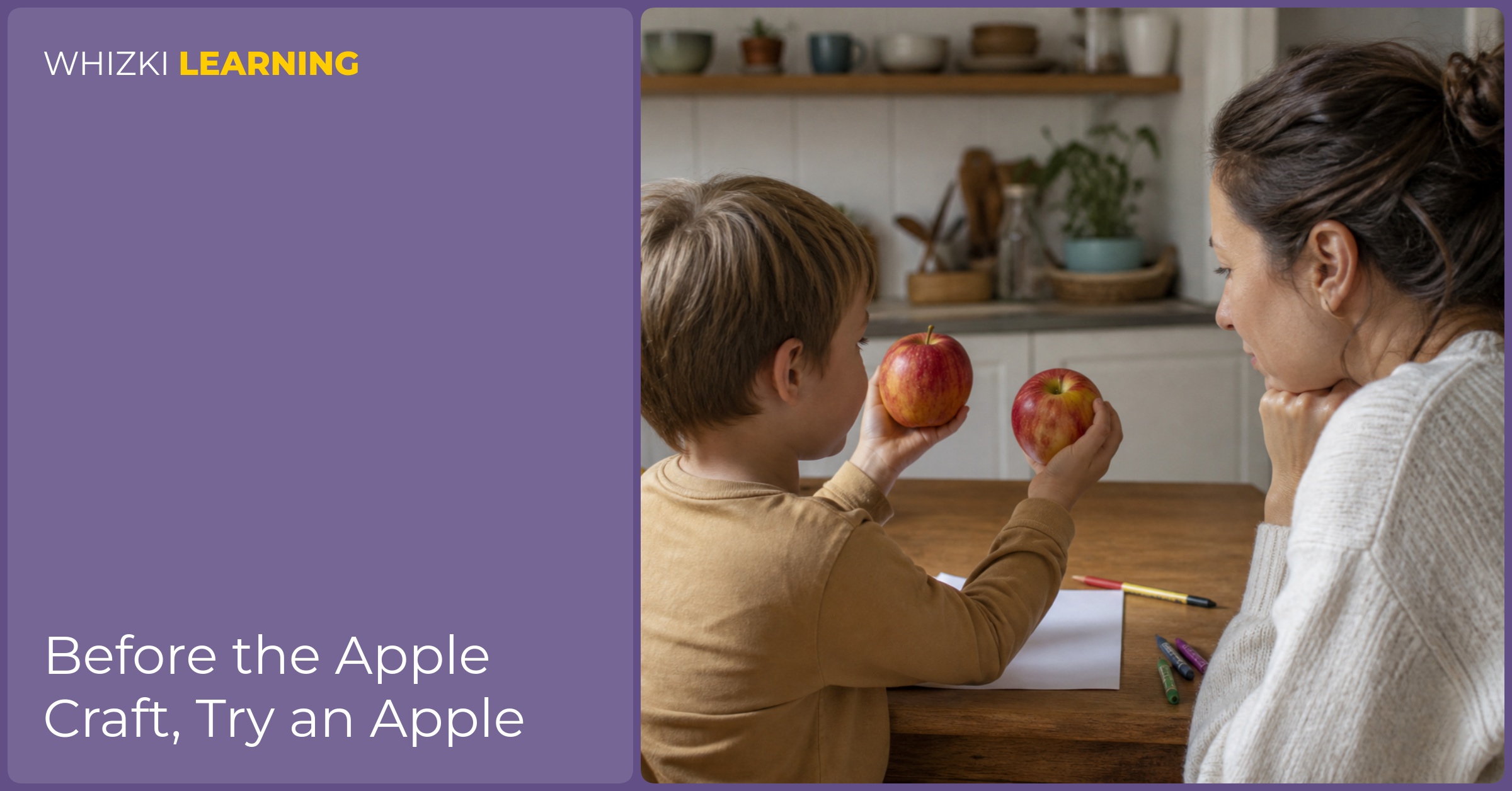
The whole-apple comparison can start with color because color is easy for most children to notice. Montessori sensorial work often begins with one clear property at a time, so a child can say red, green, yellow, speckled, shiny, dull, dark, or light before moving to another feature.
The stem and skin invite careful finger work without turning the moment into a fine-motor drill. Occupational-therapy heuristics favor short, purposeful hand tasks, so a child can trace the stem shape, rub the skin gently, and notice bumps or smooth spots with adult guidance.
The weight and smell comparison adds science language without needing a scale. A child can hold one apple in each hand and decide which apple feels heavier, then smell near the stem end and describe the scent as sweet, fresh, sour, grassy, or faint.
Look at the cut surface with adult help
The cut-surface step belongs to the adult because kitchen knives are adult tools. Occupational-therapy safety habits are plain here: the adult cuts the apple, places the knife away from the table edge, and gives the child only the apple half to observe.
The cut surface gives children a new view of the same object, which is a real science idea in child-sized form. The child can look for the pale flesh, seed pockets, juice, star shape near the core, peel line, and any browning that appears after a few minutes.
Tasting stays optional because some children explore food best through looking, touching, and smelling before taking a bite. Speech-language pathology feeding practice often respects gradual sensory steps, so a child may describe the apple slice without being asked to chew or swallow.
If apple week connects with fall traditions at home or school, the holiday and culture printables can add drawing pages, simple cards, and seasonal prompts without turning the observation into a worksheet stack. A printable works best after children have handled the real apple, because paper records make more sense after sensory work.
Use drawing as the record
The drawing record is the child’s science note, not a coloring page that needs adult fixing. Orton-Gillingham practice values saying sounds and words clearly, so an adult can slowly model apple, stem, skin, seed, and core while the child draws without turning the moment into a spelling lesson.
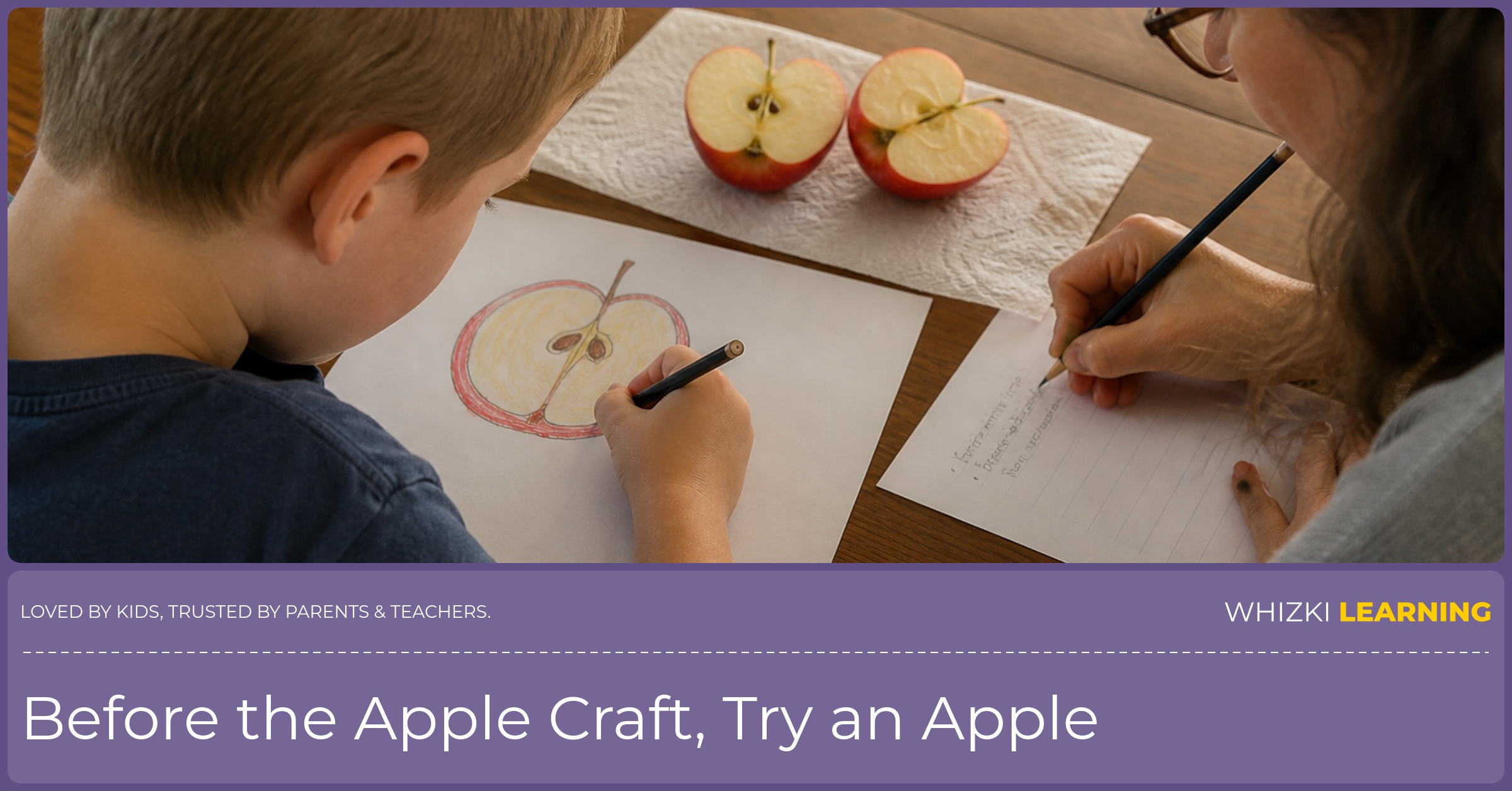
The apple drawing can include color patches, a stem line, dots for speckles, seed shapes, or a circle around the cut middle. A parent or teacher can write the child’s exact words beside the picture, such as “smooth skin” or “tiny seeds,” so the record honors the child’s observation.
The drawing record is more useful than a worksheet when the page shows what the child actually noticed. A worksheet can support later practice, but the first record should come from the child’s eyes, hands, nose, and pencil.
Adjust for ages and real-life limits
The apple observation for ages 3 to 4 should stay short and sensory. NAEYC developmentally appropriate practice supports brief choices, so the adult might ask, “Do you want to draw the outside or the inside?” and then stop before attention runs out.
The apple observation for ages 5 to 7 can include a little more comparison language. A kindergartener or first grader may draw two apples side by side, mark heavier or lighter with adult spelling help, and dictate one full sentence about the cut surface.
The real-life limit is that some days a child will only smell the apple, make one green scribble, and leave the table. The apple observation still counts because careful noticing can be small, and the craft can wait for another pocket of calm.
Before the apple craft, the apple observation gives children a reason to look, touch, compare, and draw from life. The finished picture may be lopsided, quick, or wonderfully odd, and the record still shows real thinking. The parent or teacher can save the craft for afterward, when the apple on the page belongs to the child’s own noticing.