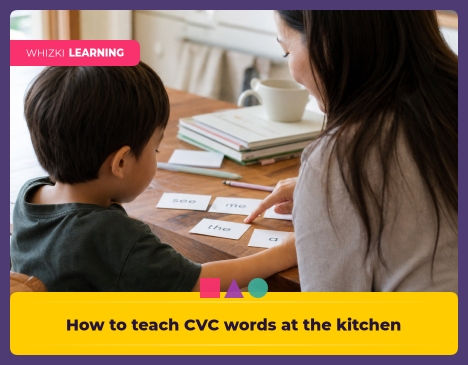
If CVC practice at the kitchen table turns into guessing, bargaining, or a child sliding under the chair, pause the lesson and start tonight with three letters, one word family, and five calm minutes. CVC reading grows best when the adult keeps the task small, warm, and hands-on. A child age 3 to 7 does not need a lecture on spelling; a child needs to hear sounds, touch sounds, and blend sounds into a real word.
Reviewed by Whizki Editorial Team, Early Childhood Education Editors.
Blend sounds, do not spell letter names
The blend-don't-spell rule is the kitchen-table version of a core Orton-Gillingham habit: teach the sound first, then connect the sound to the letter. A CVC word has a consonant, a vowel, and a consonant, such as mat or hop. The parent says /m/ /a/ /t/ and slides the sounds together, instead of saying the letter names em, ay, tee.
The letter name can wait because the letter sound is what the child needs for reading. A child who says em-ay-tee still has to translate each name into a sound before blending, which is a lot of work for a new reader. The adult can say, "That is the letter name; for reading, use the sound /m/."
The first word family should feel almost too easy, because early success builds attention. Start with -at words for one or two short sessions, then add a nearby family such as -am or -ap. For more options after the first few nights, keep the CVC words list nearby and choose only a few words at a time.
Teach finger-tap blending
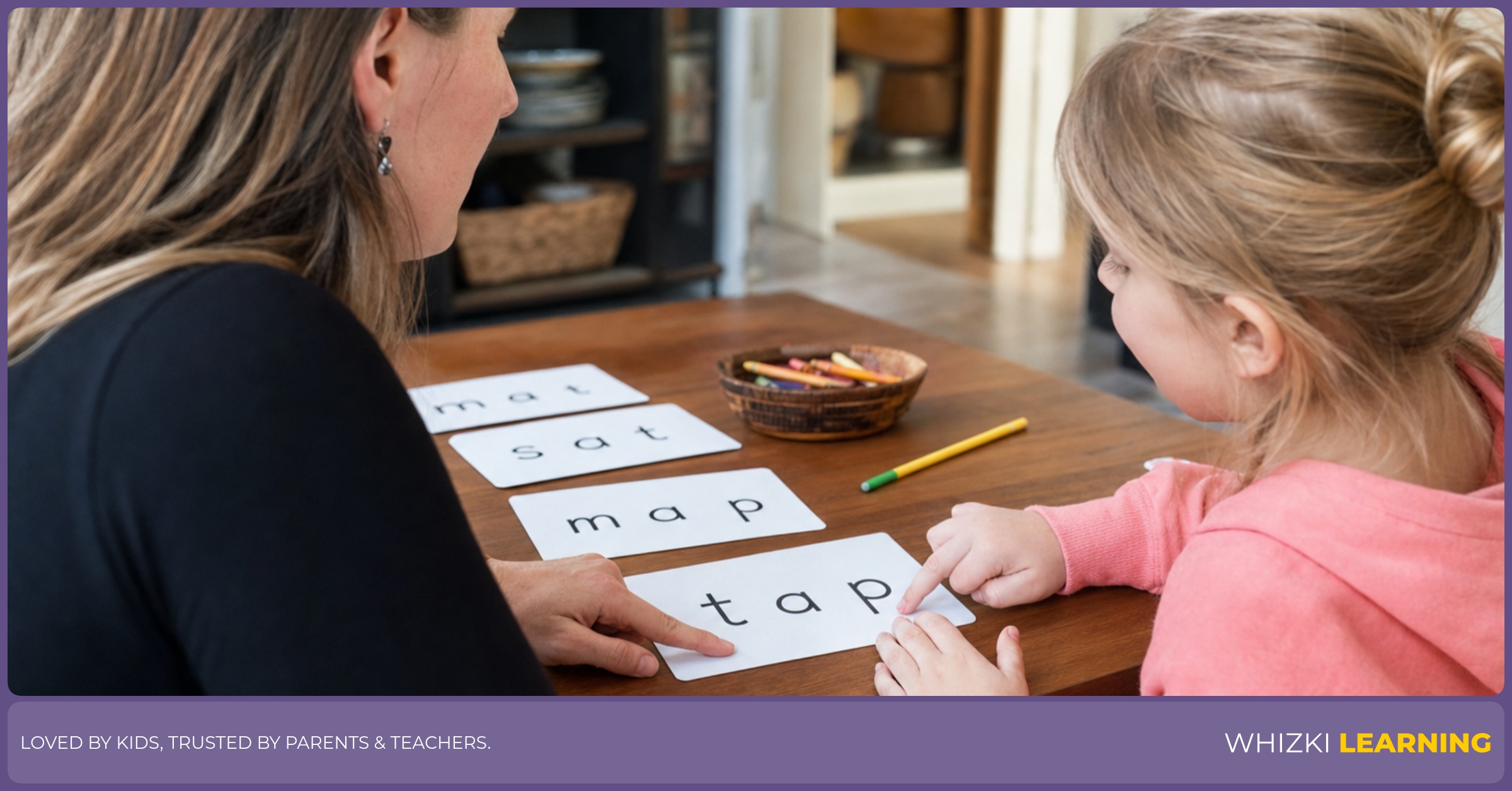
Finger-tap blending gives a child a body cue for each sound, which lines up with occupational-therapy basics I use when print feels too flat for little hands. The adult holds up one hand and taps thumb to index finger for the first sound, thumb to middle finger for the vowel, and thumb to ring finger for the last sound. The hand then sweeps left to right while the mouth blends the sounds into the whole word.
For mat, the adult says /m/ while touching the first finger, /a/ while touching the second finger, and /t/ while touching the third finger. The adult then slides a finger under the printed word and says mat without stopping between sounds. The child copies the same taps, because a shared motion is easier than a spoken direction alone.
A child who guesses should return to the taps before the adult gives the answer. The parent can say, "Tap the sounds with me," and keep the voice steady. The goal is not speed during the first week; the goal is clean sound-by-sound blending without letter-name spelling.
Use magnetic letters on the fridge
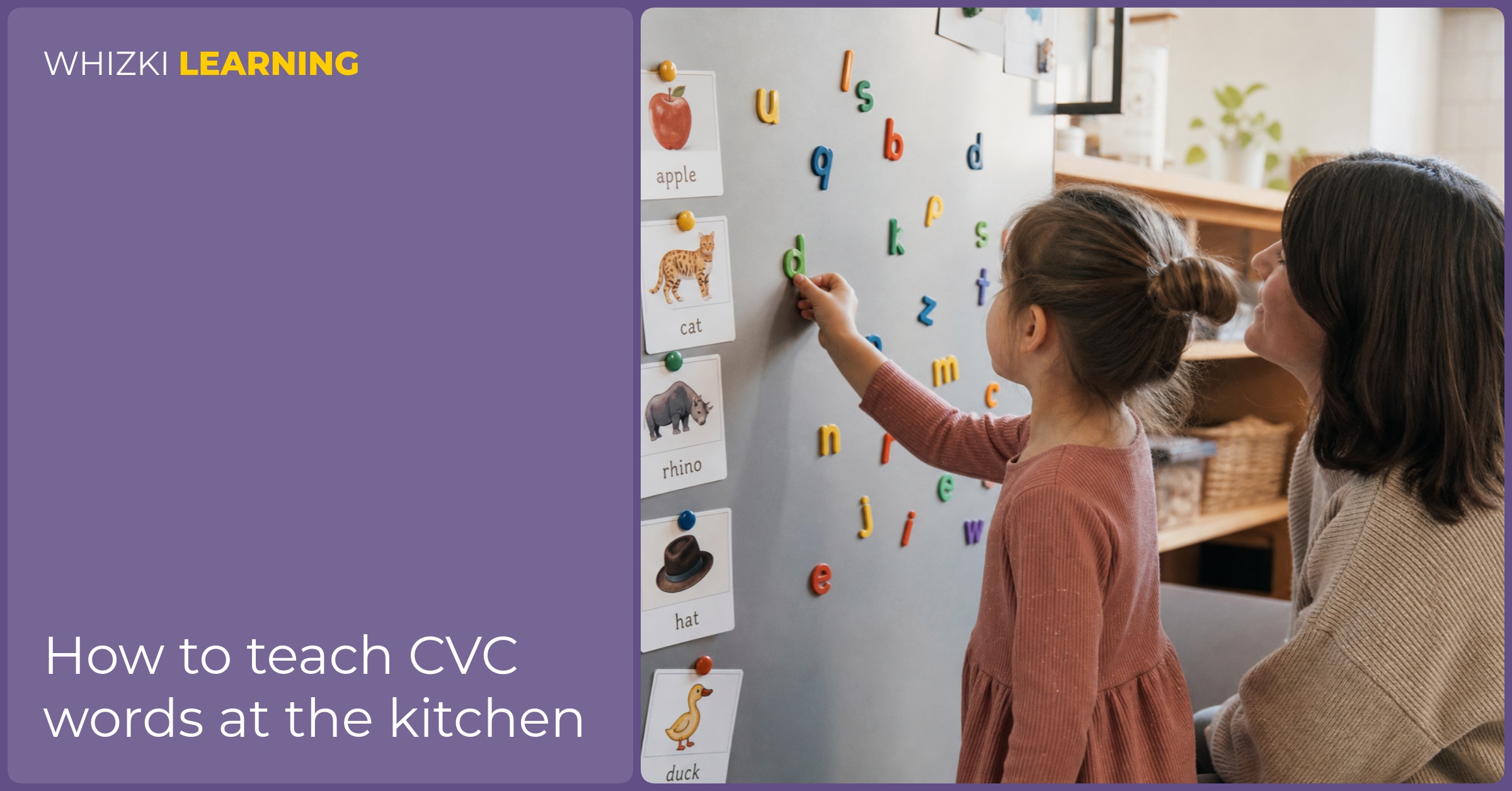
Magnetic letters on the fridge turn CVC practice into movable play, which fits both Montessori hands-on materials and Reggio-style observation. The adult watches which letter the child reaches for, which sound the child says first, and where the child hesitates. That observation tells the adult whether the child needs more sound practice or a new word.
Keep only the letters needed for the tiny set in front of the child. For an -at lesson, place a, t, m, s, c, and p on the fridge, then build at together before adding one beginning sound. The child can swap m for s and hear how mat changes to sat, which makes the alphabetic principle visible.
The fridge lesson should stay playful and short. A parent can ask, "Can the first sound change?" and let the child move one magnet. If the child starts stacking magnets or making a pretend menu, the adult can join for a minute and then bring attention back to one readable word.
Run a five-minute nightly routine
A five-minute nightly routine matches NAEYC guidance that young children learn well through brief, responsive, playful interactions. Minute one is sound warm-up, where the child says three letter sounds with the adult. Minute two is finger-tap blending, minute three is one printable line, minute four is one magnetic-letter change, and minute five is a quick reread plus a high-five or sticker.
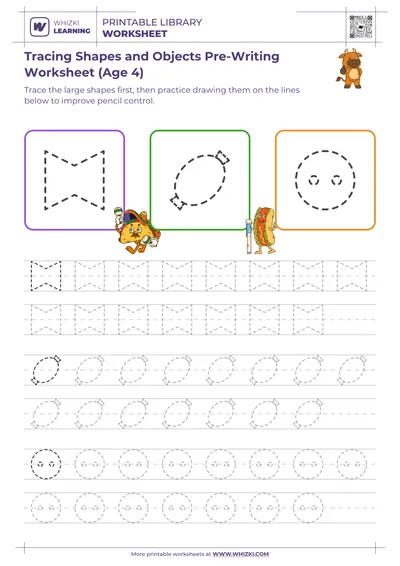
The printable line should be visible before the routine starts, because hunting for supplies can drain the child's attention before reading begins. Print one CVC page before dinner, slide the page into a plastic sleeve, and tape the page near the table or fridge. A dry-erase marker lets the child circle the word after reading, which gives the hand a job without turning reading into a long worksheet.
For the middle minute of the routine, choose one matching CVC word-mat printable from our printable library, print the page, and tape the page where practice already happens. The taped page becomes a calm nightly cue: tap, blend, read, and stop while the child still feels successful.
Sight words belong in a separate pocket of the routine, not mixed into the first CVC blending step. Many high-frequency words do not follow the same simple pattern, so early readers can get confused when was or said appears beside mat. When the child is ready for a short memory-word warm-up, use our sight-words printables after the CVC reading, not before.
Know when to move beyond -at
Moving from -at to mixed vowels should follow mastery, a steady Orton-Gillingham scope-and-sequence idea that protects a new reader from avoidable guessing. A child is ready when the child can read several short a-family words with taps, reread the same words after a minute, and fix a first guess after hearing, "Check the middle sound." The adult should see the child looking through the whole word, not just naming the first letter and guessing from the picture.
The next step can be one new short vowel at a time. After -at, -am, and -ap feel familiar, add short i with words such as sit and pin during a separate session. Mixed-vowel practice can begin when the child can hear that mat and mit do not have the same middle sound.
Speech-language pathology practice reminds teachers and parents to listen carefully to the sound the child can say and the sound the child can hear. A child who cannot pronounce a sound may still recognize the letter-sound connection, but the adult may need to choose words the child can say clearly. If the vowel sounds blur every time, slow down and sort two spoken words first, such as sat and sit, before asking for print reading.
Troubleshoot common kitchen-table snags
A child who memorizes the word order may need the cards shuffled, because the child may be reading the pattern of the page instead of the print. The adult can cover the pictures, point under each letter, and ask for taps before the whole word. Speech-language pathology and structured-literacy practice both support giving the child a clear model before asking for independent reading.
A child who refuses may need a shorter routine, a different seat, or a job for the hands. NAEYC guidance favors responsive teaching, so the adult can reduce the page to one word and still count the session as practice. Reggio observation helps here too, because the child's posture, voice, and choices can show whether the task is too hard, too long, or simply happening at a rough time of day.
A child who reverses letters should get more tactile practice before more paper practice. Occupational-therapy basics often start with big movement, so the child can trace a letter in salt, build the letter with play dough, or skywrite the sound before reading the word again. If letter confusion, sound confusion, or frustration continues across several weeks, ask the kindergarten teacher, pediatrician, speech-language pathologist, or reading specialist for guidance.
CVC teaching at home does not need to be fancy. The strongest routine is the one a tired adult can repeat kindly: three sounds, three taps, one blend, one tiny win.
Kitchen-table reading grows when the child knows what comes next and the adult knows when to stop. End the five-minute routine while the child still has a little energy left, and tomorrow's practice will be easier to begin.