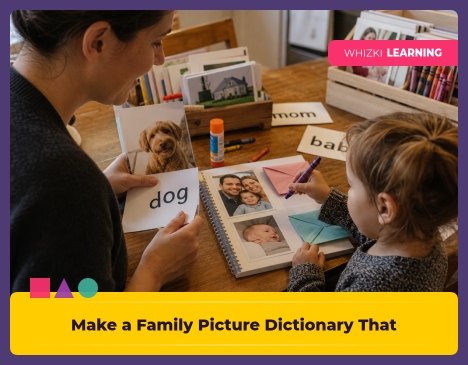
When your child points to a blanket and one adult says “blankie,” another says “cobija,” and a store-bought word list says “quilt,” pick five familiar photos today and write the words your family actually uses under each picture. A family picture dictionary lowers the argument about the “correct” word because the page belongs to your home. The first version can be five photos on a cereal box flap, a stapled booklet, or index cards.
Reviewed by Whizki Editorial Team, Early Childhood Education Editors.
Start with five real pictures
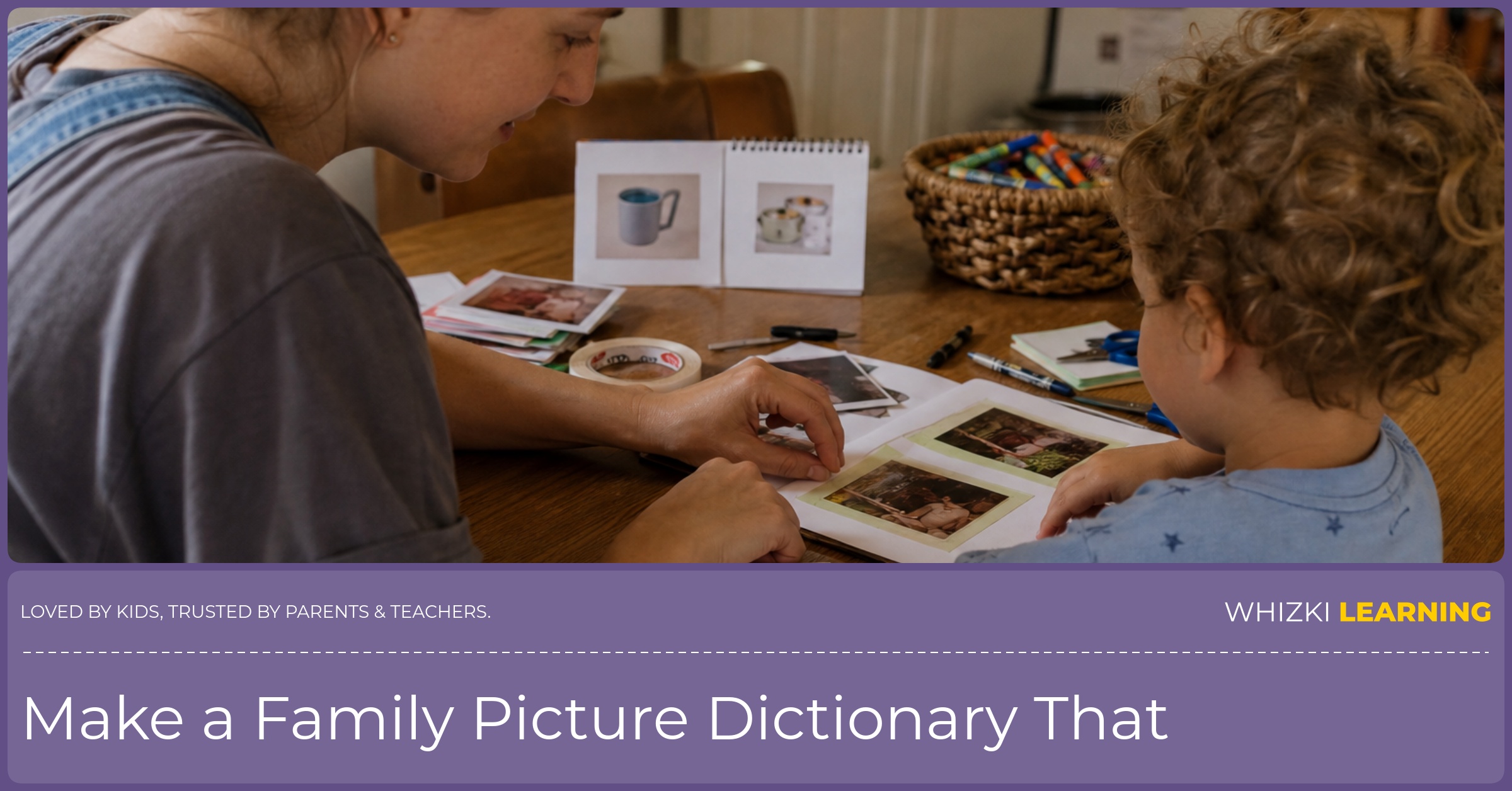
A family picture dictionary works best when the pictures come from your child’s day. Gather five photos or quick drawings, a marker, tape, and folded paper; the first build takes about 15 minutes. Reggio-inspired classrooms begin with close observation, and NAEYC guidance also reminds adults to connect learning to children’s families and cultures.
Household photos can show the actual cup at breakfast, the shoes by the door, the favorite stuffed animal, the family car seat, or the dog on the couch. Drawings work when printing photos is a hassle, and a child’s sketch can carry just as much meaning as a polished picture. The goal is recognition, not a perfect art project.
For ages 3 and 4, choose three to five pictures and let the child point, name, and stick the picture down. For ages 5 to 7, invite the child to help choose categories such as food, people, places, and bedtime. A kindergarten teacher using Orton-Gillingham routines would still keep the first set small because children learn print best through clear, repeated pairings.
Choose the words your family actually says
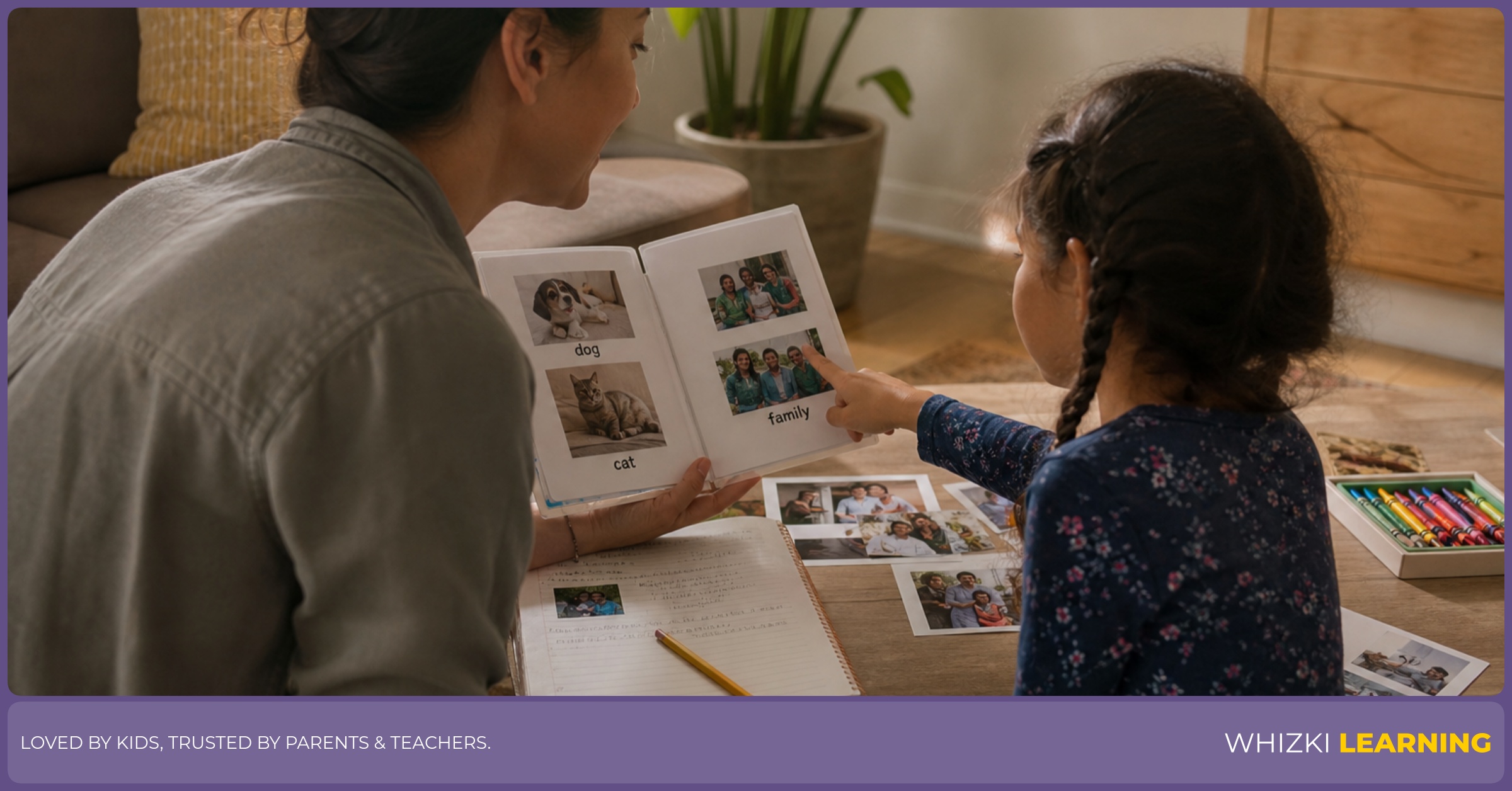
Family word choice matters more than matching a generic vocabulary list. Speech-language pathologists often ask families what a child hears at home because real communication grows from familiar people, places, and routines. If your family says “sofa” and Grandma says “couch,” both labels can live on the page without a correction scene.
Each picture can have one label in each family language, written in the word order and script your family uses. The label can be “abuela,” “Nana,” “Tía Luz,” or a home nickname when that word is the one your child needs for daily talk. Keep dialect words, regional food names, and family pronunciations because those choices carry identity as well as meaning.
The family dictionary pairs well with shared reading in more than one language. If your family is already reading a favorite book twice, the previous bilingual home guide gives a gentle way to keep both languages visible without turning story time into a lesson. The picture dictionary then becomes the child’s own word bank for the same home languages.
Add pronunciation, touch, and a tiny routine
Pronunciation support can be as simple as a caregiver saying the word slowly while the child taps the picture. A short audio note is useful when one caregiver is away, when a teacher wants to hear the family pronunciation, or when a child loves replaying a grandparent’s voice. If audio creates a power struggle around the phone, skip the recording and keep the spoken model face to face.
Occupational therapy basics remind adults that young children learn through hands, eyes, and movement. Invite the child to trace the picture border, point to the label, clap the syllables, and say the word while looking at the photo. When a child notices first sounds, the alphabet learning hub can support letter practice without replacing the home words.
The routine should stay short enough to repeat without dread. The adult reads two pages, the child chooses one page to say alone or echo, and the dictionary closes before attention falls apart. Orton-Gillingham teaching uses multisensory practice in small, consistent pieces, and the same spirit works at the kitchen table.
A ready-made alphabet printable can sit beside the family pages when a child asks, “What letter starts abuelo?” Browse the main Learning Hub for letter play, then return to the home photos for the words that matter at breakfast and bedtime.
Keep the dictionary useful, not perfect
A family dictionary stays useful when the pages change as the child’s world changes. Montessori observation asks adults to notice what children reach for and talk about, and NAEYC family engagement guidance values the knowledge families bring. Add the new lunchbox, the baby cousin, the bus stop, or the comfort object when those words become important.
The page count has an honest limit because young children do not need a giant binder. A preschooler may use 10 pages for months, while a 6-year-old may enjoy sorting 20 pages by room or routine. A teacher or homeschool parent can copy the same idea for classroom centers, but the classroom version should still welcome family labels rather than replacing them with one official word.
Dialect deserves respect inside the dictionary. The kindergarten word list may say “sneakers,” while your family may say “tennis shoes,” “trainers,” or another local word. The page can show both school language and home language, with the home word treated as knowledge instead of a mistake.
A family picture dictionary is small enough to start today and personal enough to keep using. Five pictures, real labels, and a few calm repeats can turn vocabulary practice into a record of how your child’s people actually talk.
If the project stalls, choose one photo from the day and add one label before bedtime. A living dictionary grows by ordinary moments, not by adult perfection.