When a child wants a show and you need fresh air without turning the afternoon into a project, trace one safe shadow today, mark the time, and come back once or twice. The shadow investigation feels playful, costs almost nothing, and gives a young child a real reason to predict, compare, and revise. Sunny note: keep the object still, choose a place away from driveways, and let the noticing matter more than perfect lines.
Reviewed by Whizki Editorial Team, Early Childhood Education Editors.
Set up one safe shadow
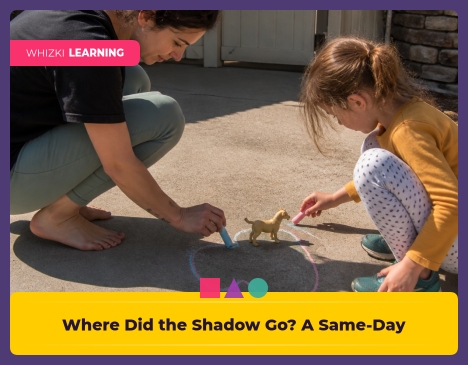
The shadow setup works best with one object that can stay put: a chair leg, a fence post, a toy animal weighted with a rock, or a child standing still for a quick body outline. NAEYC guidance asks early science to start with direct observation, so the shadow setup should feel like noticing, not like a quiz. Chalk on pavement is fastest, while painter's tape and paper work on a porch or sunny floor.
The adult job is safety and consistency. Pick a surface where no one will trip, write the time beside the first line, and remind the child that the object stays in the same spot while the shadow changes. A Reggio-inspired teacher move is to say, “I wonder where the shadow will be after snack,” then wait for the child to point, guess, or draw.
Mark, predict, and return
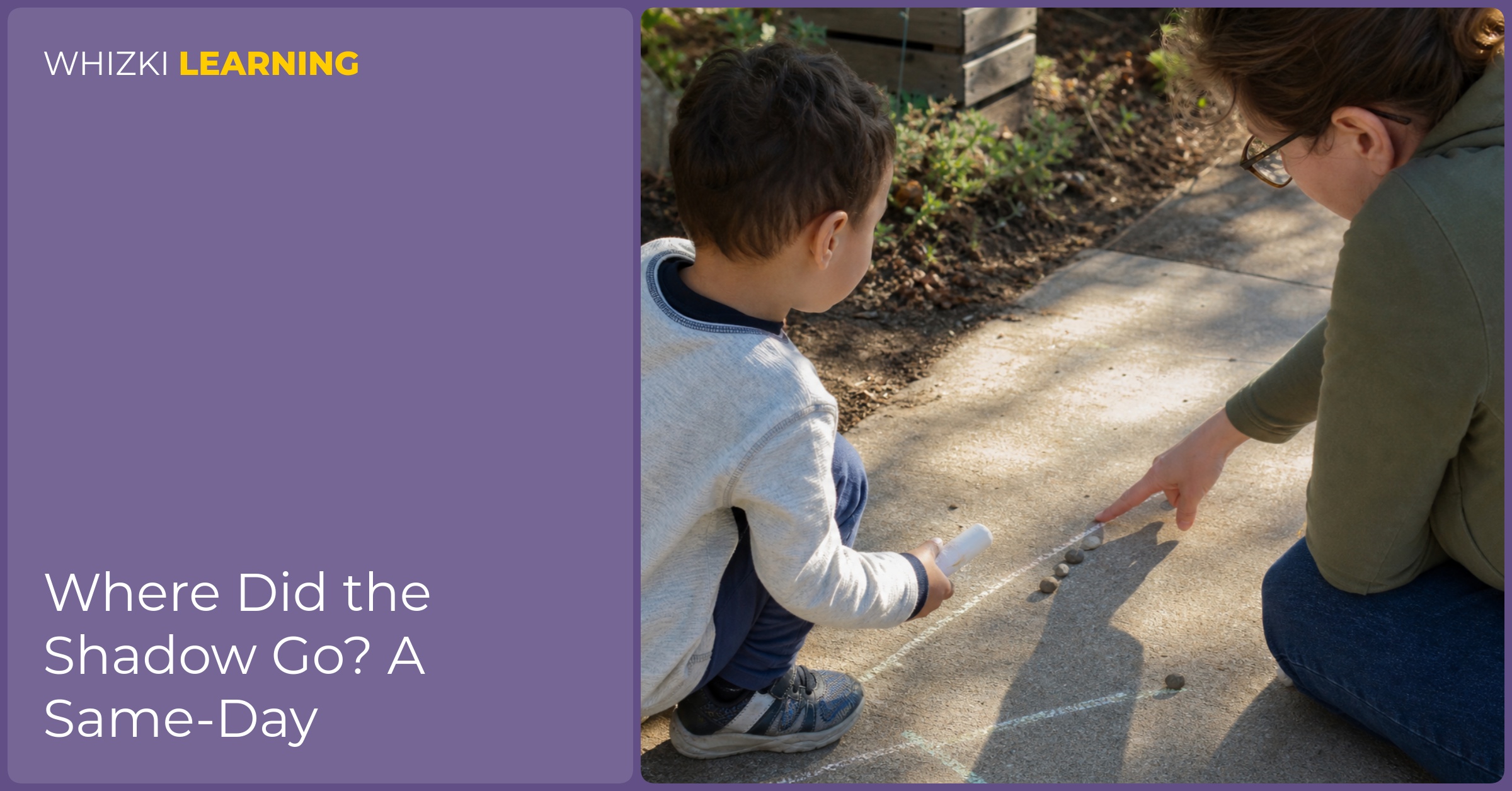
The investigation takes about 5 minutes at each visit. Trace the shadow at 9:00, noon, and 3:00 if the day allows, or choose morning, after lunch, and late afternoon without naming clock time. Montessori practical-life habits show up here because the child is carrying chalk, placing a hand carefully, and returning materials to the same spot.
The prediction can be tiny. Ask the child to place a pebble, sticker, or fingertip where the next shadow might land before the next check. Speech-language practice favors modeling fuller language, so an adult can recast “over there” as “You think the shadow will move closer to the garden bed.”
The record should stay simple enough for a preschooler to own. Use one color per visit, or draw a small sun mark beside each time if numerals are still new. Occupational-therapy basics remind adults to offer thick chalk or a short crayon when a small hand needs a steadier grip.
A recording page can help when a child wants to save the discovery for a grandparent, a co-op group, or circle time. The printable library has low-prep pages that can sit beside chalk marks without turning the shadow investigation into seatwork.
Talk about the moving sun carefully
The astronomy language can be honest and still child-sized. The sun's apparent movement is the kid-friendly observation, while Earth's rotation is the cause. Say, “The sun looks like the sun is moving across the sky, and Earth is turning, so the shadow points a different way as the day goes on.” NAEYC science guidance supports accurate everyday language because young children build later ideas from the words adults use now.
The adult does not need to explain orbit, tilt, seasons, and time zones during one sidewalk activity. The shadow investigation only needs one careful idea: light travels from the sun to the object, and the object blocks some light, so a dark shape appears on the ground. When the sun appears in a new place in the sky, the blocked-light shape lands in a new place.
The child may say the shadow is running away, hiding, or stretching. A Reggio-style documentation habit treats that phrase as useful thinking, so write the child's words near the line and add the adult science sentence beside the words. The child gets imagination and accuracy sitting side by side.
Use paper when chalk is not possible
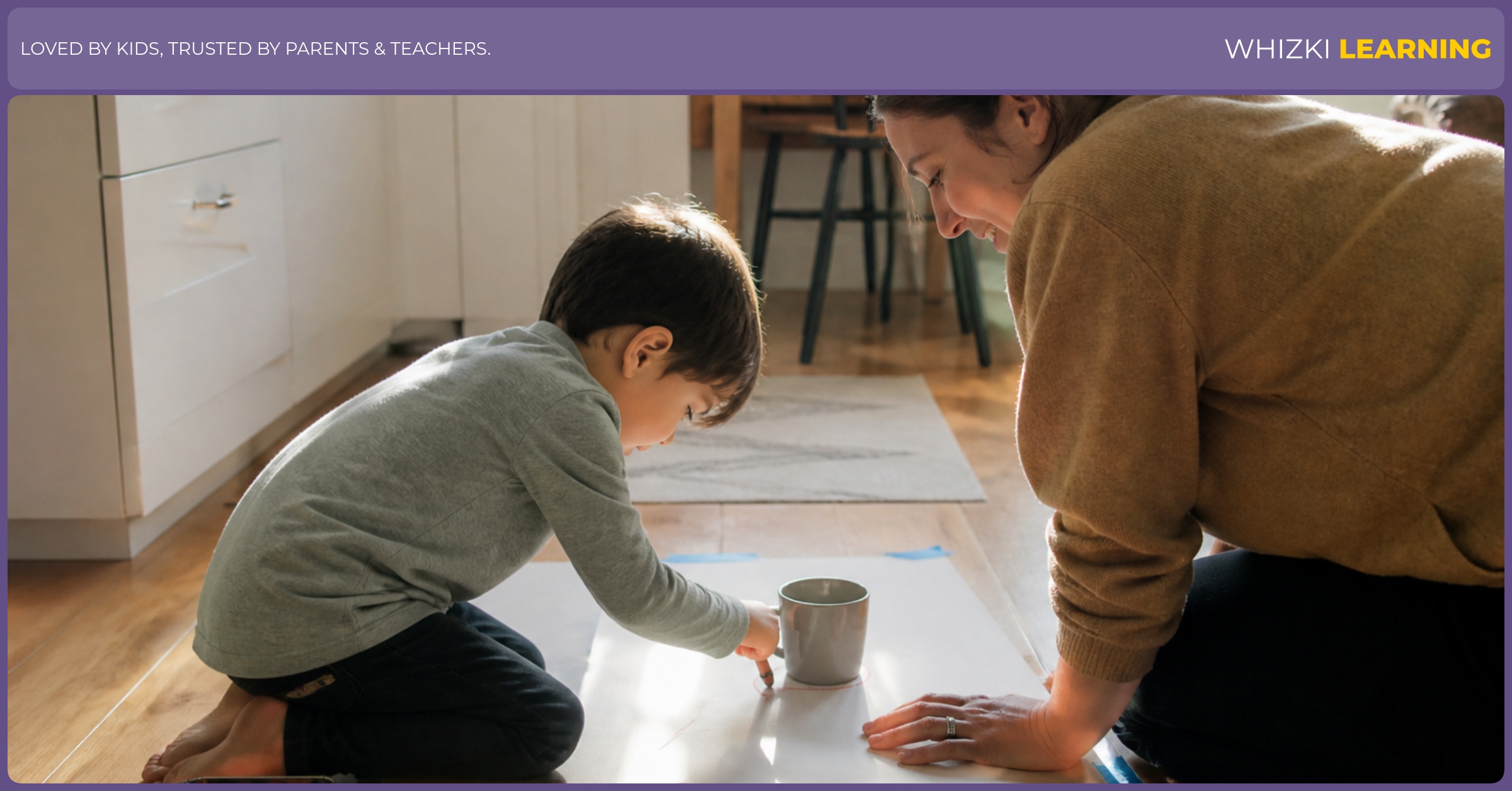
The paper version helps renters, rainy-day classrooms with a sunny window, and families without safe pavement. Tape a large sheet to the floor, place a cup or block at the same corner, and mark the shadow edge two or three times. Occupational-therapy practice often uses vertical and horizontal surfaces for shoulder and wrist control, so a big paper trace can support motor practice while the science stays central.
The indoor limit is worth naming before the child starts. A window shadow can shift because of the sun and because curtains, blinds, or the object move, so the adult should say, “Our paper lab is a close look, not a perfect clock.” Honest limits keep the activity calm when clouds interrupt the plan.
The paper record can connect to other world-learning walks. Families who enjoyed the previous world lab guide can use the same compare-and-notice talk: longer, shorter, closer, farther, lighter, darker. For more off-screen ideas by age and skill area, the Learning Hub keeps related activities in one place.
What counts as enough for ages 3 to 7
The 3-year-old version can be one trace and one return. The child may care more about coloring the shadow than predicting the next spot, and that response still belongs in early science. Montessori and Reggio traditions both value repeated hands-on contact before formal explanation.
The 4- and 5-year-old version can include a guess mark before the second visit. The kindergarten child can compare two lines with words like longer, shorter, turned, near, and far. Orton-Gillingham teaching reminds me to pair hearing, seeing, saying, and moving, so the child can say the prediction, point to the place, and trace the line.
The 6- and 7-year-old version can add arrows and simple time labels without making the investigation feel like a worksheet. The child can notice that morning and afternoon shadows often point different ways, while midday shadows may look shorter depending on season and location. The adult should avoid promising the same pattern every day because clouds, buildings, latitude, and season all matter.
The stopping point matters as much as the setup. End the investigation when curiosity is still alive, not after every possible question has been answered. NAEYC-aligned practice favors play, conversation, and choice, so a child who wants to jump over the shadow line has found another valid way to learn through the body.
The shadow investigation is small on purpose. A child sees that a mark can hold a moment, a prediction can be checked, and the sky can be watched without a screen or a lecture. The adult gets a science routine that fits between snack, laundry, and the next real-life interruption.