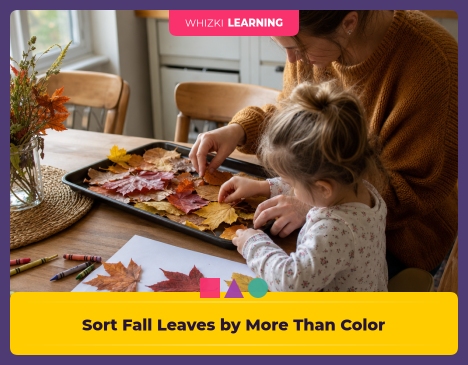
When the leaf pile turns into an argument over who found the "best" red one, invite each child to pick three leaves and say, "We are sorting like scientists today: edge, size, shape, texture, and condition." Fall leaves are familiar enough for preschoolers to handle with confidence, and the categories give kindergarten children a real reason to compare beyond favorite color. A ten-minute tray on the porch, kitchen table, or classroom rug is enough for the first round.
Reviewed by Whizki Editorial Team, Early Childhood Education Editors.
Set up a leaf investigation, not a craft
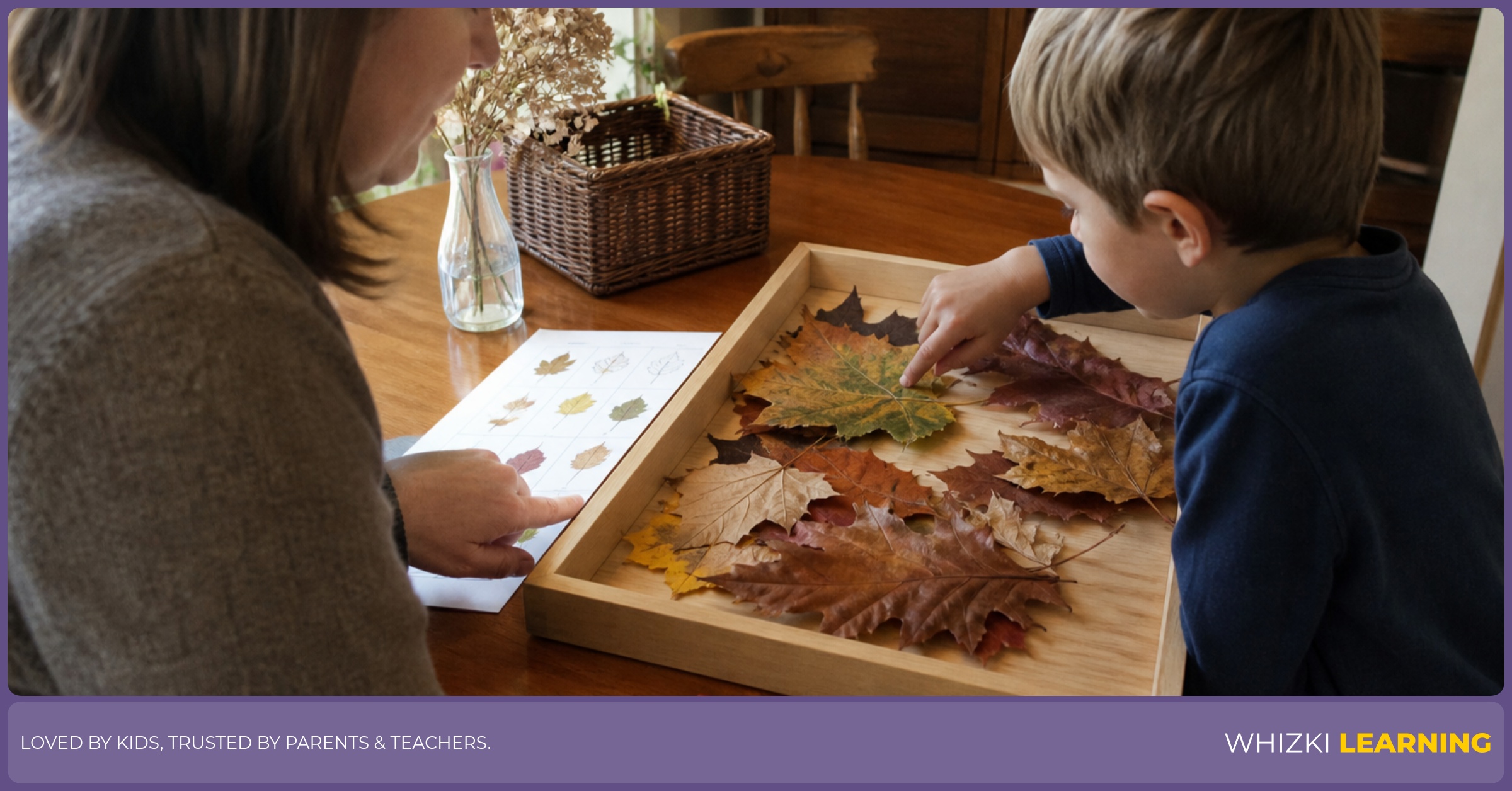
The leaf investigation works best when the adult treats the table like a small science station, not a perfect art project. Reggio practice invites children to notice real materials before adults rush toward a product, and NAEYC guidance supports hands-on comparison for young children. The same slow noticing showed up in the previous world lab guide, where language grew from touching, looking, smelling, and naming.
The materials are simple: a tray, five to ten leaves, a magnifier if one is handy, plain paper, and a crayon for quick drawings. Occupational therapy basics remind adults to watch comfort with touch, because a child who dislikes crumbly or damp textures can point, use tongs, or compare photos instead. Three-year-olds may sort two categories, while six- and seven-year-olds can explain a reason for every placement.
The time estimate is ten to fifteen minutes for home and about twenty minutes for a small classroom group. The adult job is to slow the pile down, name one feature at a time, and accept child language like "poky edge" before adding words such as toothed or lobed. The honest limit is weather: soggy leaves tear fast, so a paper towel under the tray saves frustration.
- Gather six specimens.
- Inspect margins.
- Sequence lengths.
- Trace outlines.
- Brush surfaces.
- Circle flaws.
Use a decision tree for categories
The decision tree gives young children a clear path when a pile of leaves feels like too much. Orton-Gillingham teaching trained me to move from one clear feature to the next, using touch, speech, and sight together. The same structured habit helps children compare without guessing what the adult secretly wants.
The first branch asks, "What do the edges feel like?" A child may notice smooth, toothed, bumpy, torn, curled, or pointy edges. The adult can say, "Edge means the outside line," while a finger traces around the leaf.
The second branch asks about size and shape. Size can mean smaller than the child’s hand, about the same as the child’s hand, or bigger than the child’s hand, which keeps measurement concrete for ages three to seven. Shape can mean long and skinny, round, oval, heart-like, star-like, needle-like, or hand-like.
The third branch asks about texture and condition. Texture covers fuzzy, waxy, papery, slick, crunchy, or soft, while condition covers fresh, dry, spotted, holey, cracked, chewed, or folded. A leaf can belong in more than one category, so a large spotted maple leaf may sit with "big," "hand-like," and "spotted" at the same time.
Color can stay in the conversation without taking over the investigation. The adult can say, "Red is one thing you noticed, and now find one thing your finger notices." The goal is flexible sorting, because real objects rarely fit one neat box.
For a paper follow-up after the leaf tray, the seasonal pages in holiday and culture printables give children space to draw, label, and compare discoveries without turning the walk into a worksheet race. A printable can be a quiet recording page after real leaves or photos have been handled first.
Try a photo-only version when leaves stay put
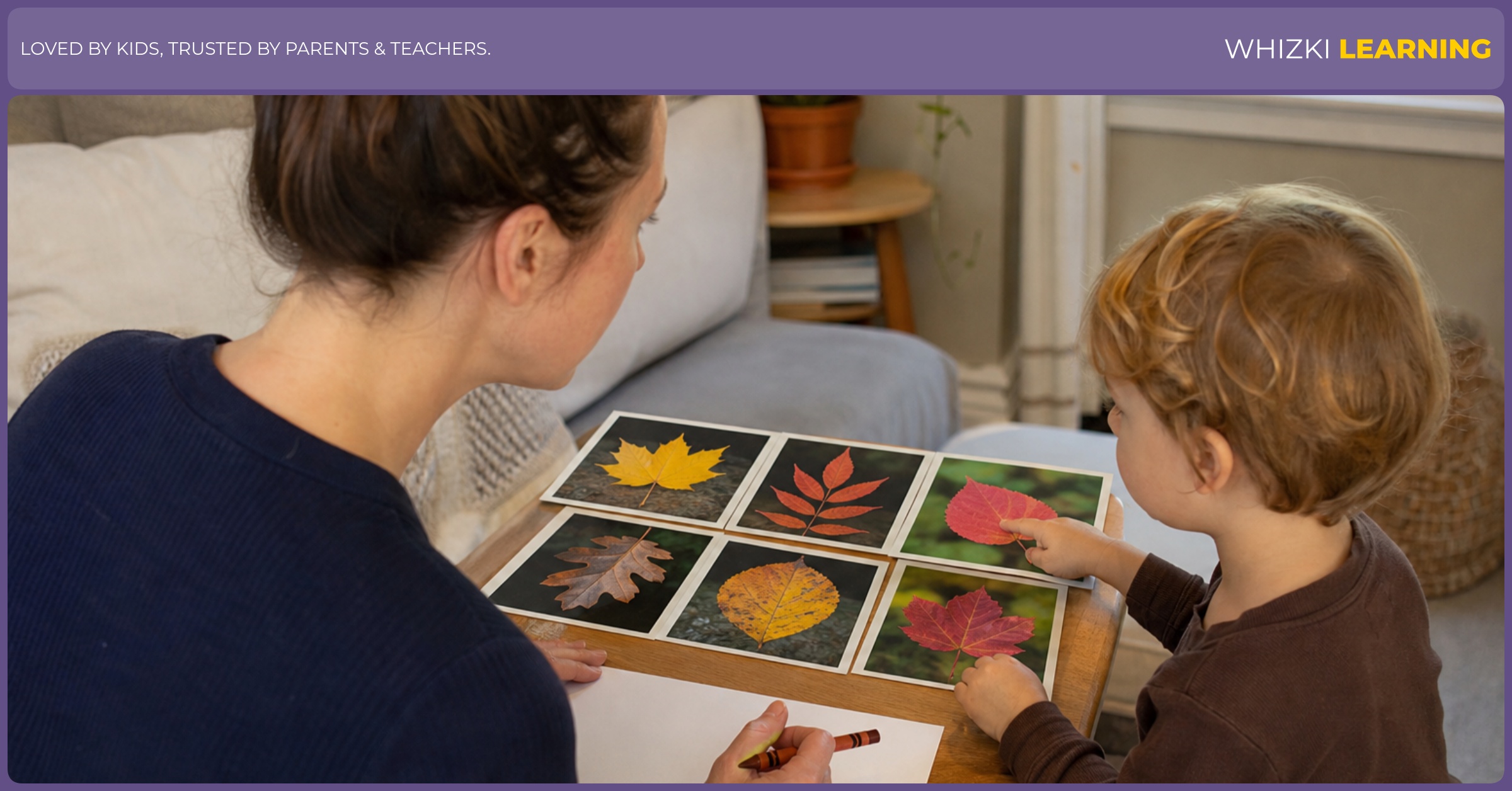
The photo-only version respects parks, nature centers, apartment grounds, and schoolyards where collecting is not allowed. Montessori and Reggio observation both support careful looking before taking, and that habit matters outdoors. The adult can model, "Leaves can teach us while leaves stay on the ground."
Photographs work best when the adult takes close shots of single leaves beside a shoe, hand, twig, or coin for scale. Print the photos or view the photos together briefly, then ask children to point to edges, compare sizes, and name visible shapes. For preschoolers, use three photos; for older kindergarten children, use six to eight photos.
The photo-only version has a real limit because a picture cannot always show texture. The adult can say, "The photo shows a wrinkled look, but our hands do not know whether the leaf feels crunchy or soft." That honest sentence teaches children that scientists sometimes need a closer tool, a better angle, or more information.
Talk through the math and science
The comparison language is the math. NAEYC guidance treats early math as sorting, matching, ordering, describing, and explaining with real materials, which is exactly what leaf work gives children. For another low-prep place to gather early math and world learning ideas, browse the Learning Hub when a rainy day keeps the walk short.
The adult sentence frame can be simple: "I notice blank, so I put the leaf here." Speech-language pathology practice often uses sentence frames because a steady pattern lets children focus on the new vocabulary instead of building a whole sentence from scratch. A child might say, "I notice little holes, so I put the leaf with damaged ones."
Kindergarten teachers and homeschoolers can add a quick record without making the paper more important than the leaves. Ask the child to draw one leaf and label one feature with adult help, such as edge, size, shape, texture, or condition. The best record for ages three to seven is short, spoken first, and tied to something the child actually touched or observed.
The leaf sort is finished when the child can explain one choice, not when every pile looks perfect. Save two favorite leaves in a bag for another day, or save two photos if collecting is not allowed, and revisit the categories after snack or read-aloud time. The adult goal is steady curiosity: "Show me how you know."