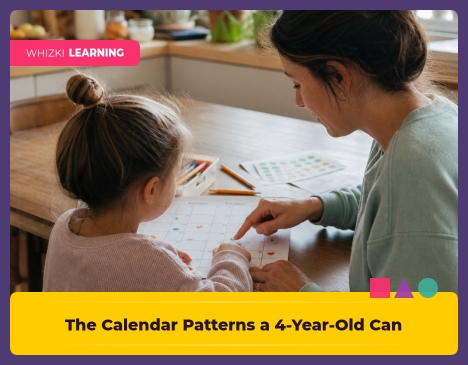
If your child asks, “Is Grandma coming today?” six times before breakfast, put one paper calendar page on the fridge and mark today together before answering again. Calendar talk can feel oddly hard because adults carry the whole month in adult memory, while many 3- to 7-year-olds understand time through breakfast, school, bath, sleep, and the next exciting thing.
Reviewed by Dr. Anna Klein, EdD, Early Childhood Curriculum Specialist.
Start with one visible week
The one-week calendar is the right starting point for most preschool and kindergarten children. NAEYC guidance on developmentally appropriate practice reminds teachers and parents to begin with what children can observe, touch, and repeat in daily life, so seven boxes usually make more sense than a full wall calendar full of tiny numbers.
The calendar setup takes about five minutes. Use a blank sheet of paper, a ruler, a marker, and seven roomy boxes labeled by the adult with the days your family actually uses, such as school days, home days, therapy days, library day, or grocery day.
The calendar goal is not a perfect recital of January through December. The calendar goal is for the child to notice that today gets a mark, tomorrow is the next box, and the weekend often has a different feel from the weekday routine.
For families who like one printable landing spot, Whizki Learning keeps a gentle planning page in the family learning planner. Use a single week box as the calendar piece, then keep the rest of the page for meals, errands, or read-aloud plans.

Mark days as they happen
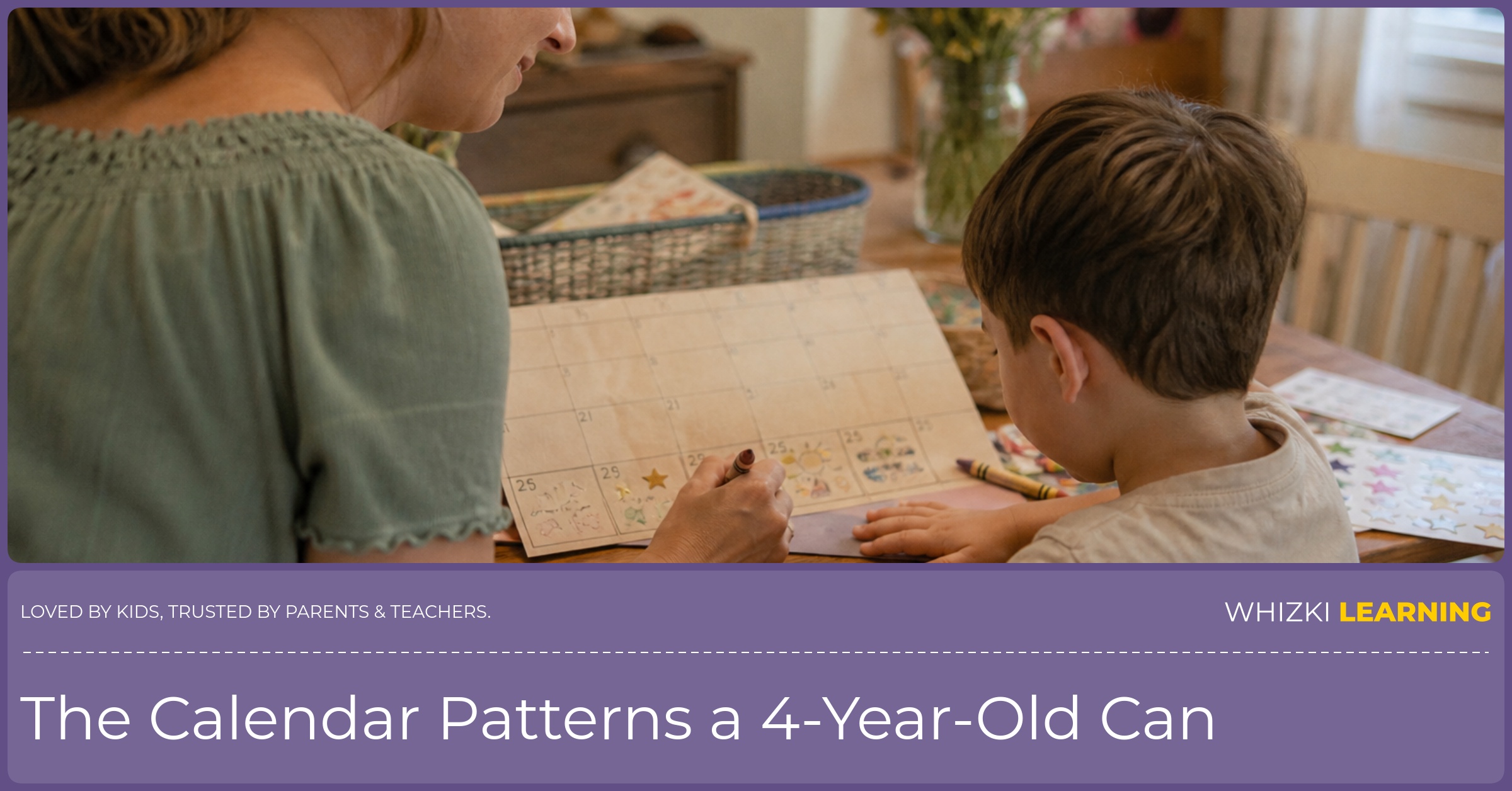
The daily mark is the part young children can actually see. Reggio-inspired teaching treats children as observers of real life, so the calendar becomes stronger when the child adds a dot, sticker, or slash after a familiar routine rather than before an abstract talk about the whole month.
The morning calendar routine can be short and steady. After breakfast, say the day, touch the box, add one mark, and name the next anchor in the child’s day, such as preschool, park, rest time, or dinner with a cousin.
The occupational-therapy rule of thumb is to make the motor job simple enough that attention can stay on the idea. Tape the paper so the calendar does not slide, offer a thick crayon or sticker, and guide the child to move from left to right if the child is ready for that visual path.
Notice weekends and repeating routines
The weekend pattern is often the first calendar pattern a child recognizes. The Orton-Gillingham habit of saying, seeing, touching, and moving in a steady order works well here because the child hears the words, touches the boxes, and connects the pattern to lived routines.
The weekend cue can be as plain as two yellow boxes at the end of the row. Say, “These two boxes are home mornings,” then connect the boxes to something concrete, such as pancakes, soccer, church, visiting family, or slower pajamas.
The repeating-routine cue should match family reality instead of an ideal schedule. A preschool teacher might mark music day with a tiny note, while a homeschool parent might mark library day, and a caregiver might mark the day a grandparent arrives.
Count to a near event
The near-event countdown works best when the event is two to seven days away. Speech-language pathologists often build understanding with short, repeated phrases, so use the same words each day, such as “three sleeps until the picnic” or “two boxes until the dentist.”
The counting routine should use one finger touch for each empty box between today and the event. If number naming feels shaky, pair the calendar with simple counting ideas from the numbers learning hub, then return to the real calendar square right away.
The paper calendar also gives children one-to-one correspondence practice. The same idea shows up in the previous math at home guide, where each paper clip counts once, and each calendar box should also be counted once.
Adjust for ages and real family life
The age adjustment should protect the child from too much time language at once. A 3-year-old may only mark today and notice “home day,” a 4- or 5-year-old may count two or three boxes to a visit, and a 6- or 7-year-old may help write a simple event word with adult support.
The calendar limit is worth naming because time is still abstract. Montessori practice moves from concrete materials to symbols, and a paper calendar is still a symbol, so confusion after a late night, travel day, or changed plan is normal.
The adult response can stay calm and practical when the plan changes. Cross out the old plan, draw a small arrow to the new day, and say, “The plan moved,” because the visible change teaches more than a long explanation.
The best calendar routine for young children is small enough to repeat on an ordinary Tuesday. One mark, one pattern, and one short countdown can do more than a full month of tiny boxes that nobody in the house wants to explain.
The family calendar will never remove every “how many more days” question. The family calendar can give the child a place to look, touch, count, and slowly build the idea that time moves one day at a time.