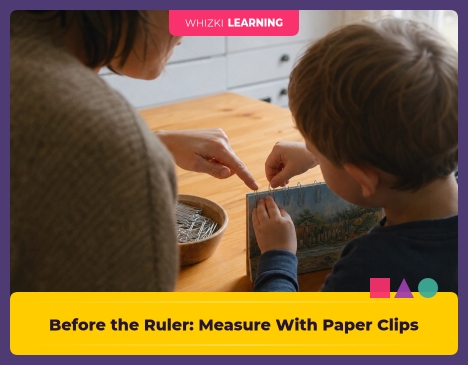
When one child announces the toy train is “nine paper clips long” and another insists on “ten,” the kitchen-table friction is real, so try one measurement today with only same-size paper clips and one clear start line. Early measurement can feel messy because young children are still learning that the unit has to stay equal, touch the next unit, and cover the whole length. The goal for ages 3 to 7 is not a perfect number on the first pass, the goal is a short investigation your child can see, touch, and fix.
Reviewed by Dr. Anna Klein, EdD, Early Childhood Curriculum Specialist.
Start with equal units your child can handle
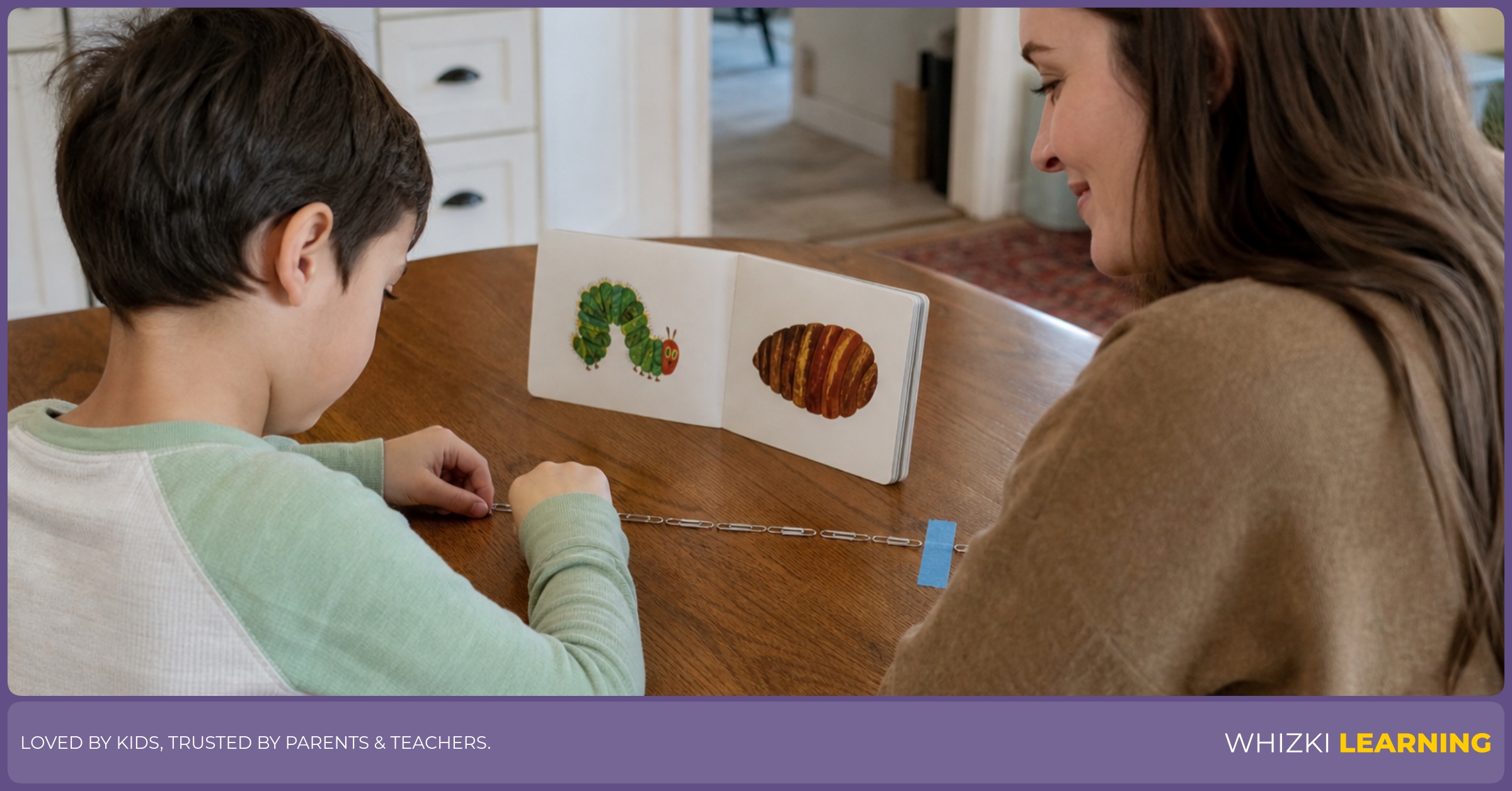
The paper clip investigation needs 10 to 12 minutes, 15 to 25 paper clips of the same size, one small book or toy, and a strip of painter’s tape for the start line. NAEYC guidance favors concrete, playful materials for early math, and paper clips give children a unit that can be picked up, moved, and checked. Equal units mean every paper clip stands for the same amount of length, so mixing jumbo clips with tiny clips changes the count.
A 3-year-old can compare “shorter” and “longer” with five large clips beside a chunky block, while an older 5- to 7-year-old can measure a pencil, a shoe, and a picture book. The parent can say, “One unit, one unit, one unit,” while the child touches each clip. The steady touch-and-say pattern borrows from Orton-Gillingham teaching, where clear language and multisensory repetition help a new idea stick. For number word practice around the row, the numbers learning hub can support counting language without turning measurement into a quiz.
The adult job is to limit choices at first, not to quiz. Reggio-inspired teaching treats materials as a language, so the row of clips becomes the child’s first explanation of length. If the paper clips are slippery or tempting to chain together, switch to same-size blocks or square crackers and return to clips later.
Keep the line honest: no gaps, no overlaps
The paper clip row is accurate only when each clip touches the next clip without a space and without sitting on top of a neighbor. Montessori teachers often use a control of error, meaning the material lets the child spot the problem, and a crooked row of clips makes gaps and overlaps visible. Say, “The clips need to kiss, not climb,” if playful language fits your family.
The occupational-therapy basic here is simple: the helper hand holds the object steady while the working hand places each unit. A child who keeps bumping the book may need a nonslip placemat, a wider object, or fewer clips. Fine-motor strain can hide the math, so make the measuring path easier before correcting the count.
For ages 3 and 4, the adult can place the first two clips and invite the child to copy the pattern. For ages 6 and 7, the child can become the “measurement inspector” and slide one finger along the row to find spaces. The inspector job turns correction into checking, which usually lands better than “wrong.”
Mark the start and the finish before counting
The start point is the place where measuring begins, and the end point is the place where measuring stops. In my classroom, I use a bit of tape at the left edge of the object and a fingertip at the far edge because young children often count the clips before the row actually covers the length. The Orton-Gillingham habit of naming the steps in order helps here: start, place, touch, stop, count.
The end point matters because a row can look tidy and still miss the final corner of a book. A child may count eight clips when a small part of the object sticks past the last clip, and that small part is the beginning of later ideas like “almost nine” or “a little more than eight.” Keep the language informal for ages 3 to 7: “eight clips and a leftover bit” is enough.
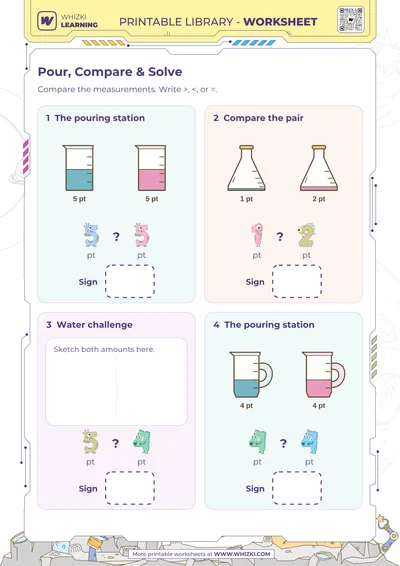
The paper-clip measuring page in the Whizki printable library can give your child a simple place to draw the object and record the clip count. A blank piece of paper works too, because the learning comes from lining up, checking, and talking.
Why two answers can both make sense
Two people can get different answers because the measurement choices may not match. One child may leave tiny spaces, another child may overlap clips, and an adult may choose a different start point. A Reggio-style conversation helps more than a quick correction: ask each measurer to show the row and explain the choices.
The different answers are also useful data for the adult. If the same shoe measures ten small clips or six jumbo clips, the count changed because the unit changed, not because the shoe changed. The previous math at home guide uses a similar idea: children learn from sorting, comparing, and explaining visible groups.
The limit is attention span. If the measurement debate turns into a power struggle, pause after one object and save the ruler for another day. Short, honest math talk beats a long table session where everyone wants to flee.
Connect paper clips to a ruler without rushing
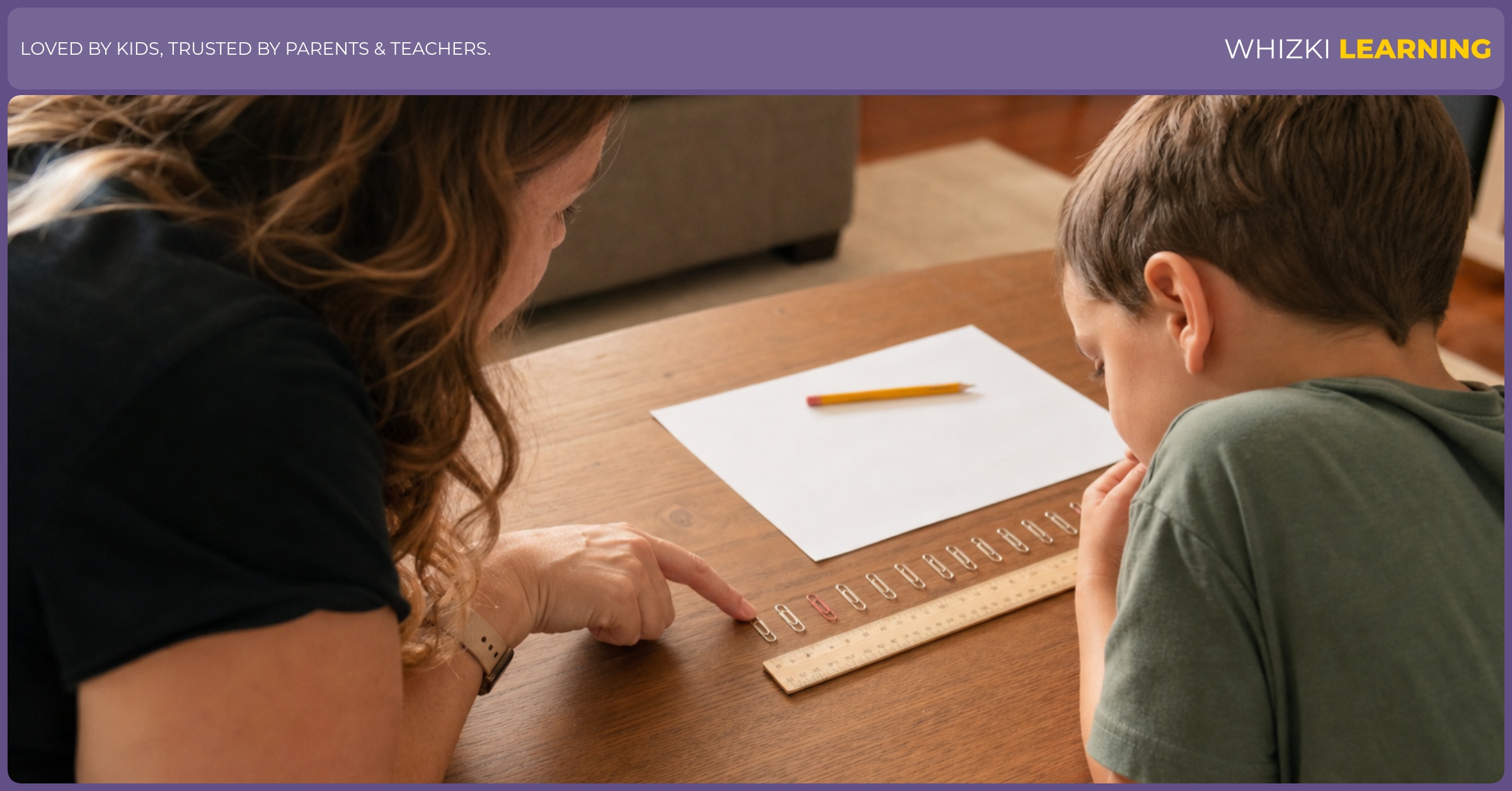
The ruler is a row of equal spaces that someone already organized, and that idea is the bridge from paper clips to standard measurement. NAEYC developmentally appropriate practice reminds adults to connect new symbols to hands-on experience, so lay a ruler beside the paper clip row before naming inches or centimeters. The child can notice that the ruler marks are lined up in order, just like the clips.
Try a comparison before a lesson. Put the first paper clip at the zero end of the ruler, line up three or four clips, and say, “The ruler has marks that help people agree.” Avoid asking for inch or centimeter names right away because the real concept is equal spaces with a shared start point.
For a 3- or 4-year-old, the adult can simply say, “The ruler is another measuring tool.” For a 5- to 7-year-old, invite the child to predict whether the paper clip row will reach the same place after the row is rebuilt. Montessori comparison work often uses repeated matching, and repeated matching helps children see that measuring is about the unit, the path, and the endpoints.
Paper-clip measurement is small enough for a busy afternoon and serious enough to build real math thinking. When the adult keeps the unit equal, checks for gaps and overlaps, marks the start and finish, and welcomes different answers as clues, the ruler starts to make sense instead of feeling like a mysterious school tool.