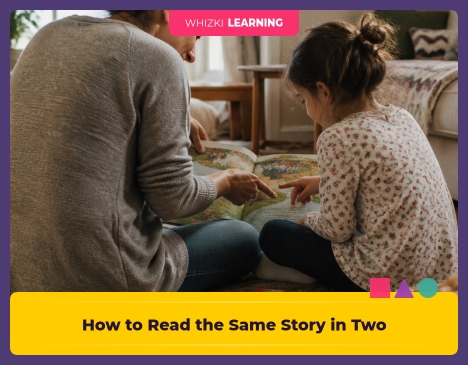
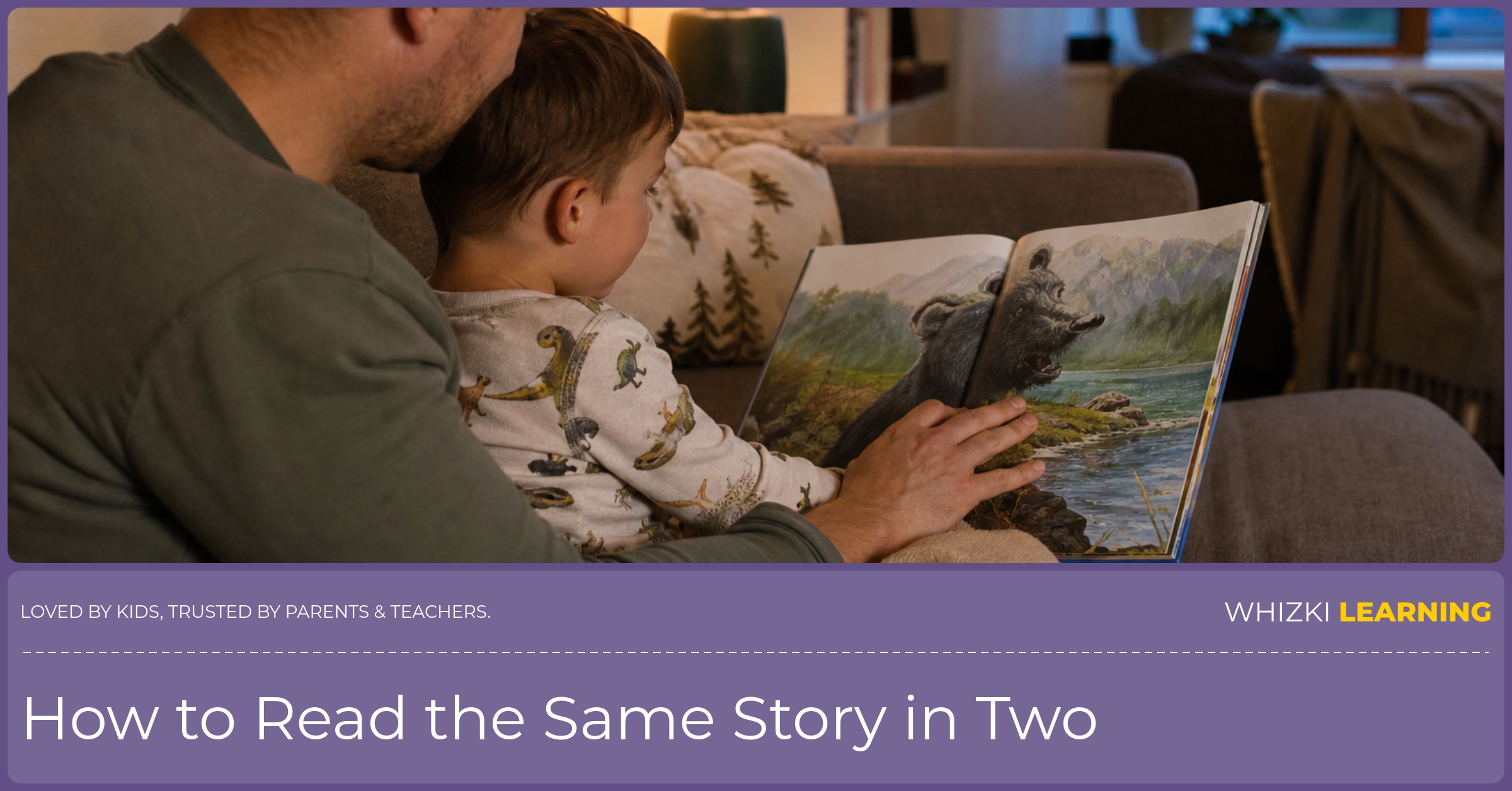
When your child asks for the same bedtime book and the grown-ups are split on which language to use, try reading for meaning first tonight: one adult tells the story naturally, and everyone lets the wording be different. The bilingual read-aloud does not need to sound like a courtroom translation. The useful next step is simple: pick one favorite page, tell the page in the language that feels natural, and ask, “What happened here?” before anyone worries about matching every word.
Reviewed by Whizki Editorial Team, Early Childhood Education Editors.
Start with story meaning, not matching words
The story meaning should lead the bilingual read-aloud because young children build language through shared attention, pictures, voice, and memory. NAEYC guidance on developmentally appropriate practice points teachers toward rich, responsive language instead of performance pressure, and the same idea works at the kitchen table. A child who can retell the bear getting lost has understood the page, even when the child uses different words from the book.
The adult can read a page in English and then retell the same page in Spanish, Arabic, Mandarin, ASL-supported speech, or another home language without stopping after every sentence. The page retell can be shorter, longer, sillier, or more homey than the printed version. The goal is shared meaning, because story enjoyment keeps children age 3 to 7 willing to come back tomorrow.
The Reggio tradition reminds teachers to watch what the child notices before deciding what the lesson should be. During a two-language story, the child might point to the red boots, laugh at the puppy, or copy a repeated line. The adult can follow that spark and say the interesting part in both languages, then keep the page moving.
Use a five-minute decision tree during read-aloud
The bilingual decision tree starts before the book opens: choose the language that makes the adult feel warm and fluent for the first reading. If one adult is tired, the tired adult can use the stronger language and keep the read-aloud short. Occupational therapy basics often use the “just-right challenge” idea, and the same idea helps with language because a five-minute story with comfort beats a twenty-minute struggle.
If the child already knows the book well, the second language can come in as a playful retell after the first read. If the child has never heard the book, the first pass should carry the plot clearly with pictures, gesture, and a steady voice. A brand-new story plus a word-for-word translation can feel too choppy for many preschoolers.
If two adults speak different languages, each adult can take a natural role instead of trying to copy the other adult. One adult might read the printed text at nap time, and another adult might tell the same story from memory at breakfast. Montessori observation practice would call that following the child’s concentration, because the adults are watching attention rather than forcing a script.
If the family wants a simple way to remember which stories worked, add a note in the family learning planner after the read-aloud. The note can be tiny: “Loved the wolf voice in both languages” or “Too tired for a second pass.” A small record helps the adults repeat what felt good without turning the bookshelf into homework.
Compare one or two useful phrases, then move on
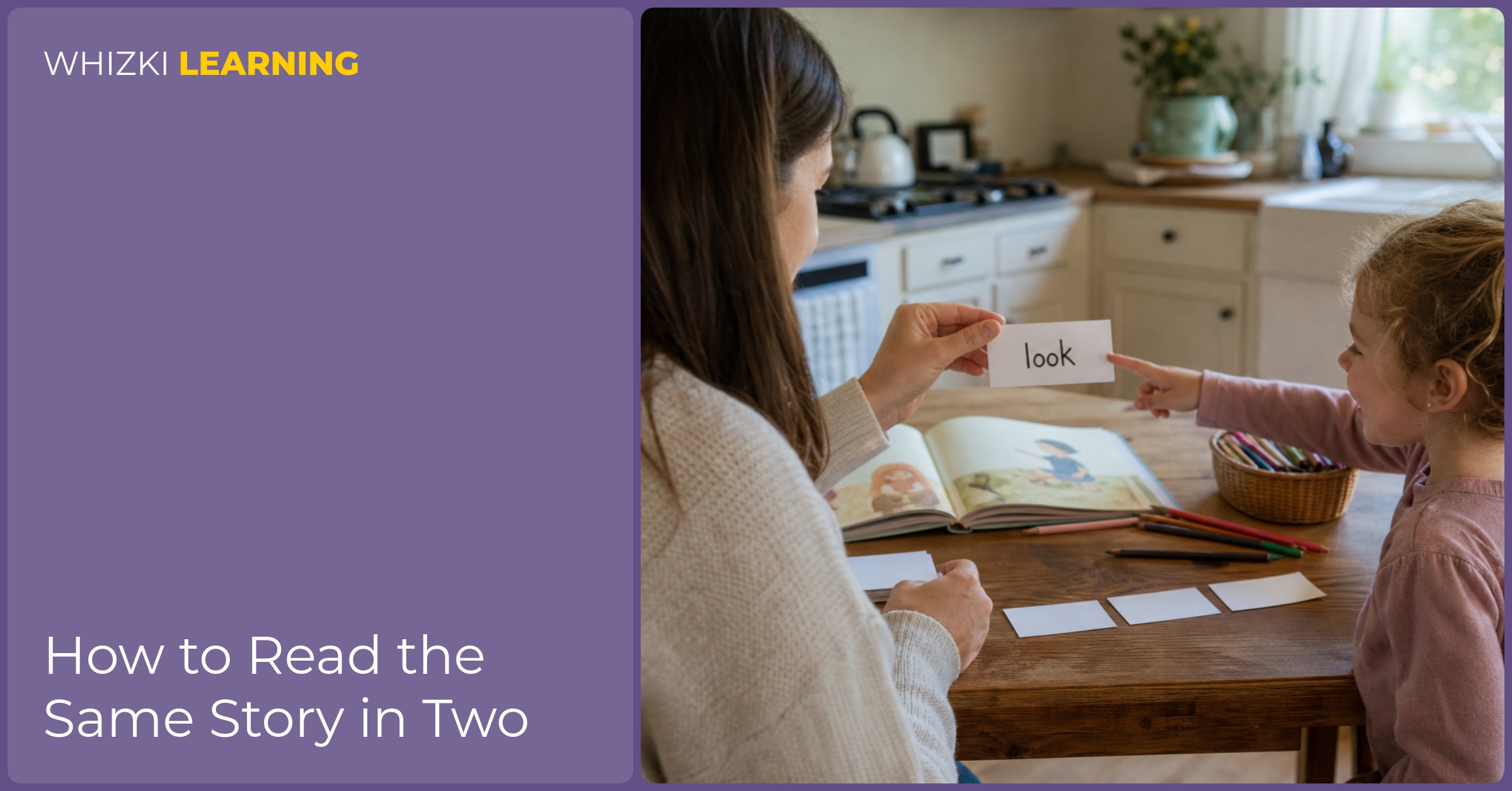
The phrase comparison should be small enough for the story to stay alive. Choose one useful line such as “I’m scared,” “Come here,” or “Let’s go home,” and say the line in both languages with the same facial expression or action. Speech-language pathology practice often values functional phrases because children use meaningful language more readily than isolated vocabulary drills.
The Orton-Gillingham approach gives another helpful reminder: make language concrete, multisensory, and paced. A child can touch the page, act out “run,” whisper a repeated phrase, or tap the rhythm of a short sentence. The adult does not need to explain grammar labels to a 4-year-old for the child to notice that two languages can carry the same idea.
The adult can accept different wording when the child retells the page. “The bunny is mad” and “The rabbit feels angry” can both fit the story, and the home language version may choose a phrase that sounds more natural to Grandma. The adult’s response can be, “Yes, that means the bunny is upset,” and then the story can continue.
For families who like a little paper support, a printable story-choice mat or read-aloud plan from the Learning Hub can help adults pick a book, a language order, and one phrase to compare. The printable is a helper, not the lesson.
A pencil note in the margin of a planner can do the same job when the evening is messy. The best tool is the one the adult will actually use after dishes, pajamas, and one more drink of water.
Options when only one adult speaks both languages
One bilingual adult can carry the two-language read-aloud without making the child sit through a double-length book every time. The adult can read the whole story in one language on Monday and retell favorite pages in the other language on Tuesday. NAEYC family guidance supports honoring home language as part of the child’s identity, so the schedule can protect both connection and rest.
A monolingual adult can still join the bilingual routine by handling the pictures, page turns, sound effects, and prediction questions. The bilingual adult can supply key lines later, while the monolingual adult says, “Tell me what happened on this page.” Shared book time stays shared, even when only one adult knows both languages.
A caregiver who is learning the second language can use a small, honest script. The caregiver might say one greeting, one animal name, and one good-night phrase, then let the fluent adult or an audio recording from a trusted family member fill in more language another day. Speech-language pathologists often tell families that warm, accurate interaction matters more than a long list of corrected words.
Keep the joy visible and know the limits
The child’s body gives useful information during a bilingual story. If the child leans in, adds a sound effect, or asks for one more page, the routine is probably at a good size. Occupational therapy observation often looks at posture, attention, and effort, and parents can use the same common-sense cues without turning story time into a behavior chart.
The adult should stop the comparison before the child starts protecting the book from the lesson. A preschooler who says “just read” is giving a clear boundary, and the adult can respect that boundary by returning to the plot. Reading the same story in two languages should feel like a bigger doorway into the story, not a pop quiz with pictures.
If a school form, screening question, or teacher conference makes the family wonder which language to report, the previous bilingual home guide can help the adults prepare clear answers. The read-aloud routine cannot replace a speech, hearing, or developmental evaluation when a real concern appears. The routine can, however, give the child more chances to hear loving, useful language in the places where family life already happens.
A same-story read-aloud works best when the adult protects the story first and teaches lightly around the edges. Pick one favorite book, one comfortable language order, and one phrase worth comparing. When the child asks for the book again, the child is telling the adult that the routine is doing its most important job.