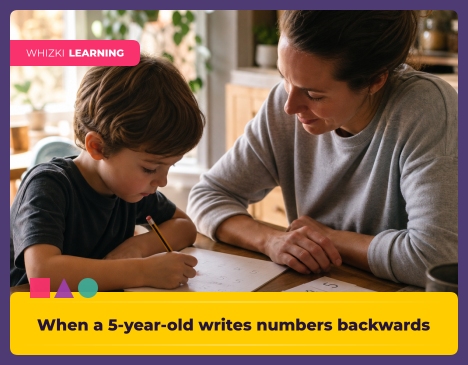
If your 5-year-old just wrote a 3, 5, or 7 backward on a math page and your stomach dropped, circle one correctly written number, say, "Your pencil is still learning the path," and invite your child to trace that model with one finger. Mirror writing feels alarming because adults see the mistake instantly, but young children are still sorting direction, starting points, and pencil movement. Backward numbers are common through age 7, especially when children are tired, rushing, or writing without a nearby model.
Reviewed by Dr. Anna Klein, EdD, Early Childhood Curriculum Specialist.
Is mirror writing normal at five?
Mirror writing at age 5 is usually part of early handwriting development, not a sign that a child is lazy or careless. NAEYC guidance reminds early-childhood educators to judge skills across time, settings, and meaningful work, rather than from one worksheet at the kitchen table. A reversed 3 on Monday and a correct 3 on Tuesday tells me the child is still building a reliable motor plan.
Number reversals often show up in 3, 5, 7, and sometimes 2 because those shapes depend on direction and turns. The pattern is so common that I treat reversals as a teachable clue, not a scolding moment. For a closer look at the most common flipped digits, see our guide to number reversals explained with child-friendly examples.
Kindergarten handwriting grows from repeated, low-pressure practice with a clear model nearby. In my classroom, children who reverse numbers during free writing often write the same number correctly during a guided game because the starting point and language are fresh. That difference matters because the skill is still forming, not missing.
Why young brains flip numbers
The young brain often treats a shape as the same shape when the shape faces left, right, up, or down, because recognizing a cup, shoe, or block from any side is useful. Written numbers break that everyday rule, so a 5 may look "the same enough" to a beginner even when the open side faces the wrong way.
Reggio-inspired observation helps adults watch what the child understands before correcting the page. A child may know that the symbol means five objects and still place the curve on the wrong side, because math meaning and handwriting direction are separate skills. The adult job is to give the child a clearer path for the hand while keeping the math confidence intact.
For a quiet reference point during number play, Whizki Learning keeps the numbers learning hub organized by early number skills. The page can help adults use the same counting and formation language from one day to the next.
Two tactile fixes that actually help
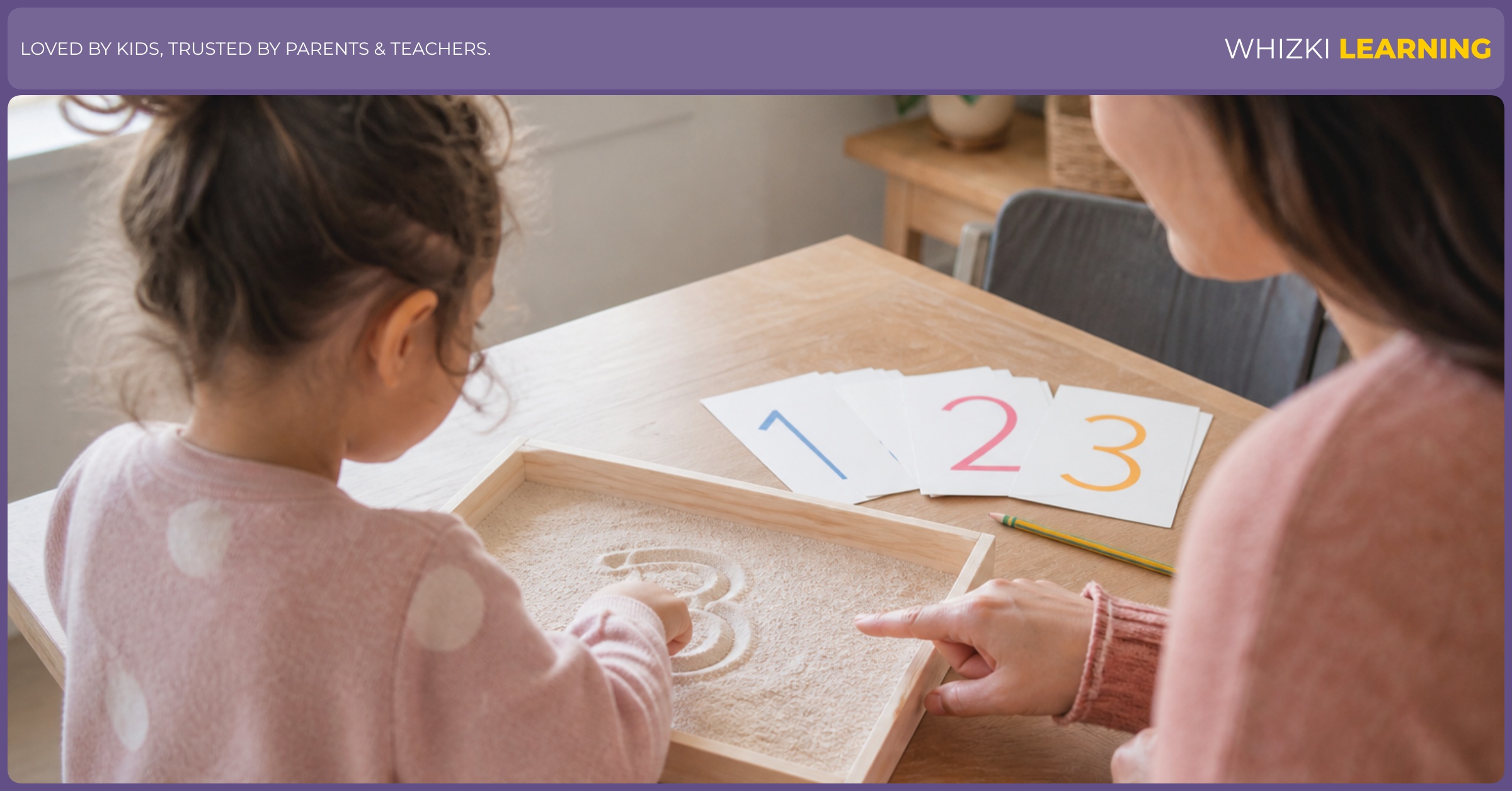
A sand tray is my first tactile fix because the finger can feel the path before the pencil has to control the path. Occupational-therapy basics often move from big muscle practice to small muscle work, so a shallow tray of salt, sand, or dry rice gives the child a forgiving place to start. The adult writes one correct model on a card, places the model beside the tray, and says the same short direction each time.
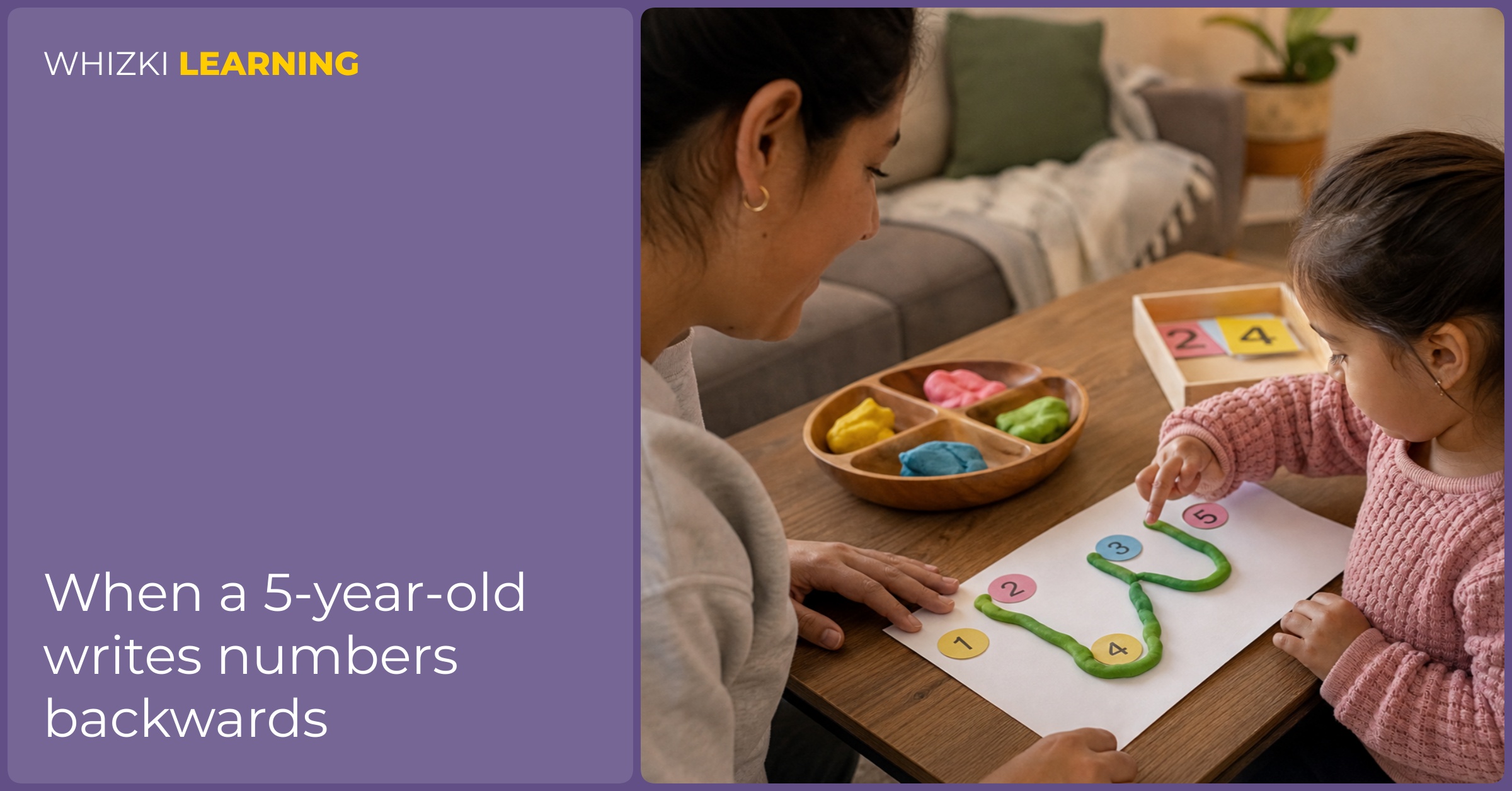
A play dough road is my second tactile fix because the child builds the number shape before writing the number shape. Roll one long rope, place the rope over a large 3, 5, or 7 drawn by an adult, and let the child drive a fingertip or toy car along the route from the starting dot. Orton-Gillingham practice uses multisensory links, so the child sees the number, says the cue, and moves through the shape in the same short routine.
Pencil practice should stay tiny after tactile work, especially for ages 3 to 7. Ask for three careful tries, not a whole row, because fatigue often creates the very reversal the adult wants to fix. A Montessori-style prepared space helps here: one sharp pencil, one model, one small paper, and a clear place to stop.
When to watch more closely
Backward numbers alone are rarely the reason for worry before age 7. The Orton-Gillingham approach separates formation, sound or name recall, direction, and memory, which keeps adults from treating every reversal as the same problem. A child who can count, compare small groups, and match a written number to a set of objects is showing important number understanding even with a flipped symbol.
The preschool or kindergarten teacher should hear about patterns that persist across many weeks. Ask whether the child also avoids coloring, tires quickly, presses too hard, struggles to copy simple shapes, or cannot remember where a number begins after repeated modeling. Occupational therapists often look at posture, hand strength, visual tracking, and pencil control when handwriting stays hard despite calm practice.
Letter reversals deserve their own look because b, d, p, and q carry different language demands than number symbols. For letter-specific help, use our guide to letter reversals and when to worry and share examples with the teacher if the same letters remain confusing. A pediatrician, school occupational therapist, or reading specialist can help when reversals come with strong frustration, poor fine-motor control, or trouble recognizing symbols after regular practice.
If kitchen-table handwriting is on your mind, come join our weekly newsletter for one practical, child-sized idea each week.