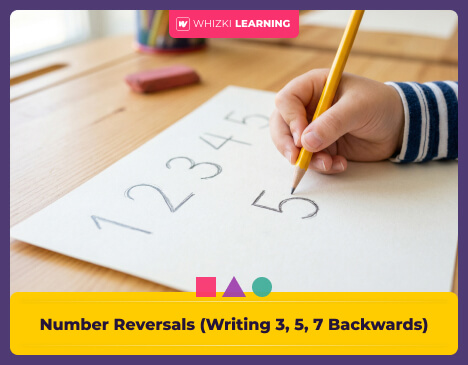
Let me guess, you are sitting at the kitchen table thinking, “Wait, why is my kid writing the number 3 backwards?” That moment of panic is so common. A parent sees a bright five-year-old proudly write “3” in reverse, and suddenly worries something is seriously wrong. The good news is that early literacy and math teachers hear this all the time, and backwards number writing is usually a normal, predictable stage of early brain development. Young children often assume a symbol means the same thing no matter which direction it faces, kind of like how a chair is still a chair whether it points left or right.
And yes, it can be frustrating, because you want your child to get it right. While number reversals are developmentally appropriate for preschoolers, children do need hands-on support over time to form correct directional habits. This guide explains why digits like 3, 5, and 7 tend to cause the most confusion. With simple, tactile teaching strategies, parents can gently steer kids toward correct number formation without turning practice into an anxiety-filled battle.
Why Children Reverse the Numbers 3, 5, and 7
Developmental psychologists explain that young children do not yet have the mature visual-spatial skills needed to remember the exact “direction” of abstract symbols. The numbers 3, 5, and 7 are especially tricky because the pencil has to change direction mid-stroke. For example, writing the number 5 means starting with a horizontal line, dropping down vertically, and then pushing forward into a curved belly. When kids practice these more complex movements, parents can use resources like our Number 5 learning hub to offer consistent visual models.
Another common snag is remembering whether a curved line should pull toward the writing hand or push away from it. The number 3 is made entirely of curves, so it is a frequent victim of mirror writing. Parents can support early learners by using large, traceable templates found in our Number 3 learning hub to build foundational muscle memory before the child tries freehand writing.
How to Gently Correct Number Reversals
A tactical, teacher-approved sequence utilizing visual cues and gross motor practice to correct backwards numbers naturally.
1. The 'Starting Dot' Visual Cue
Occupational therapists emphasize that many number reversals happen because the child starts in the wrong spot. Parents can help by placing a bright green “starting dot” sticker at the exact top-left or top-right corner where the target number should begin. If a child struggles with the diagonal line of a 7, parents can use targeted printables from the Number 7 learning hub and place a green dot at the top-left starting position. This clear visual cue reduces spatial guesswork and helps the pencil “know where to start.”
2. Gross Motor Sensory Writing
When a child keeps reversing the same number, it is time to pause pencil-and-paper for a moment. Educational specialists recommend having the child draw the troublesome number using their entire arm in a large tray of sensory sand or shaving cream. This gross motor movement engages the shoulder and elbow, building whole-body muscle memory that is often stronger than the fine motor memory of fingertips alone.

3. Grouping Numbers by Direction
Experienced kindergarten teachers group numbers based on their starting directional pull to help children remember the physical pattern. The parent can teach the child that the numbers 2, 3, and 7 all ask the pencil to “pull backward” toward the left margin of the paper. By categorizing numbers by how they move, not just by their names, the child’s brain gets a clearer motor-planning framework.
If you notice your child gets wiggly or shuts down during practice, try pairing this step with a short focus routine. For a simple way to build that “ready to try” mindset, see How to Build a 15-Minute Focus Habit Before Kindergarten.
When to Seek Professional Evaluation
Backwards numbers are normal for preschoolers, but parents do want to watch progress as children move into formal schooling. Pediatric learning specialists say most children stop reversing letters and numbers by the end of first grade, usually around age seven. If an eight-year-old is still writing numbers backward every day even with consistent, high-quality handwriting practice, the typical developmental window has likely passed.
Parents should consider a formal evaluation from a school psychologist if number reversals show up along with difficulty understanding basic quantities. Dyscalculia, a specific math learning disability, involves more than messy handwriting. A child with dyscalculia may struggle to understand that the number 5 represents five physical objects. When persistent reversals come with quantity confusion, it is a strong reason to request a professional educational assessment.
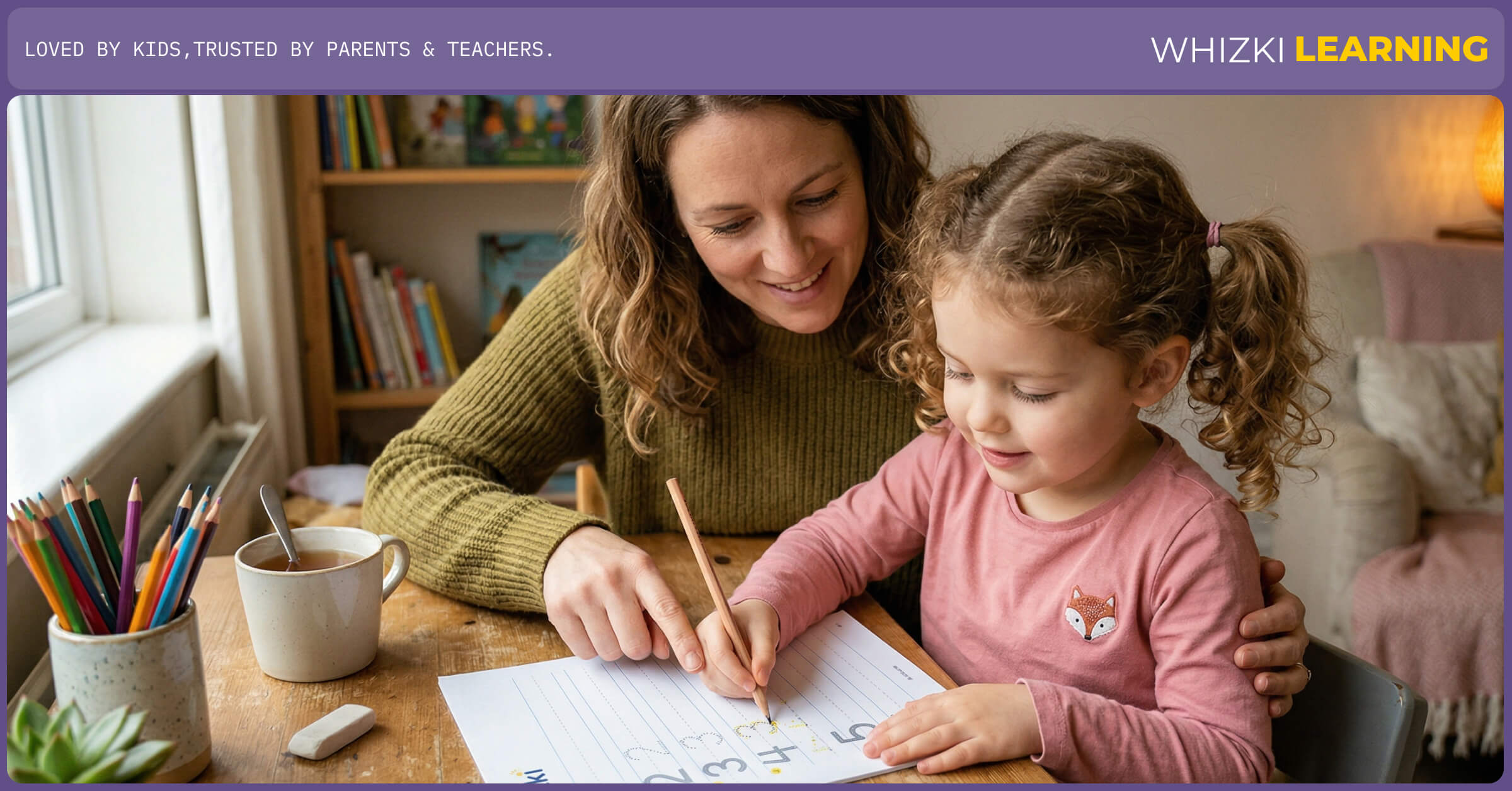
Building Muscle Memory with Whizki Workbooks
Correcting backwards numbers takes consistent, tactile repetition that digital screens cannot fully replace. Whizki printed math workbooks use premium 120gsm paper, which creates the right amount of physical friction for a young child’s pencil. That gentle resistance helps the child slow down, so the brain can actively process the correct directional strokes for tricky numbers like 5 and 7. Whizki screen-free workbooks give kids the structured, hands-on practice environment they need to replace old habits and build confident handwriting.
And if practice time tends to turn into a power struggle, you are not alone. When kids are dysregulated, tracing and writing become harder. For calm, screen-free support before you start tracing, check out 10 Calm-Down Activities Before Tracing and Writing (Ages 4-6).
Correction Without Criticism
Number reversals are a temporary milestone on the way to mathematical fluency, not a permanent intellectual flaw. With sensory tracing activities and clear visual starting dots, parents can guide children toward correct number formation gently. Choosing high-quality printed materials also helps because the child gets repetition with less frustration, which means fewer tense moments and fewer “stop doing it wrong” conversations at the kitchen table.
If you are also wondering how to keep your child motivated without defaulting to screens, you may find this helpful: Why “Boredom” is the Ultimate Screen-Free Teacher.