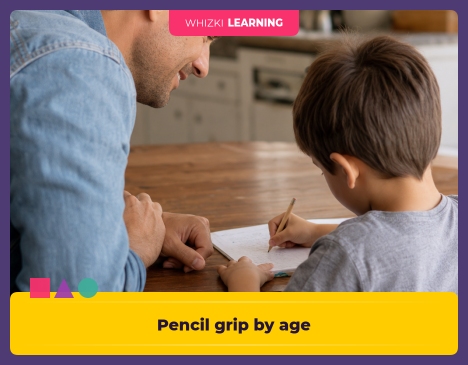
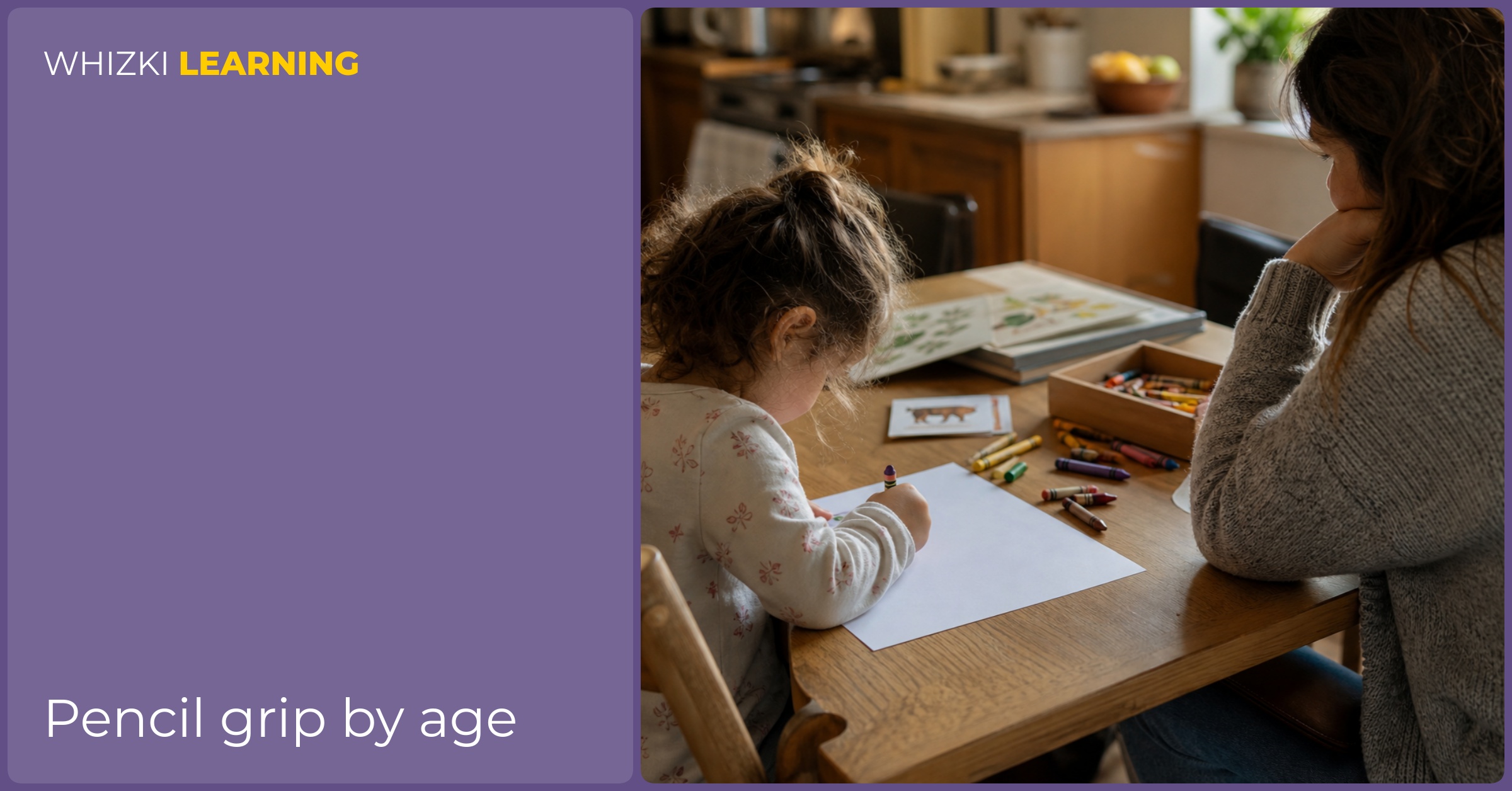
If your child is gripping a pencil in a fist, pressing so hard the paper wrinkles, or switching hands mid-page, start by taking a breath and offering a short crayon on blank paper for two minutes. Pencil grip grows through stages, and many messy-looking grips are normal for ages 3 to 7. A calm next step is watching comfort, control, and stamina before trying to change the child’s fingers.
Reviewed by Emily Chen, MA, OTR/L, Pediatric Occupational Therapist.
The four normal pencil grip stages by age
The fisted grip, often called a palmar grasp in occupational therapy, is the early stage where the crayon sits in the whole hand and the arm does most of the work. Many toddlers use the fisted grip around ages 1 to 2, and a tired 3-year-old may return to the fisted grip during heavy coloring. The fisted grip is not a problem by itself when the child is still exploring marks, scribbles, and cause-and-effect drawing.
The digital pronate grip usually shows up around ages 2 to 3, with the pencil held in the fingers and the point coming out near the pinky side of the hand. The wrist often turns downward, so the child’s forearm and shoulder still do a lot of the moving. Occupational therapy basics treat the digital pronate grip as a normal bridge between whole-hand control and finger control.
The four-finger grip, often called a quadrupod grasp, commonly appears around ages 3.5 to 5. The pencil rests against the hand while four fingers help steer, and the hand may look busy or crowded. Many preschool and kindergarten children write comfortably with a four-finger grip, especially when the pencil marks are clear and the hand does not tire quickly.
The tripod grip usually becomes more steady around ages 4.5 to 6, sometimes closer to 7 for children who need extra fine-motor time. The pencil rests between the thumb, index finger, and middle finger while the ring finger and pinky side give support. A dynamic tripod, where the small fingers move the pencil instead of the whole arm, is a later refinement rather than a preschool deadline.
What usually needs no fixing
A fisted or pronated grip needs no fixing when the child is 3, the drawing is playful, and the hand is comfortable. NAEYC guidance reminds early-childhood adults to protect developmentally appropriate play, which means a preschool child does not need formal handwriting drills to prove readiness. Short crayons, chalk, finger paint, and big paper often teach the hand more than repeated corrections.
Hand switching is also common before a clear dominant hand settles. Reggio-inspired observation asks adults to notice patterns over time, so a caregiver can jot down which hand the child chooses for spoon use, bead stringing, scissors, and drawing across several days. A single left-right switch during a worksheet is usually fatigue, curiosity, or a reach across the table.
Left-handed grips do not need to look like right-handed grips. Montessori classroom practice often gives the child a slanted page, space on the left side of the table, and a model that does not block the child’s view. The left-handed child may hook the wrist when the paper is straight up and down, so changing the paper angle is often kinder than correcting the hand.
When handwriting practice is really alphabet practice, the Orton-Gillingham approach keeps the goal clear: hear the sound, name the letter, and make a simple mark. For sound-letter play without too much pencil pressure, the alphabet learning hub gives families a place to keep practice brief and concrete. The grip can stay ordinary while the child learns that letters stand for sounds.
When to help with pencil grip
The occupational therapy heuristic I use is comfort, control, and endurance. Comfort means the child’s hand, wrist, and shoulder are not hurting during short writing play. Control means the child can make the intended mark most of the time, and endurance means the child can stay with a brief age-appropriate task without falling apart from hand fatigue.
A pencil grip deserves gentle help when the grip gets in the way of the child’s participation. A 5-year-old who avoids every drawing center, complains that the hand hurts, tears the paper from pressure, or cannot finish a name card may need support. The goal is not a perfect tripod; the goal is a hand that can join classroom and home routines.
A caregiver can also watch for red flags that belong in a pediatrician or occupational therapist conversation. Ongoing pain, a thumb tucked tightly inside the fist, no helper hand holding the paper, major trouble with buttons or utensils, or a sudden loss of a skill deserves professional eyes. The professional can separate normal variation from a fine-motor need that benefits from targeted practice.
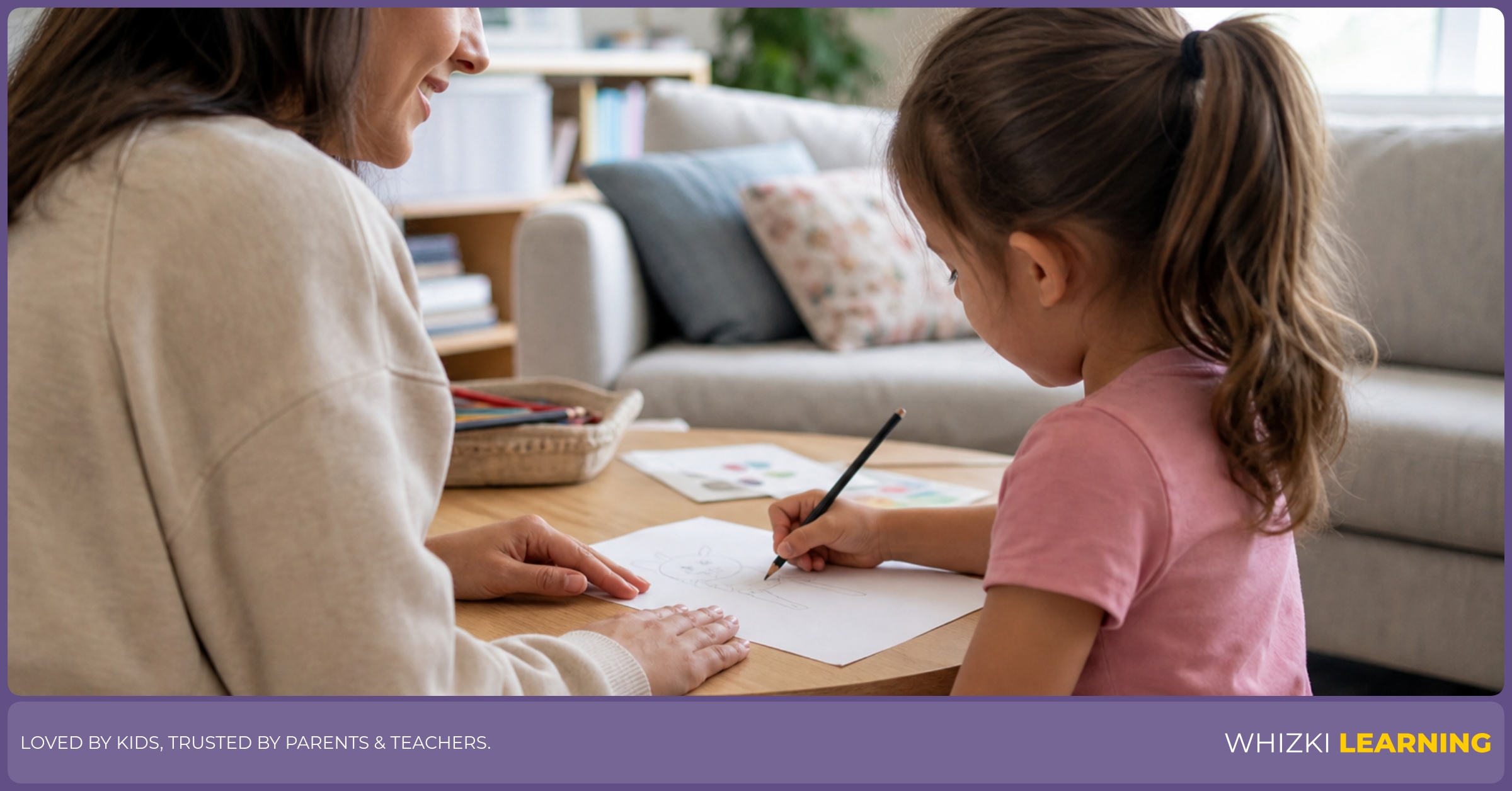
When the child needs support but the pencil has become a battle, start with gentle pencil grip fixes before naming fingers or forcing a grasp. Short tools, vertical surfaces, tiny bits of broken crayon, and playful hand warmups usually work better than repeated reminders. The adult tone matters because the child is learning whether writing feels safe enough to try again tomorrow.
Practice that builds hands without pressure
Occupational therapy basics usually build big muscles before asking for tiny finger control. Climbing, animal walks, play dough, clothespins, spray bottles, tearing paper, and sticker peeling all give the hand strength and feedback. A child who has more whole-body stability often has an easier time sitting, holding paper, and steering a pencil.
NAEYC-aligned preschool practice keeps fine-motor work playful and brief. A 3-year-old may color for one minute, while a 6-year-old may copy a short word and then move on to drawing. The adult can stop while the child still feels successful instead of waiting for the hand to tire.
Orton-Gillingham teaching also favors multisensory practice, which is helpful for children who grip too hard during pencil work. A child can trace a letter in sand, build a letter with dough, say the sound, and then write one version on paper. The paper mark becomes one small piece of learning rather than the whole lesson.
Whizki Learning keeps low-pressure fine-motor pages in our printable library for families who like having paper ready at the table. Choose short tracing, coloring, or cut-and-paste pages, then stop before the child’s hand gets tired.
What teachers and caregivers can watch
A Reggio-style lens treats pencil grip as something to observe before something to correct. The teacher can watch the child across drawing, name writing, blocks, snack containers, and outdoor play. Patterns across routines say more than one worksheet done at the end of a long day.
A NAEYC-informed classroom also adjusts materials before blaming the child. Thick crayons, small chalk pieces, vertical easels, slanted paper, and stable seating can change the child’s grip without a lecture. The best setup lets the child feel the tool, see the page, and keep both feet supported.
Orton-Gillingham tutors often separate handwriting mechanics from letter-sound learning when a child is working hard. The adult might ask for one careful letter, then move into oral sound blending or tile work. Separating skills keeps a pencil grip problem from making the child feel bad at reading.
The four stages are a map, not a race. A 3-year-old in a fisted grip, a 4-year-old in a digital pronate grip, a 5-year-old in a four-finger grip, and a 6-year-old moving toward tripod can all be on a normal path. The useful question is whether the grip lets the child participate with comfort, control, and enough stamina for the child’s age.
Pencil grip is one small part of school readiness, and the child in front of you matters more than a chart. If kitchen-table support sounds useful, come join the weekly Whizki newsletter.