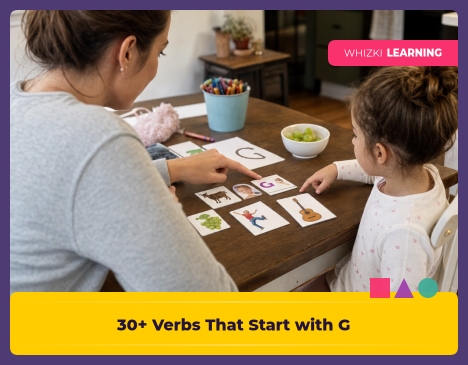
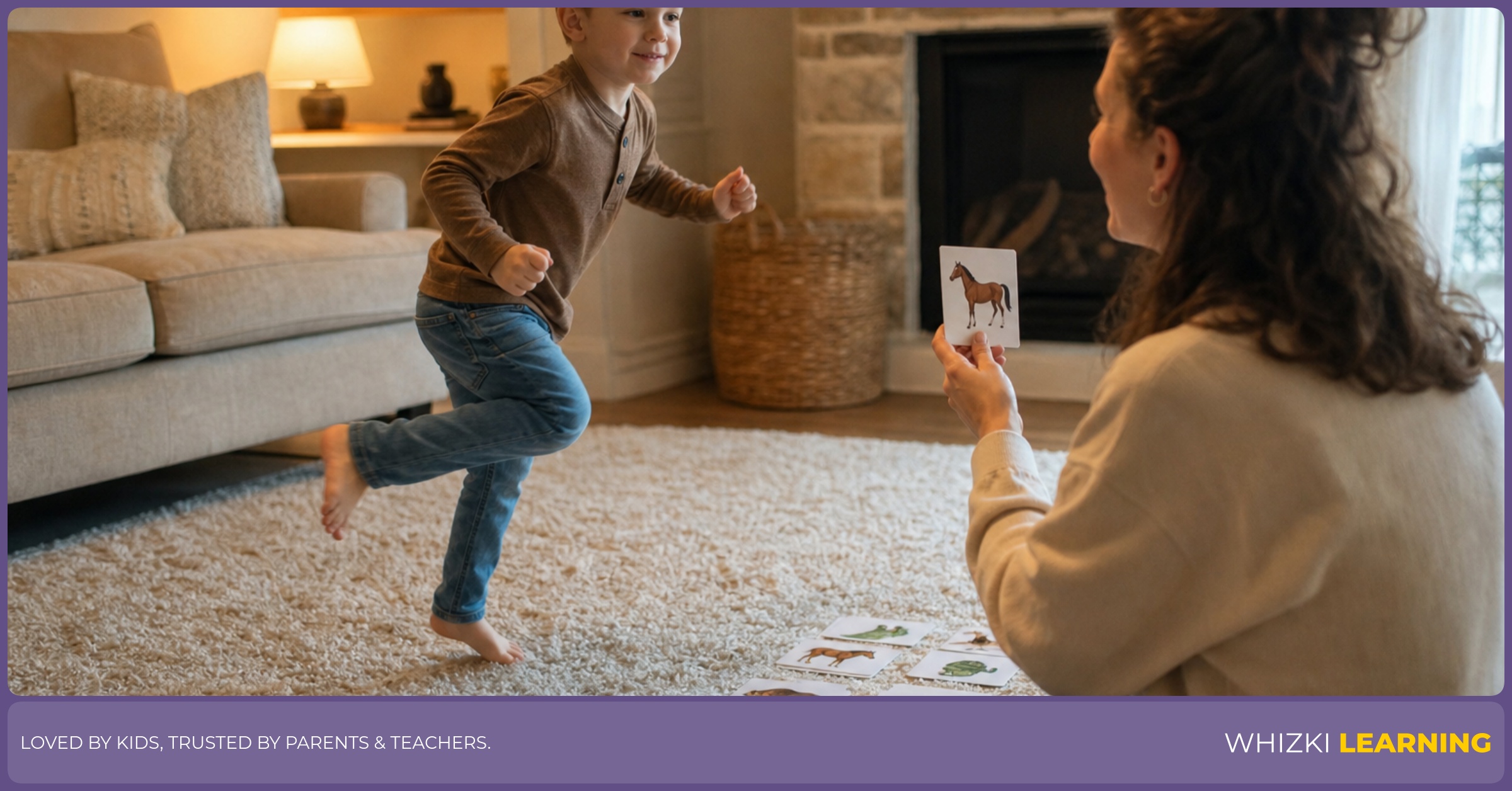
If your child freezes when you ask for a “G word,” start with a body action: say “gallop,” do the motion together, and praise the try. Action words make letter learning feel less like a quiz and more like something a child can do with hands, feet, voice, and face.
Reviewed by Whizki Editorial Team, Early Childhood Education Editors.
How to teach G verbs without a worksheet battle
The letter G can sound like /g/ in “go” or /j/ in “gentle,” so kindergarten readers need clear, playful practice with one sound at a time. In an Orton-Gillingham routine, I say the sound, show the letter, trace the letter, and connect the letter to a real action from our letter G learning page.
The G verb list in this guide stays in the run, jump, hug zone because NAEYC guidance reminds early-childhood teachers to match literacy practice to a child’s real life. If a child needs object words too, use first words starting with G; if a child is ready to describe, use describing words starting with G.
A verb tells what someone does, so a child should be able to act out most early verbs. The strongest kindergarten practice is simple: say the word, do the action, clap the syllables, and let the child try again without pressure.
Body actions that start with G
Body-action verbs are often the easiest G words for preschool and kindergarten children because the whole body can carry the meaning. Occupational-therapy basics support short movement bursts, especially when a child needs wiggles before pencil work.
The body-action list works best when the adult models first and the child copies second. The goal is not perfect reading on the first try; the goal is linking the printed G word to a movement the child can remember.
Body G verbs to act out
- Go: Go to the door.
- Gallop: Gallop across the rug.
- Glide: Glide past the couch.
- Grab: Grab your red ball.
- Grip: Grip the jump rope.
- Grin: Grin at your grown-up.
- Giggle: Giggle behind your hands.
- Gasp: Gasp like you are surprised.
- Growl: Growl like a bear.
- Groan: Groan softly, then smile.
- Gulp: Gulp pretend lemonade.
- Gaze: Gaze at the window.
Household actions that start with G
Household verbs are powerful because a child hears the same words during snack, cleanup, and morning routines. Montessori practical-life work uses small real tasks for focus and coordination, and the same idea helps G verbs feel useful.
The household-action list fits a kitchen table, bathroom sink, or cleanup basket. NAEYC practice favors meaningful language during daily routines, so say the G verb while the child completes the job.
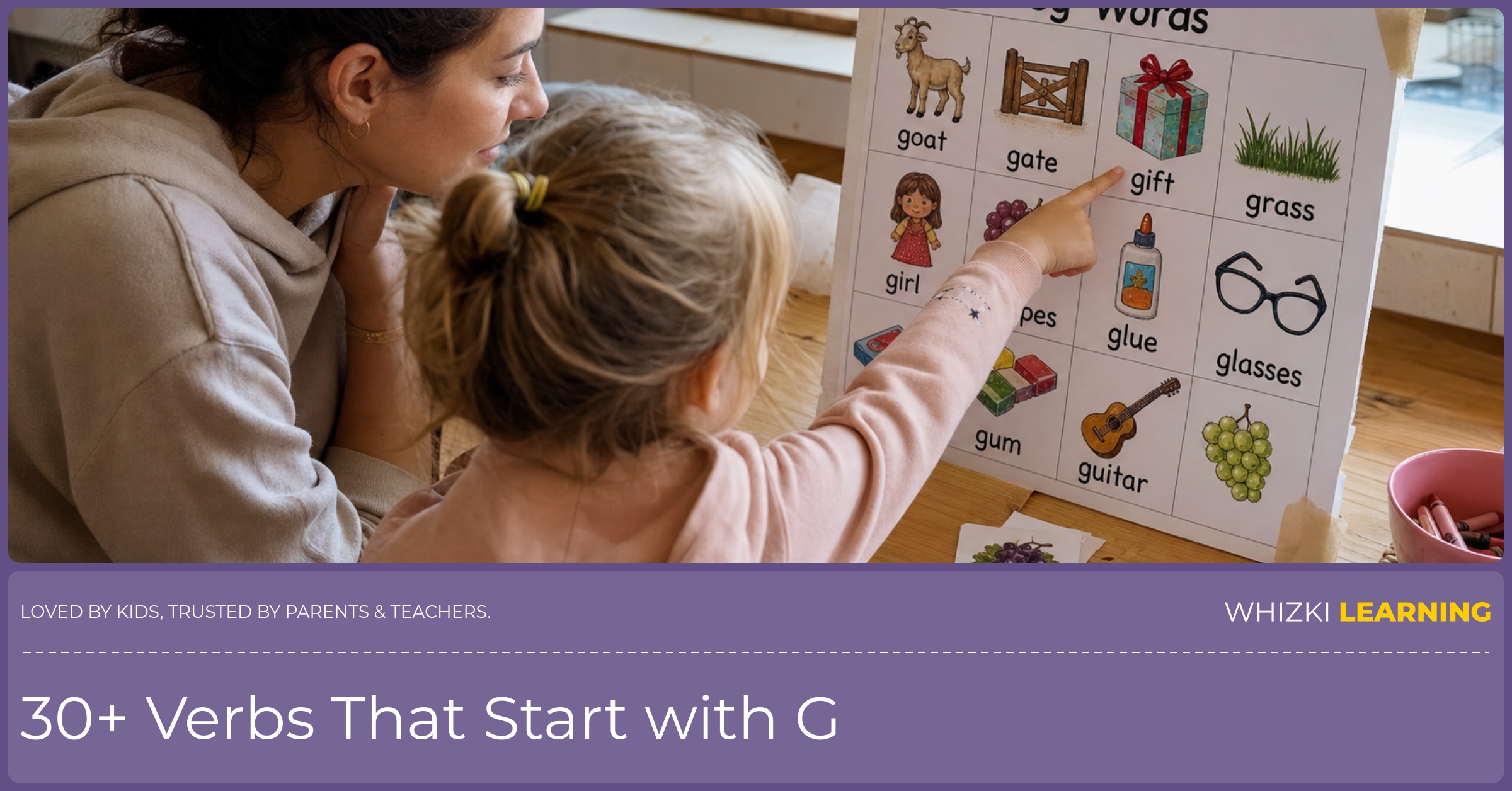
Print a small G action-word page from our sight-words printables and tape the page near the play shelf or kitchen table. A quick wall chart lets a child point, say, and act out one word while dinner cooks or cleanup starts.
Household G verbs to use in routines
- Get: Get one clean sock.
- Give: Give Dad a napkin.
- Gather: Gather three toy cars.
- Glue: Glue paper on cardboard.
- Groom: Groom the stuffed puppy.
- Gargle: Gargle water in the sink.
- Garden: Garden with a tiny shovel.
- Grow: Grow seeds in a cup.
- Gobble: Gobble your apple bites.
- Greet: Greet Grandma at the door.
- Group: Group spoons by size.
- Guide: Guide the mop slowly.
Play actions that start with G
Play verbs give a child permission to be silly while still practicing letter sound, word meaning, and early reading. Reggio-inspired observation helps here because the adult watches which pretend actions the child chooses naturally and builds language from that interest.
The play-action list can sit beside blocks, puppets, stuffed animals, or a dress-up basket. A kindergarten teacher can read one card, and a child can show the meaning before the group says the word together.
Play G verbs for pretend time
- Guess: Guess which hand hides the pebble.
- Guard: Guard the block tower.
- Graze: Graze like a pony.
- Groove: Groove to quiet music.
- Golf: Golf with a pool noodle.
- Gab: Gab with your puppet.
- Gesture: Gesture with both arms.
- Glance: Glance at the picture.
- Grumble: Grumble like a troll.
- Gift: Gift Mom a drawing.
Act-it-out G verb charades
G verb charades turns vocabulary into a short game, which is often better than a long lesson for ages 3 to 7. Speech-language pathology practice often pairs a spoken word with a gesture or action because the movement gives the child another path to meaning.
The charades game needs only paper scraps, a crayon, and a bowl. The adult reads the word if the child is not reading yet, and the child acts without talking while the group guesses the action.
- Pick six G verbs from one group and write each word on a separate paper scrap.
- Place the paper scraps in a bowl and let the youngest player choose first.
- Read the chosen word quietly to the actor, or whisper the word for a nonreader.
- Set a gentle timer for thirty seconds and let the actor move, point, or make a face.
- After each turn, say the word together and trace a big G in the air.
Trace-the-word tip for G verbs
Tracing a G verb should feel like hand practice, not a handwriting test. Occupational-therapy heuristics often start with large arm movement before small pencil movement, so begin with a sky-writing G before moving to paper.
The trace-the-word tip I use is simple: write one bold word, such as “gallop,” on a strip of paper, and let the child trace the first letter with two fingers before using a crayon. Orton-Gillingham practice connects sight, sound, touch, and speech, so say /g/ while the finger follows the letter shape.
The best tracing setup has a short word, a thick line, and a reason to move after writing. After the child traces the word, ask the child to do the action one time, because the movement keeps the word from becoming a flat mark on paper.
G verbs do not need a perfect lesson plan to be useful. Pick three words for one routine, act out each word, and save the rest of the list for another day when the child has fresh energy.