
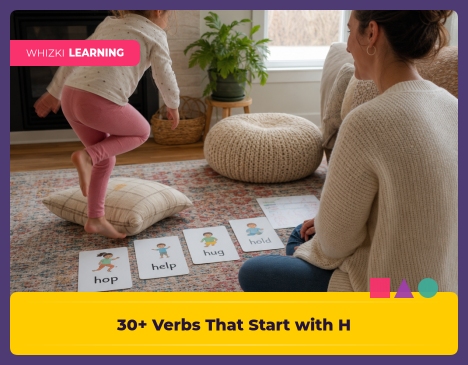
If H-word practice turns into wiggling, bargaining, or a child sliding under the table, choose three action words, act each word for ten seconds, and stop while the game still feels easy. Children ages 3 to 7 often learn verbs best through movement before pencil work. A short, playful routine can build vocabulary without turning the kitchen table into a standoff.
Reviewed by Whizki Editorial Team, Early Childhood Education Editors.
How to teach H action words
The verb is the doing word in a sentence, and H verbs are easy to teach because many H words invite motion. The Orton-Gillingham approach often connects sound, sight, speech, and movement, so a child can hear /h/, see the letter H, say the word, and act the word. The action keeps the lesson concrete for preschool and kindergarten learners.
The letter H makes a breathy sound at the start of many child-friendly words, and our letter H learning page can help families add sound practice beside vocabulary play. The guide below stays with verbs, because verbs tell what someone does. For other H vocabulary, use first words starting with H for nouns and everyday words, or describing words starting with H when a child is ready for adjectives.
Speech-language practice often pairs a word with a real action, because a child can show meaning before a child can explain meaning. A parent or teacher can say, “Show me hop,” then model the action, then let the child copy the action. The same routine works in a classroom circle, a homeschool lesson, or a five-minute after-snack game.
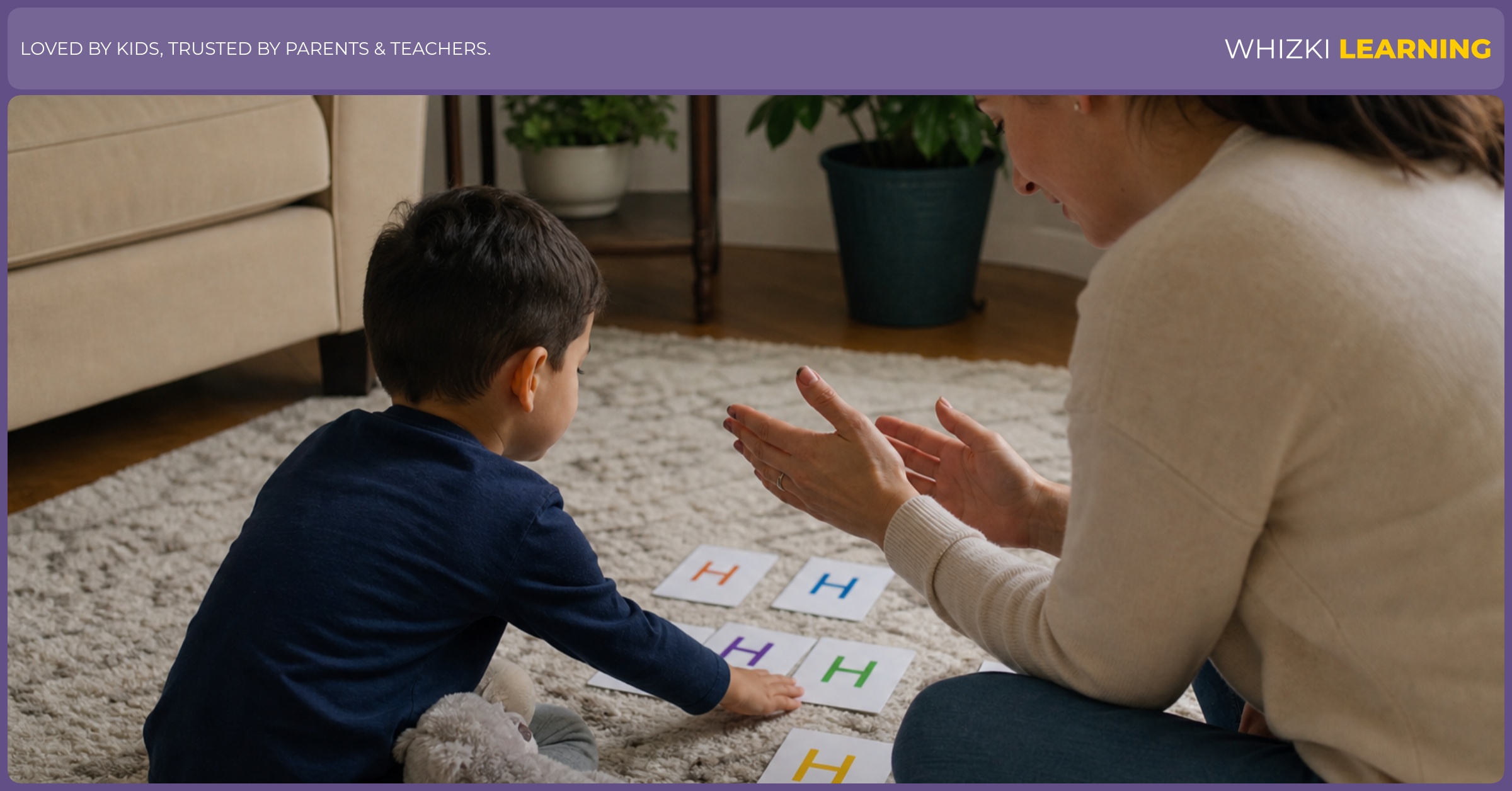
Body actions that start with H
Body actions are usually the easiest H verbs because a child can feel the word in muscles, balance, voice, and breath. NAEYC guidance supports active, play-based learning in early childhood, and occupational-therapy basics remind adults to match movement to the child’s balance and body control. A soft rug, a clear hallway, or a taped line on the floor is enough space.
Say the H sound first, then say the whole verb, then act the sentence together. The adult model matters because a child may copy the rhythm, facial expression, and body position before the child remembers the printed word. Keep the action safe and brief, especially when a preschooler is tired or excited.
- Hop: Hop over the pillow.
- Hug: Hug your teddy bear.
- Hide: Hide behind the chair.
- Hurry: Hurry to the rug.
- Halt: Halt at the tape.
- Hold: Hold both hands up.
- Hum: Hum a happy tune.
- Hush: Hush like a mouse.
- Huff: Huff into your palms.
- Hike: Hike up the hill.
- Hobble: Hobble like a pirate.
- High-five: High-five your grown-up.
Household actions that start with H
Household actions make vocabulary practice useful because the child hears the word during a real routine. Montessori practical-life work treats home tasks as learning tasks, and occupational-therapy basics value pouring, carrying, pinching, and wiping because small hands build coordination through ordinary jobs. A child does not need a long lesson when the kitchen already has language waiting.
The adult still owns safety, so a child can pretend a risky action or help with the safe part of the job. A parent can say the verb, point to the printed word, and invite one small action. The short turn keeps the routine respectful for a hungry or busy child.
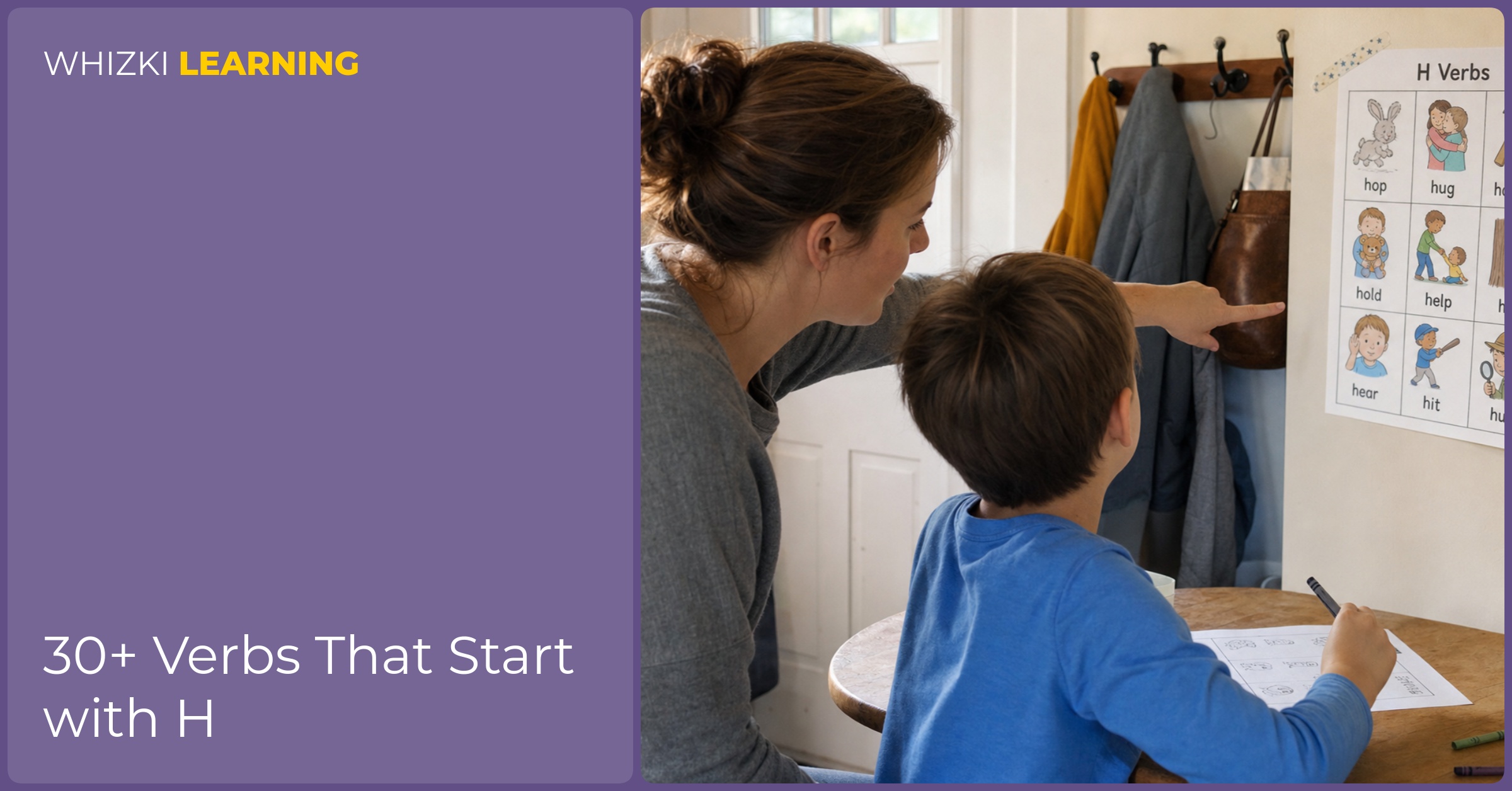
For a matching mid-routine printable, print an H action-word page from our sight-words printables and tape the page to the wall near the snack table or coat hooks. The printable gives children a place to point before acting the word, which makes vocabulary practice feel like part of the day instead of another assignment.
- Help: Help fold the towel.
- Hand: Hand me one spoon.
- Hang: Hang your blue jacket.
- Hook: Hook the backpack strap.
- Haul: Haul laundry to Dad.
- Hammer: Hammer the play peg.
- Hose: Hose the muddy boots.
- Harvest: Harvest three garden peas.
- Heat: Heat soup with Mom.
- Heap: Heap blocks in basket.
- Hoist: Hoist the toy bin.
- Hand-wash: Hand-wash the snack plate.
Play actions that start with H
Play actions help a child practice H verbs without feeling tested. Reggio-inspired teaching asks adults to observe what the child already loves, such as blocks, animals, pretend food, or chalk, and then add language to that play. The strongest verb is often the word connected to the toy already in the child’s hand.
Speech-language practice also values repetition with a small change, because a child can hear the same word in a fresh setting. A child might act one verb with a stuffed animal, then act the same verb with a block figure, then act the same verb with a grown-up. The repeated action gives the printed word a memory hook.
- Hunt: Hunt for red blocks.
- Honk: Honk the toy horn.
- Howl: Howl like a puppy.
- Hatch: Hatch from pretend egg.
- Herd: Herd toy cows home.
- Hula: Hula with the hoop.
- Hopscotch: Hopscotch across chalk squares.
- Hit: Hit the toy drum.
- Hitch: Hitch wagon to trike.
- Huddle: Huddle under the blanket.
- Hover: Hover above the tower.
- Holler: Holler across pretend canyon.
Act-it-out charades game
The H verb charades game works well when a child needs movement more than another worksheet. NAEYC play guidance supports pretend action as real learning, and the Orton-Gillingham tradition gives value to hearing, seeing, saying, and doing the word. The game can take three minutes and still count as literacy practice.
Write six H verbs on separate slips, fold the slips, and place the slips in a bowl. The child pulls one slip, acts the word without speaking, and lets the family guess. The adult can read the word aloud after the guess so the printed letters connect to the action.
- Pick six safe H verbs.
- Read one slip quietly.
- Act without using speech.
- Guess the action word.
- Say the H sound.
- Switch turns with laughter.
Trace-the-word tip for little hands
The trace-the-word tip is simple: say the sound, trace the word with one finger, read the word, and act the word. Orton-Gillingham lessons often use tactile tracing because the finger path gives the brain another way to remember the letters. A child can trace in crayon, on sandpaper letters, in a salt tray, or on a laminated card.
Occupational-therapy basics suggest watching comfort before neatness, because a tired hand stops learning quickly. Use large lowercase print for words like hop, hug, and help, and let the child trace once or twice before moving. If pencil grip turns tense, switch to finger tracing or air writing and return to pencil work later.
A small H verb routine works best when the adult keeps the pace friendly and predictable. Choose a few words, act the words, point to the print, and end before the child is done having fun.
Kindergarten readers do not need to master every H verb in one sitting. A steady mix of body actions, household actions, play actions, and tracing gives the letter H a real place in a child’s day.