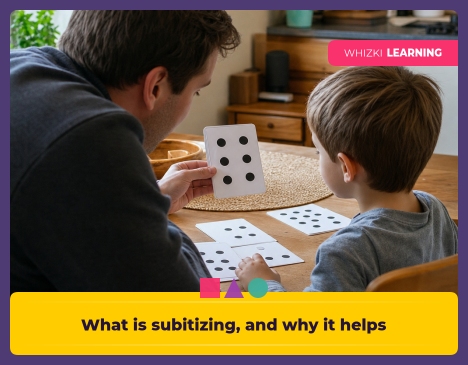
When your child counts the same four cereal pieces three times and gets a different answer, try saying, "Show me what you see," then flash four dots for two seconds and cover the card. Subitizing is the small math skill behind that moment: seeing a small amount without counting one by one. Parents and teachers can build subitizing during snack, dice play, and ten-frame routines without turning the kitchen table into a lesson plan.
Reviewed by Whizki Editorial Team, Early Childhood Education Editors.
What is subitizing?
Subitizing means recognizing an amount quickly, such as seeing three buttons and knowing "three" before counting starts. Early childhood teachers often describe subitizing as number sense in action because the child's eyes, words, and hands agree on the same quantity. NAEYC guidance on preschool math encourages adults to help children compare small groups in real play, and subitizing fits that guidance beautifully.
Perceptual subitizing is the quick noticing of very small groups, usually one through four. Conceptual subitizing is seeing a larger group as friendly parts, such as five dots and one dot making six. A kindergarten child who sees a dice face as "four" is using perceptual subitizing, while a child who sees six as "three and three" is using conceptual subitizing.
Orton-Gillingham teaching reminds educators to build fluent pattern recognition before asking for heavy memory work, and early math works in a similar way. The child who sees four dots as a square can spend less effort touching each dot and more effort explaining number relationships. Subitizing gives counting a visual anchor, which is why the skill often shows up before neat written numerals.
Why subitizing predicts math ease
Subitizing supports counting because the child starts to trust quantity before reciting number words. Montessori observation often begins with the child's hands and eyes, and a teacher watches whether the child notices "two and two make four" before asking for a written numeral. A child who can see a set quickly has a better chance of noticing when a count does not match the group.
Math ease grows when number words, finger patterns, dot patterns, and objects point to the same amount. Speech-language pathology practice reminds adults to keep language short and repeated, so phrases like "I see three" and "three is one more than two" give the child clear words for the visual pattern. Short math talk is especially useful for children who are still sorting out long directions.
A child who subitizes can often catch a counting mistake without shame. If the child says six while looking at four dots, the adult can ask, "Does the group look like four or six?" and guide the child back to the picture. The goal is not speed for its own sake; the goal is a steadier sense of amount.
Print one ten-frame page and tape the page near the snack bowl or calendar before the next counting moment. The number pages in the numbers learning hub give families a quick paper tool for matching dots, fingers, and numerals during a two-minute routine.
Easy subitizing games at home
Dice games are the easiest place to begin because the dot patterns stay the same every time. Reggio-inspired teachers often place simple materials in front of children and watch what the child notices, so a die, a bowl, and a few crackers can become a real math invitation. Roll, pause, ask "How many?" and let the child answer before any counting fingers begin.
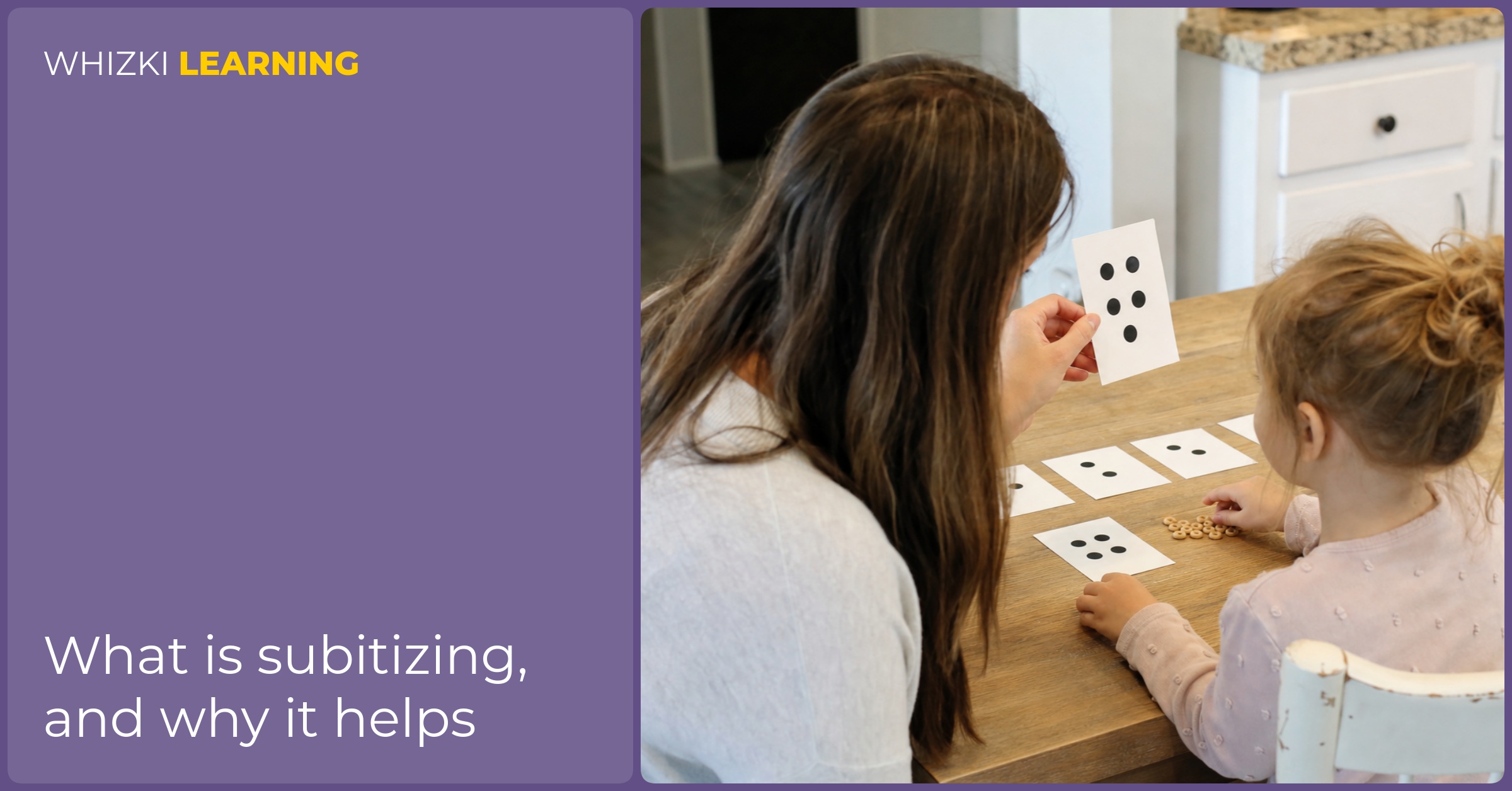
Dot-card flashes build the same skill with paper. Hold a card toward the child for two seconds, hide the card, and ask what amount the child saw. If homemade cards keep disappearing, choose a simple set from our printable library and keep the pages in a kitchen drawer for fast practice.
Finger flashes help children connect a body pattern to a number pattern. Occupational-therapy basics favor stable seating, a clear tabletop, and one focused hand movement at a time, so the adult can flash three fingers, close the hand, and ask the child to copy the same amount. The finger game should feel like peekaboo with numbers, not a quiz.
How ten frames train subitizing
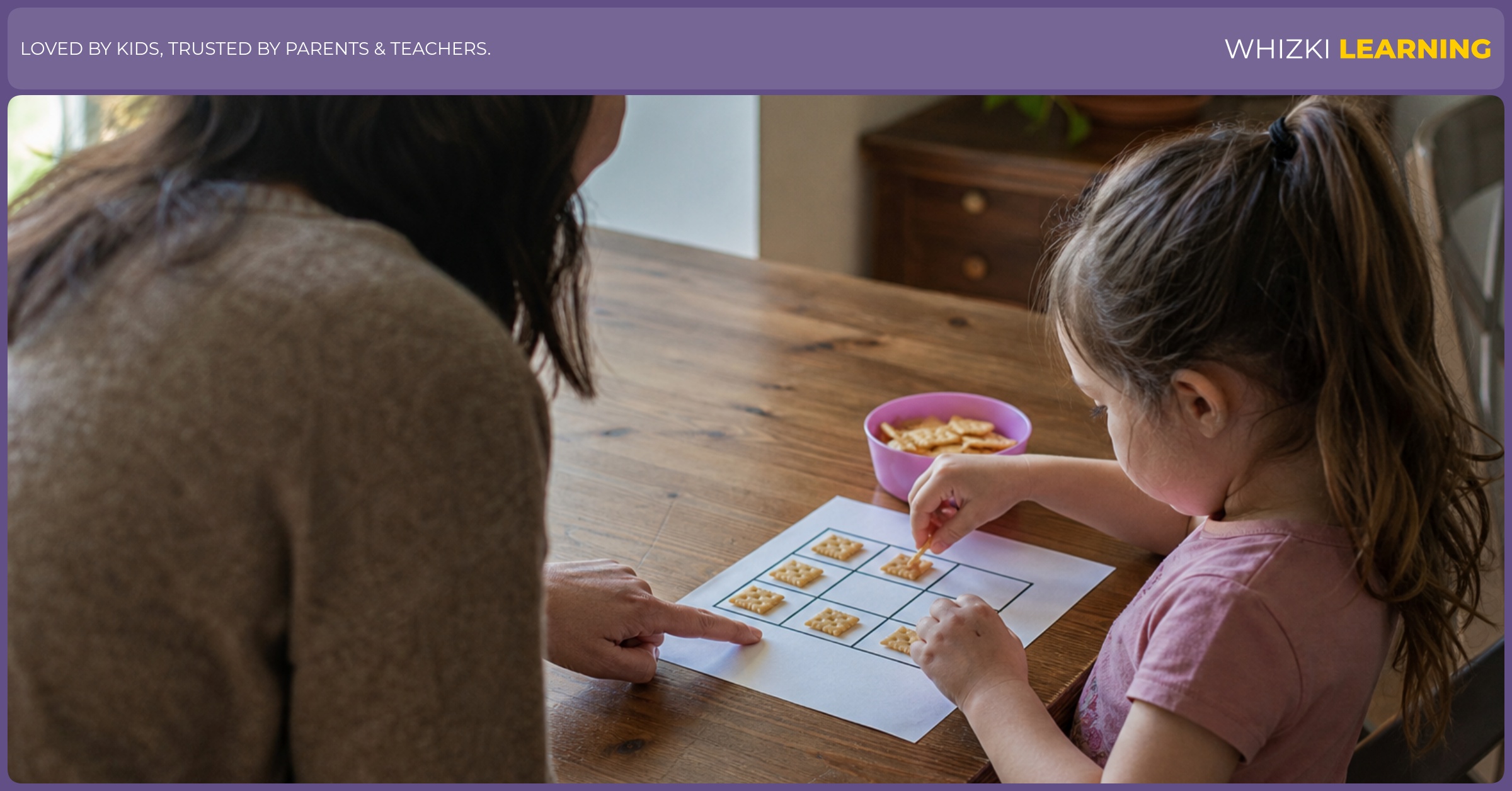
A ten frame is a rectangle with ten spaces, usually arranged as two rows of five. Occupational-therapy basics support steady left-to-right scanning and uncluttered materials, and the ten frame gives the child's eyes a reliable path to follow. A full top row means five, and one more space below means six.
Ten-frame practice trains conceptual subitizing because the child can see parts inside a bigger number. Seven becomes five and two, while nine becomes five and four or one space less than ten. A set of ten frame printables makes the pattern consistent enough for daily use.
The ten-frame routine can stay tiny. Place three crackers on the frame and ask, "How many spaces are filled?" then add one more cracker and ask what changed. Kindergarten teachers often use the same routine during calendar or small-group math because the frame turns an abstract number into a picture the child can discuss.
What to watch for as children practice
Subitizing should feel quick, playful, and concrete for ages 3 to 7. NAEYC developmentally appropriate practice reminds adults to match the task to the child, so a preschooler may only flash one to three dots while a kindergarten child may explore five, six, or ten-frame patterns. The adult can lower the number of dots when the child starts guessing.
A child who always counts every item may need more exposure to stable patterns, not more pressure. Some children need extra time because visual attention, motor planning, or language processing is still growing; occupational therapy and speech-language teams can help when daily routines feel unusually hard. A teacher or pediatrician can help decide whether support is needed beyond playful practice.
Correction works best when the adult returns to the picture. Say, "I see two on top and two on bottom, so the card shows four," and let the child touch the parts after naming the whole. The calm correction keeps math connected to noticing, which is exactly where young children learn best.
Subitizing is the reason a child can look at a dice face and say "five" before a finger touches a dot. A few dot flashes, dice turns, and ten-frame chats each week give the young learner a steadier sense of quantity.