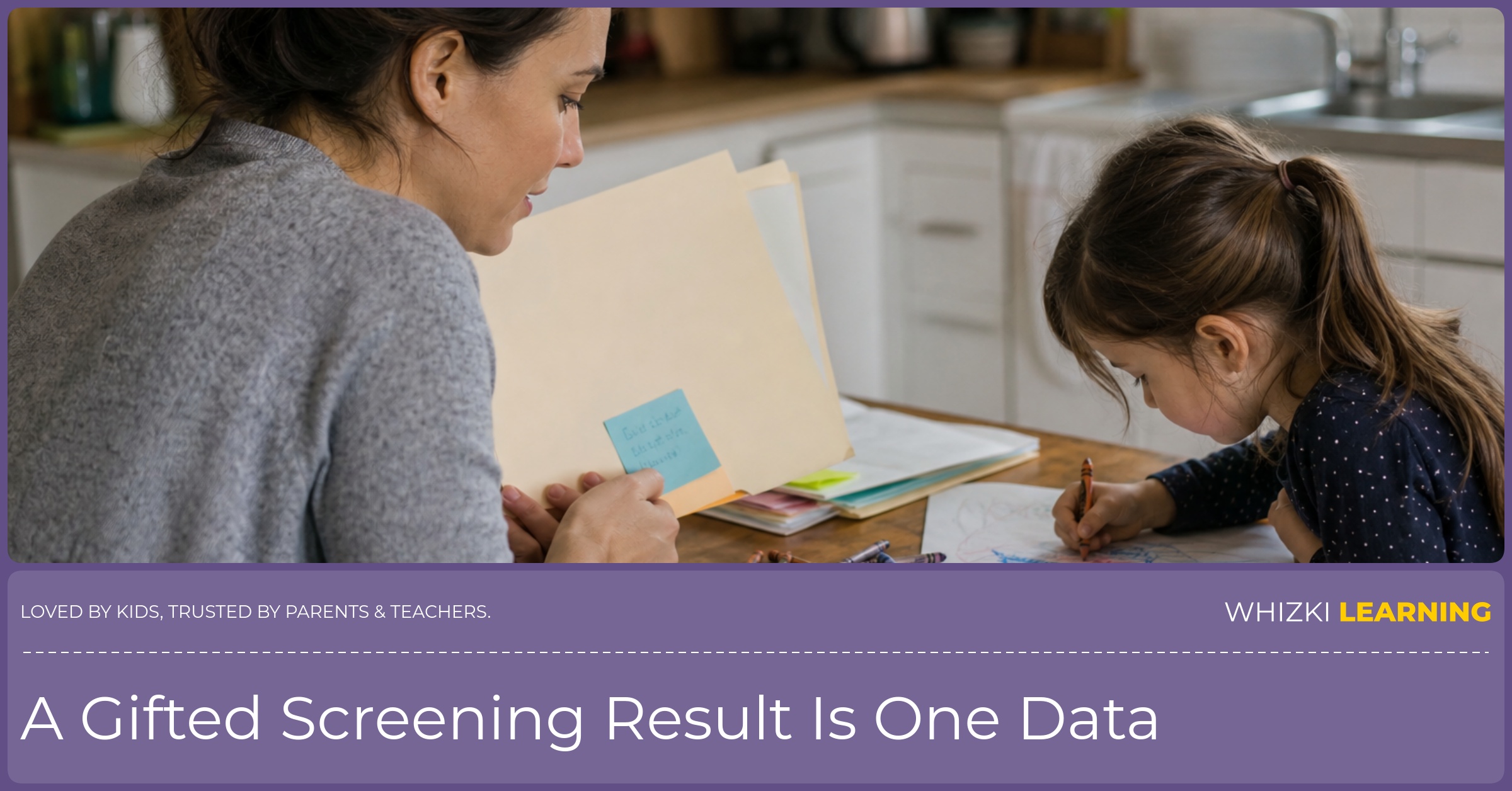
Your child came home with a gifted screening result, and now the kitchen table may hold a score report, a school deadline, and a real disagreement about whether to push for placement or pause. Today, put the report in a folder and write three questions on a sticky note: what does the score compare with, what service would my child receive, and when is the next chance to enter?
Reviewed by Whizki Editorial Team, Early Childhood Education Editors.
Understand the score report
The first question is about the score report itself. A gifted screening result is one data point, so the family needs the school, evaluator, or district gifted office to explain the test name, date, age band, percentile, confidence range if one is listed, and any notes about attention, language, vision, hearing, or motor access.
The NAEYC guideline I lean on in preschool and kindergarten is simple: young children show skills through many kinds of play, talk, drawing, movement, and problem solving. A screener can catch a pattern, but a screener cannot show the whole child, especially when a four-year-old is tired, shy, hungry, new to English, or more interested in the pencil eraser than the task.
The decision tree starts with one calm fork: if the report names a clear comparison group, ask what that group means; if the report does not name a comparison group, ask for a plain explanation before making a placement choice. For background on the limits of screeners, read the previous parent systems guide and bring your own report questions back to the school contact.
Ask about local norms and evidence
The next question is about local norms. A child can look very advanced in one preschool room and closer to the middle in a district pool, so parents should ask whether the score was compared with national norms, district norms, school norms, age norms, or a smaller peer group.
The Reggio habit of documentation helps here because teachers collect dated photos, child dictation, block structures, drawings, and problem-solving notes instead of relying on one sit-down moment. A kindergarten teacher might add evidence such as unusually complex questions during read-aloud, quick pattern noticing with counting bears, or early invented spelling that shows strong sound-symbol thinking.
The added evidence should still be fair and concrete. Ask for two or three classroom examples, a work sample, and a short teacher note rather than a vague line like "very bright," because a specific example is easier to discuss at a meeting and easier to revisit later.
Name the service before the label
The program label matters less than the daily service. Ask whether the child would receive a pull-out group, cluster placement, enrichment centers, subject acceleration for early reading or math, a project block, or simple classroom differentiation during choice time.
The Orton-Gillingham approach reminds me to ask about instruction, not just level. An early reader may need explicit phonics with harder words, richer vocabulary talk, and real books, while another child may need hands-on spatial challenges with pattern blocks and puzzles without being rushed into paper-heavy work.
The practical question is, "What will my child do on Tuesday?" A strong answer names the minutes, group size, adult leading the work, materials used, and how the program protects play, outdoor time, rest, art, social problem solving, and kindergarten routines.
A simple printable can help families gather everyday evidence without turning the home into a testing table. Try a page from the Learning Hub during a 10-minute reading or pattern play session, then jot one sentence about what your child tried, changed, or explained.
Check entry, appeal, and later chances
The entry rules question saves families from last-minute panic. Ask for the application window, required forms, retest rules, appeal deadline, accepted outside evaluations, age cutoffs, kindergarten entry differences, and whether late bloomers can be reviewed again.
The NAEYC family-school partnership stance fits the rule-checking step because families need understandable rules in a home language and enough time to respond. Ask the office to show the rule in writing, then copy key dates onto a paper calendar where caregivers, teachers, and homeschool planners can see the same plan.
The appeal question is not a fight by default. An appeal may simply mean adding a teacher observation, updated language information, a work sample, or a note about testing conditions such as illness, interrupted sleep, or a hearing issue that changed access on the screening day.
The later-opportunity question matters for children ages 3 to 7 because development can move in bursts. Ask whether the district has spring review, first-grade review, portfolio review, or classroom referral later in the year, and keep the tone open so the child does not feel like one morning decided the whole school path.

Support multilingual and twice-exceptional learners
The language-access question should come early, not after a denial. A multilingual child may understand ideas deeply while still learning how to answer quickly in English, so parents should ask what language was used, whether directions were repeated, and whether an interpreter or bilingual staff member was available when appropriate.
Speech-language pathology practice separates language difference from language disorder, and that distinction matters in gifted screening conversations. Ask whether the team considered home language, exposure time, code-switching, cultural background knowledge, and whether the task required vocabulary that the child had not been taught.
The twice-exceptional question belongs in the same calm conversation. A child can show advanced reasoning and also need support for handwriting, sensory regulation, speech sounds, attention, anxiety, vision, hearing, or motor planning, so the screening result should never erase a real support need.
The occupational-therapy heuristic I use with young children is access before output. Before adults decide that a child refused, rushed, or underperformed, adults should ask whether the chair fit, the pencil was manageable, the room was too loud, the visual page was crowded, or the child needed a movement break.
A gifted screening result can open a useful conversation, but a gifted screening result should not turn a four-year-old, five-year-old, six-year-old, or seven-year-old into a number. The next best step is a short written question list, a polite request for rules in writing, and one everyday note about how the child thinks during play, stories, building, drawing, and conversation.
The parent job is not to prove that a child is special enough. The parent job is to ask whether the school plan matches the child in front of everyone, with room for language, disability, maturity, curiosity, and later growth.