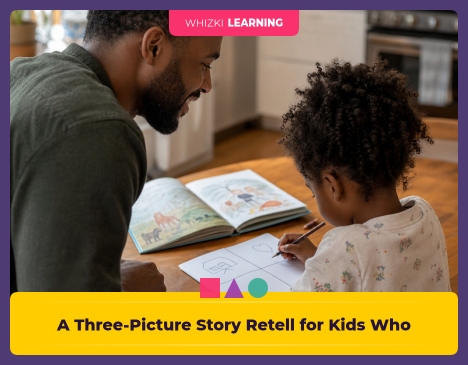
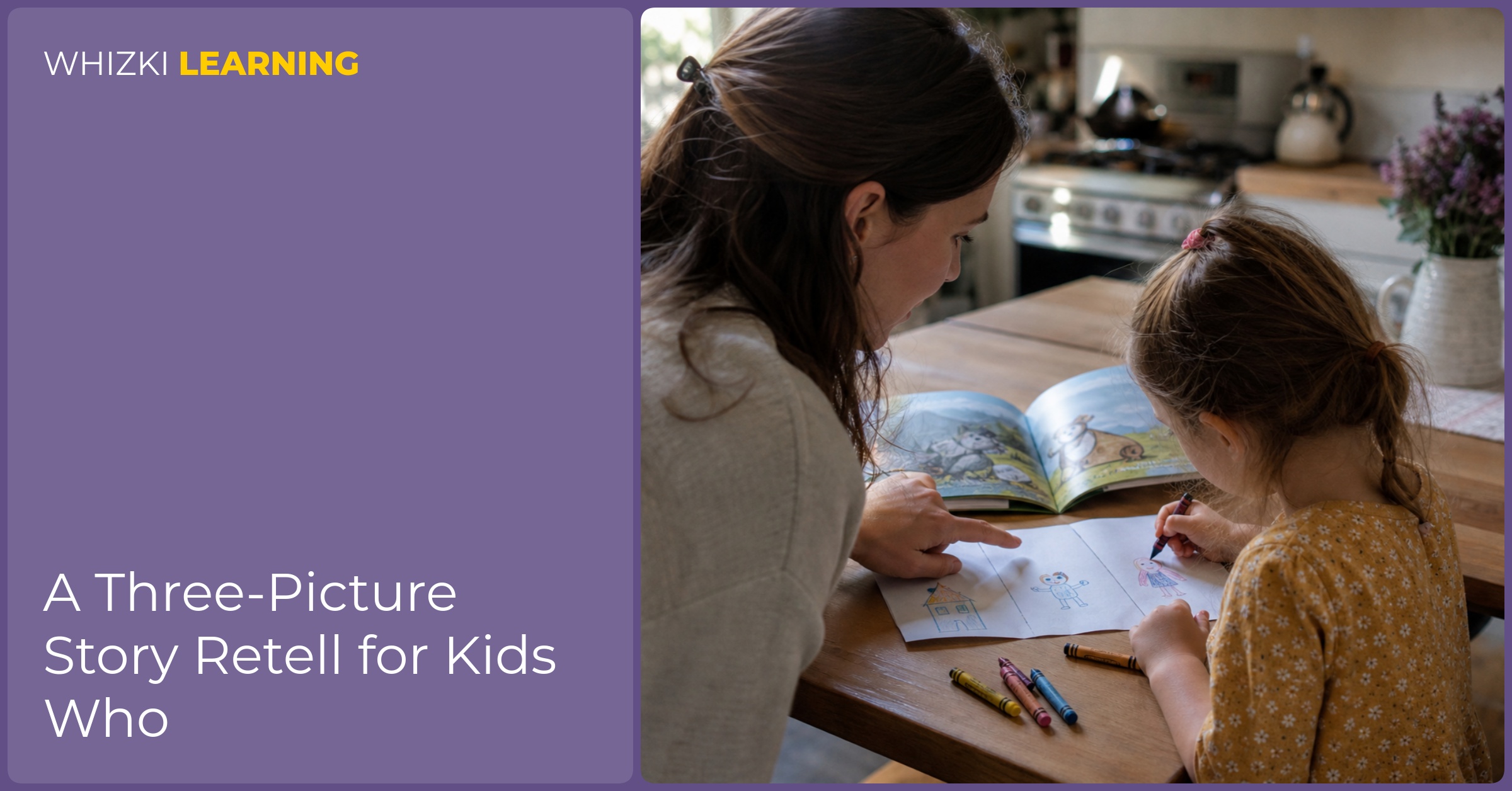
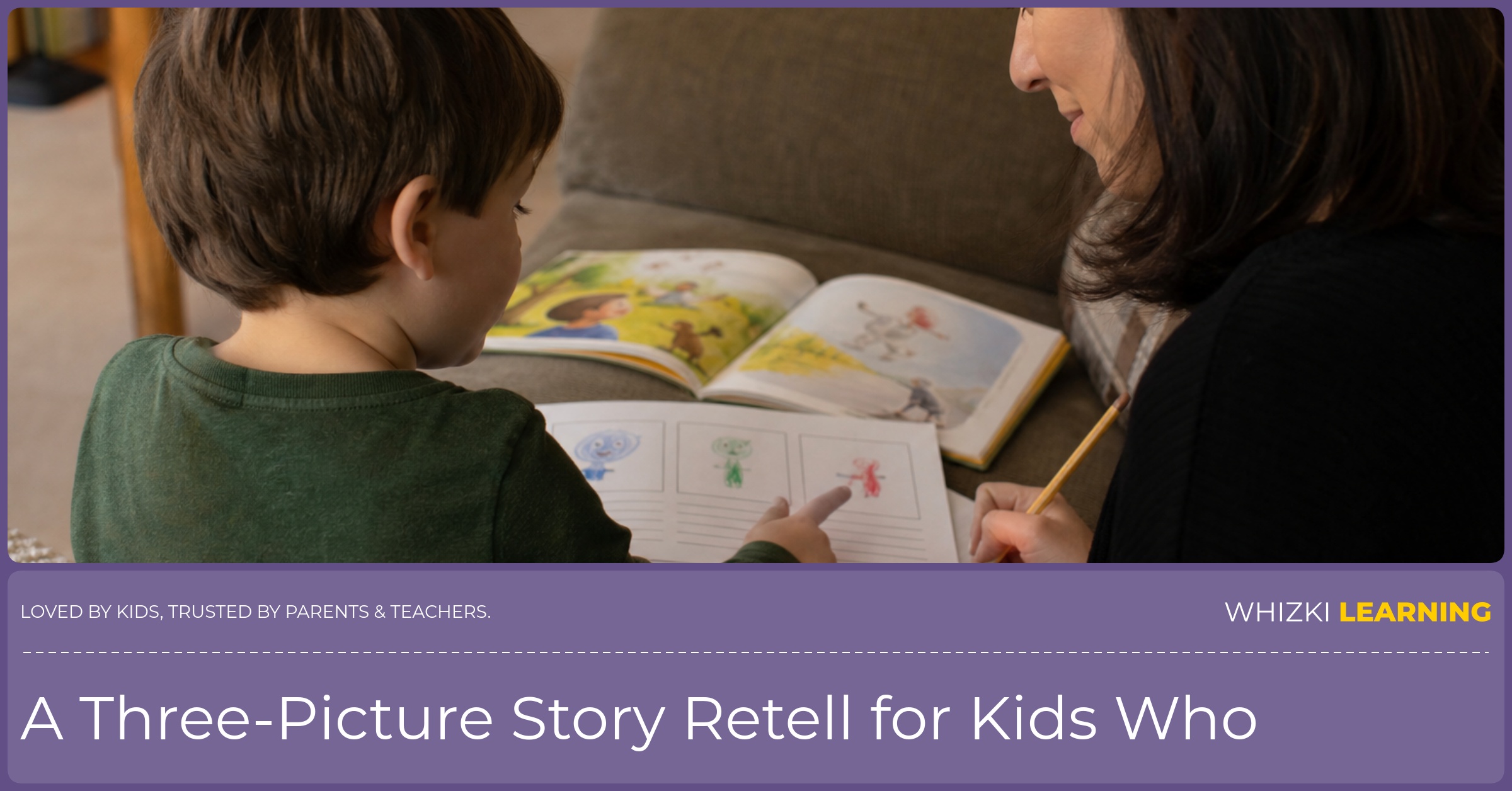
If bedtime read-aloud turns into "Tell me what happened" and your child freezes or groans, skip the full summary tonight. Fold one sheet of paper into three boxes, mark beginning, middle, and end with quick symbols, and invite your child to draw one remembered part in each box while you listen.
Reviewed by Sarah Mitchell, M.S., CCC-SLP, Speech-Language Pathologist.
Why three pictures work for reluctant retellers
The three-picture retell gives the child a job that feels like drawing rather than proving. Speech-language pathology practice often separates understanding from spoken output, because a child may know the story order before a full oral summary comes easily. The three boxes make the story visible, so memory has a place to land.
The beginning, middle, and end structure also matches how many early-childhood teachers listen during read-aloud. In Reggio-inspired classrooms, a drawing is treated as one of the child’s languages, not as decoration. A scribble, a circle around a character, or a pointed finger can carry real meaning when the adult stays curious.
The retell page is not an art lesson, and the drawing quality should not become the point. The useful question is, "Can the child connect a picture to a story event?" rather than "Does the child draw neatly?"
Set up the routine in ten minutes
The routine needs one picture book, one sheet of paper, and crayons or a pencil. Fold the paper into thirds, or draw two vertical lines to make three spaces, then read a short familiar story with the paper nearby.
The adult can say, "First box is the start, middle box is the big happening, last box is how the story ends." NAEYC guidance reminds early educators to offer developmentally appropriate choices, so the child can choose crayons, markers, or a pencil without turning choice into a delay. Montessori-style preparation helps here too, because a clear tray or small basket lowers the fuss around materials.
The age adjustment matters more than the perfect template. A 3-year-old may draw one mark in each box and point while the adult names the event. A 6- or 7-year-old may add invented spelling, speech bubbles, or one dictated sentence under each drawing.
The timing should stay short and kind. Five to ten minutes after a read-aloud is plenty, especially at bedtime or after a long preschool day.
For a low-prep page, the Whizki Learning Hub keeps early literacy printables and book routines in one place. Print one three-box page, or copy the layout onto scrap paper when the printer is out of ink.
Choose a response mode before asking for a retell
The spoken mode works well for many 5- to 7-year-olds who enjoy talking after the drawing is finished. The adult can point to each box and say, "Tell me about the first picture," then write down the child’s words if writing adds value. Speech-language practice often honors the child’s exact message before asking for a cleaner sentence.
The pointing mode helps children who understand more than the child can say in the moment. The adult can ask, "Where did the bear get lost?" or "Which picture shows the ending?" and let the finger answer. The pointing mode also supports dual-language learners because story understanding can appear before English words feel ready.
The dictation mode works when the child has ideas but handwriting or drawing effort steals attention. The adult writes the child’s words under each picture and reads the sentence back. Occupational therapy basics remind adults to watch hand fatigue, pencil pressure, and posture before assuming a child is avoiding literacy.
The response mode can change from day to day. A child may talk on the couch, point at the kitchen table, and dictate after school, and each version still counts as retelling practice.
Keep the retell low-pressure, not quiz-like
The adult can model one box first with an "I do, we do, you do" rhythm from the Orton-Gillingham approach. The adult might sketch a tiny door and say, "At the beginning, the bunny left home," then invite the child to choose the next box. The model lowers the language load without giving away the whole retell.
The prompt should stay open and concrete. Helpful prompts include "Show me the part you remember," "Where did the problem happen?" and "What changed at the end?" The retell becomes harder when the adult asks too many why questions before the child has the three events in order.
The printable is useful, but the printable is not a complete literacy plan. Families who want a ready-made page can browse the printable library, then keep the adult talk warm and brief. Repeated readings often make the retell smoother, and the previous literacy lab guide explains why familiar books build real language practice.
The three-picture story retell works best as a small routine, not a performance. Keep the drawings quick, accept talking, pointing, or dictation, and save the polished summary for another day when language, hands, and attention have more room.