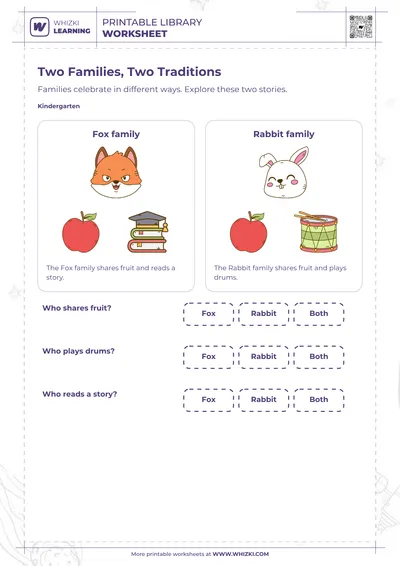
Identify sharing fruit as the activity common to both fictional families.
Distinguish the Fox family’s reading a story from the Rabbit family’s playing drums.
Select a pictured shared activity after comparing two short accounts.

This compare family traditions worksheet introduces two fictional families through short captions and pictures. The Fox family shares fruit and reads a story. The Rabbit family shares fruit and plays drums. Circle the activity both families share. Read both captions before choosing an answer.
Both families share fruit. The Fox family’s different activity is reading a story, and the Rabbit family’s is playing drums. Compare the two accounts one detail at a time. An activity can belong in Both even when another part of the celebration differs. Use the captions and matching pictures as evidence rather than guessing from the animal characters.
These are invented family examples, not claims about a country, culture, or every family of a particular kind. The task is to notice a shared detail and a difference without ranking either choice. An adult can read the captions and help the child explain how they know an answer. The follow-up conversation can use an activity the child is comfortable sharing, without requiring personal family details.
Explore the celebrations and traditions collection for related practice. The Preschool Social Studies set offers other illustrated activities. Work through a few examples with time to explain a choice. After checking the page, try one spoken example using a familiar place, activity, or object while keeping the same skill in focus.
Boost your child’s skills with our discounted workbooks. Engaging activities for preschool, kindergarten, and grade 1 - now at special sale prices!


Fast shipping
Secure Payment
Licensed Teachers
For the planet
Printed in the USA
Helpful guides for parents and teachers, and tips for making learning at home super fun.

A calm six-item travel bag for ages 3-7, with one book, paper, crayons, cards, manipulatives, and a printed page for real holiday waiting.

Mixed-language answers can show knowledge, vocabulary gaps, or a form still forming. Learn a warm recast routine that teaches without shaming.

Turn a delivery box into a quick materials investigation for ages 3-7, comparing cardboard, paper, plastic, and padding through touch, water, and reuse choices.

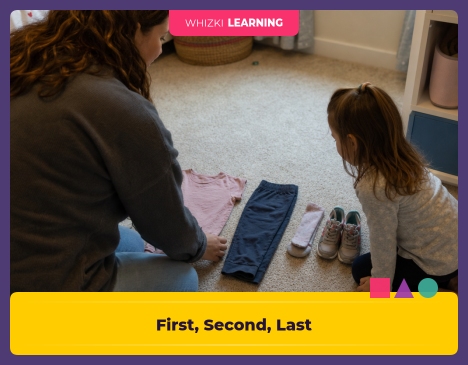
Use a three-to-five minute dressing, table-setting, or toy-line routine to teach first, second, middle, and last without turning math into a worksheet.
Get exclusive activities, expert tips, and inspiration for a more meaningful, offline family life.